Travelling in the off-season is terrific. Fewer tourists, lower prices, you get an honest feel for a place. For the most part, the weather has been fabulous. There has only been one day when we were badly rained out and that was when we met up with Xan and Meghan to go to see Siena.
Siena is an extraordinarily beautiful medieval city that in its hay-day rivaled Florence. It was an important trade route between Florence and Rome and like Florence was filled with wealthy patrons of the arts. However, Sienna was decimated by the Black Death in 1348 and never really recovered its stature. What is left is like a time capsule, one of the largest and most beautiful medieval cities in Europe.
We arrived on an overcast afternoon to explore the grand piazza in the centre of town, the Piazzo del Campo.
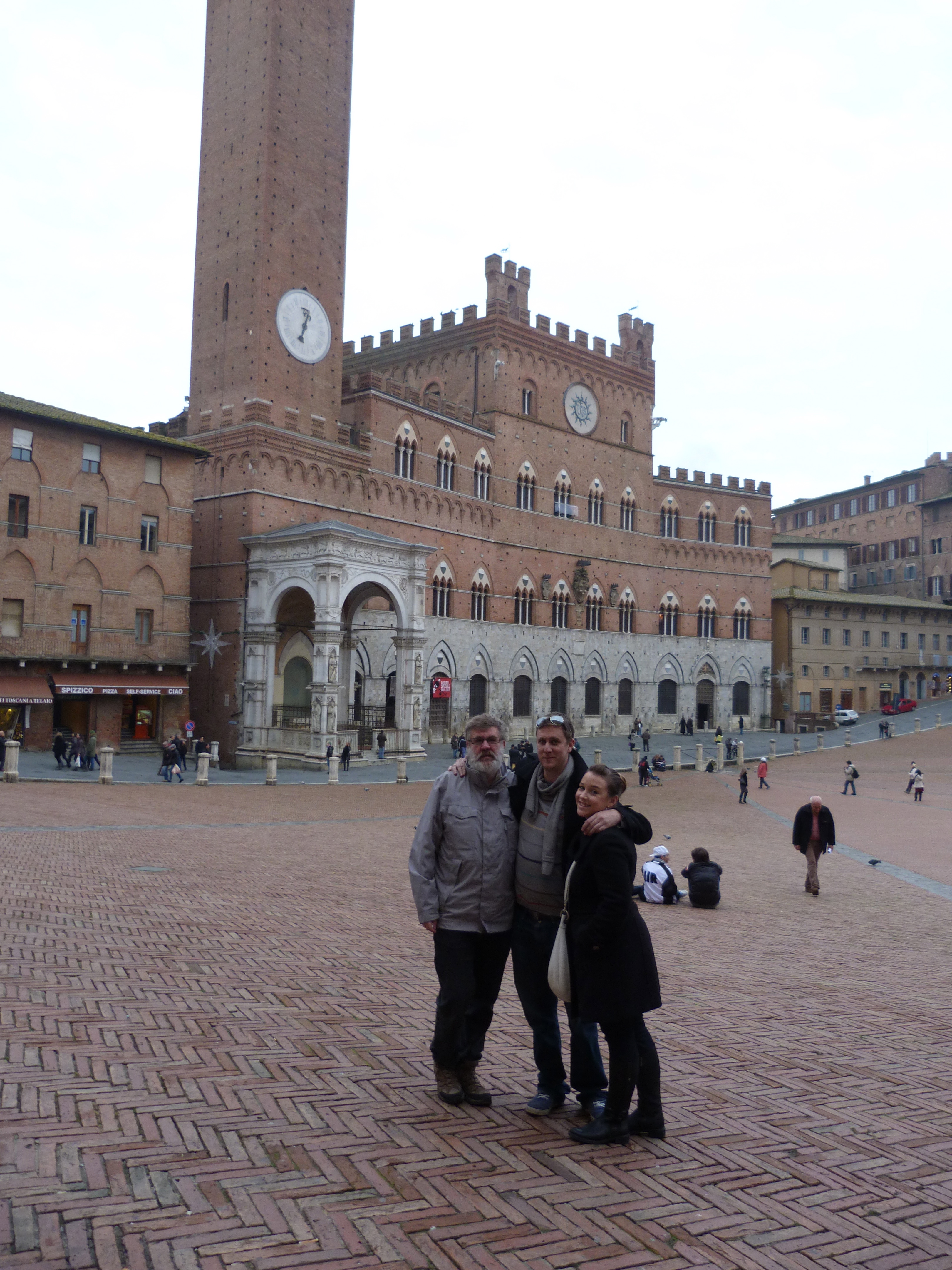
Famous for it’s curved scallop shape, it is the meeting place for thousands in the summer. We practically had it to ourselves, which gave us a chance to appreciate the grace and beauty of one of the largest piazzas in Europe.

We had planned on climbing the famous tower, the Torre del Mangia, which overlooks the piazza. A great engineering feat in its day, the tower is 88 metres high. When it was built in 1338 it was was the tallest secular tower in Europe. It was named after the first bell ringer Giovanni di Duccio, who was nicknamed “Mangiaguadagni” which roughly translates as using all of his money to eat well. We felt an immediate affinity for him.
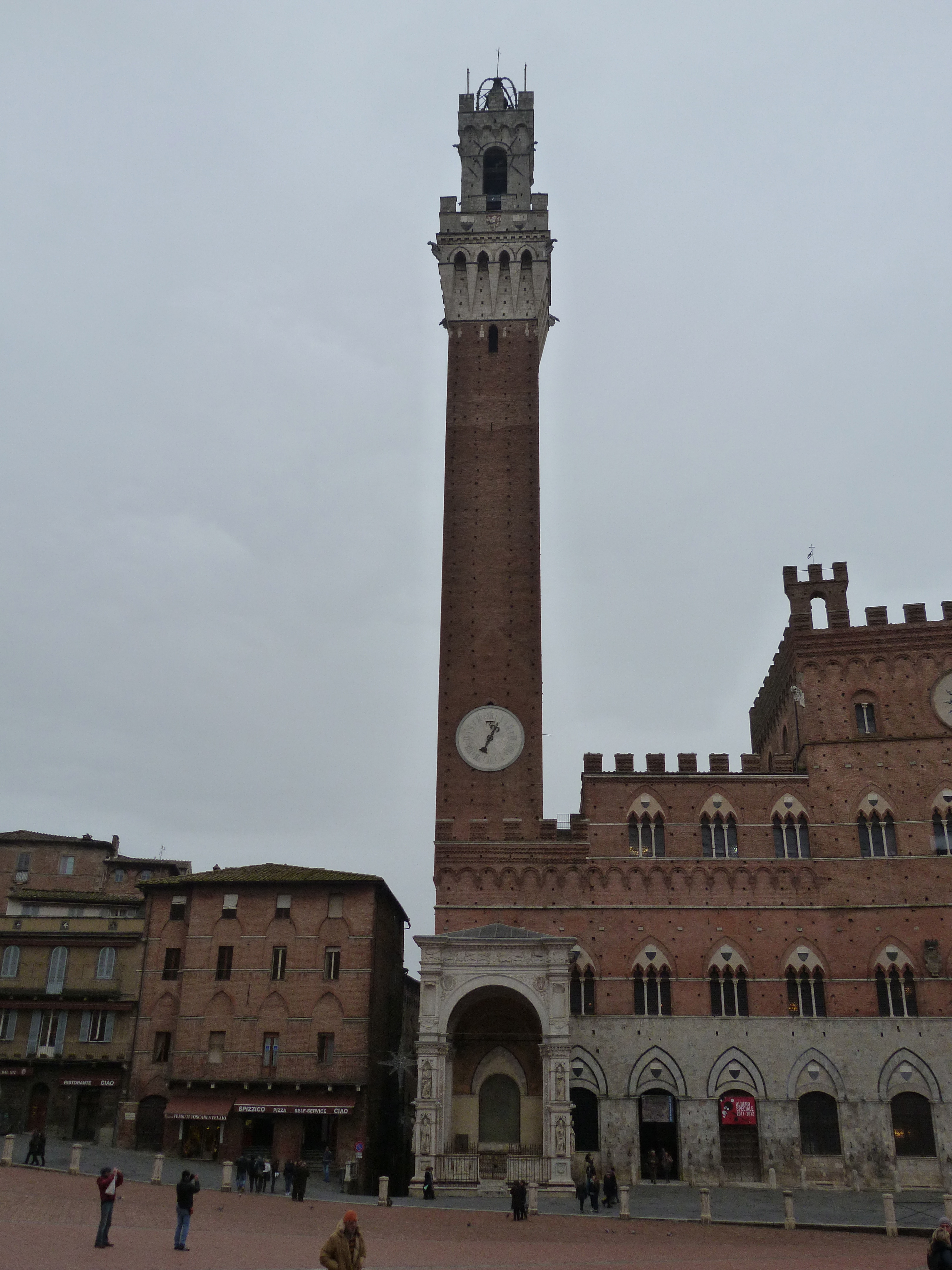
All of the guidebooks write about the gorgeous view from the top of the tower. But as we stood in line to go up and read the cautionary notes about the climb, we started to have second thoughts. Four hundred steps? Climbing up a tower that is, at some points, only 20” wide? With ceilings less than 5’? Not to be done by people who might suffer from claustrophobia or anxiety? To look out over a mist covered city on an overcast day?
We decided to go have lunch instead and found a lovely place where we could sit outside under a plastic tent with heat lamps. We confined ourselves to a 2-course lunch, with fabulous local red wines, and delicious local specialties such as papparadelle di cinghiale (pasta with wild boar sauce). Feeling replete, refreshed and very pleased with ourselves (perhaps not unlike Mangiaguadagni), we headed out for a bit of sightseeing.
Perhaps it was the wine, perhaps it was the teeming rain, but I was fully confident of the location of the one tourist place we wanted to visit, the Palazzo Pubblico, a gothic palace which is a museum of medieval art. We arrived, bought the tickets for a special tour and just as we started to go in realized that it was the wrong palace, the wrong tour. But there were only 6 people on the tour, 4 of whom were us, so we couldn’t retreat gracefully. Thus, we ended up touring the freezing cold palace of Palazzo Chigi Saracini, a palace built in the 12th century, filled with artwork collected in the 17th and 18th centuries. Reflecting the tastes of the last owner, Count Guido Chigi Saracini, we walked through room after room of quiet hideous Baroque furniture and excessively decorative paintings. The palace is now a music school, the Chigana Musical Academy, that was founded by the Count. The school has spawned many of virtuoso performers and is probably a great place to come for a concert in July. But the Count’s artistic tastes were not our own. Quite a hodge podge, in fact. The best part was the chance to see Liszt’s piano. It is very small.
By the time we finished the tour it was almost dark. Rain was pouring down. We made a quick trip to the Duomo, which as far as Duomo’s go is of a manageable size.

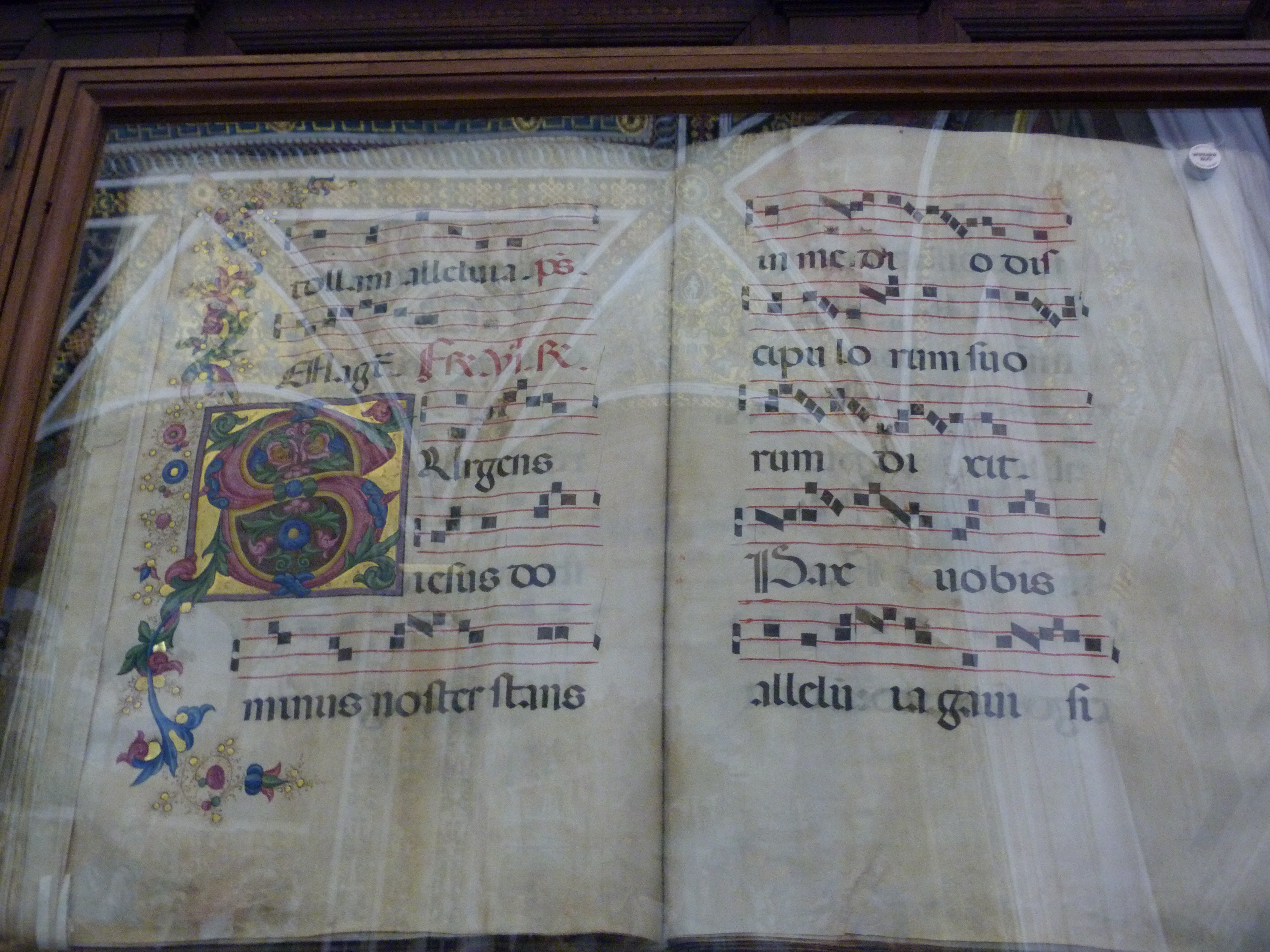
There is a small library attached, with a good display of liturgical manuscripts with gorgeous lettering and illumination.
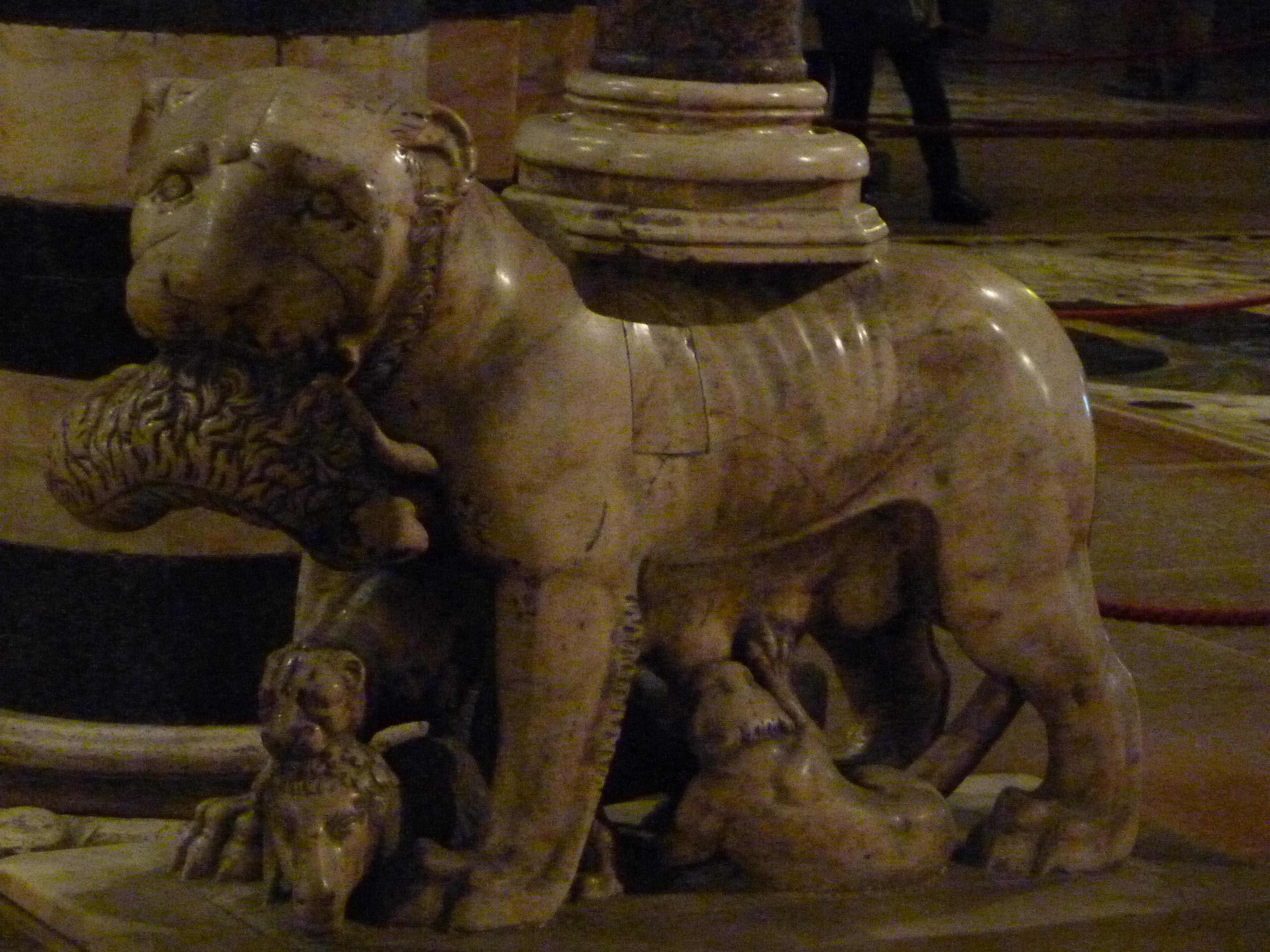
I particularly liked the Duomo’s marble pulpit, designed by Nicola Pisano in the 13th century, with four carved lions at the bottom.

I felt a fondness for the lion that was eating one of the lambs. You just can’t tell with these lions.
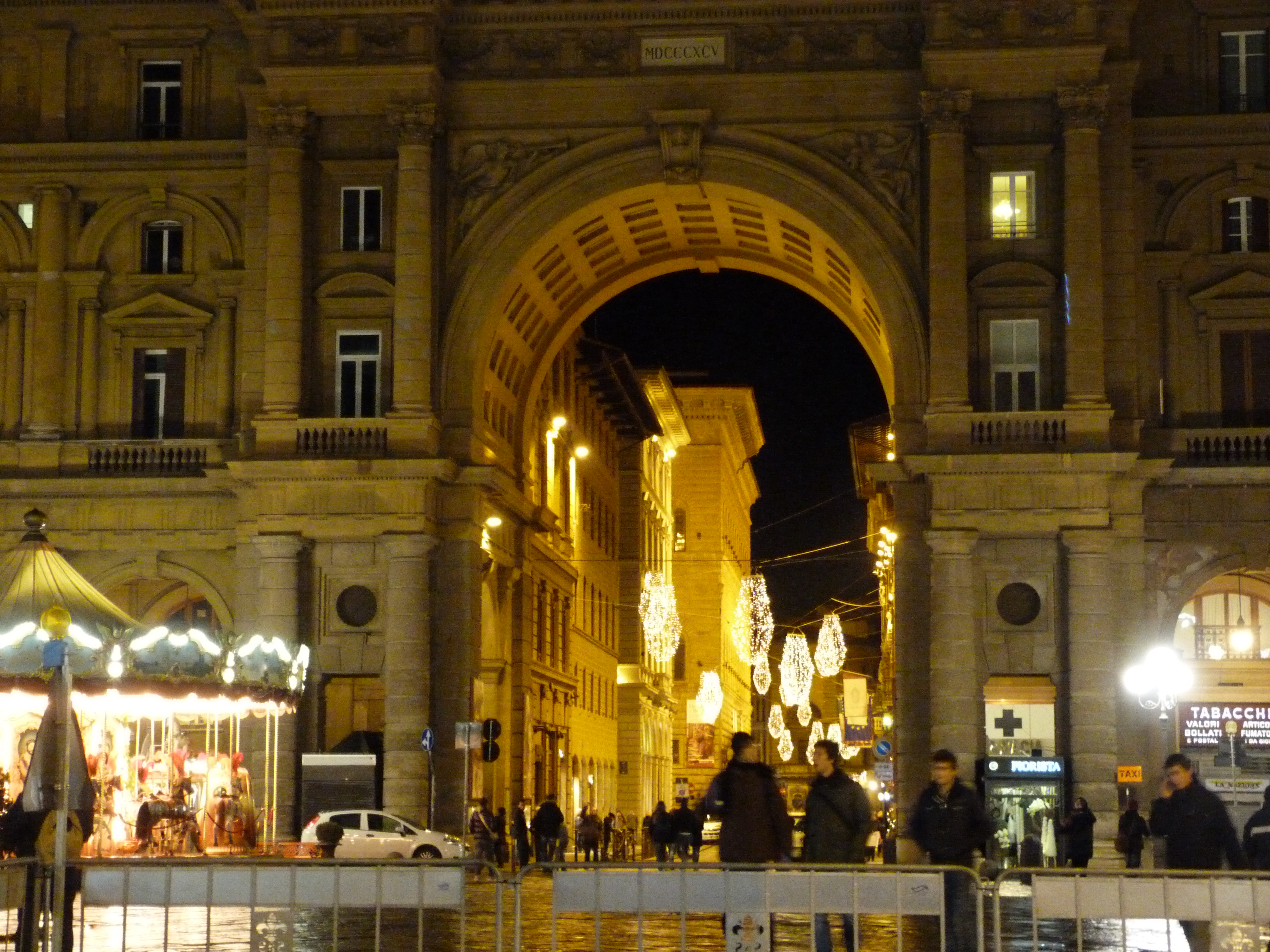
As we headed to the train station, wet and weary, we realized how little of Siena we had seen. It will have to wait for another trip, and a sunny day. We arrived back to the dry streets of Florence, under holiday lights, ending our glorious family holiday with a final dinner with Xan and Meghan before they made their way back to the ice and snow of Canada.

 Stepping off the Treadmill