Portovenere is on a promontory that juts into the western edge of the Gulf of La Spezia. A 30-minute bus ride from the city of La Spezia, the roads snake along the coast to take you from the work-a-day world of La Spezia to a resort and fishing town of startling beauty.
Portovenere
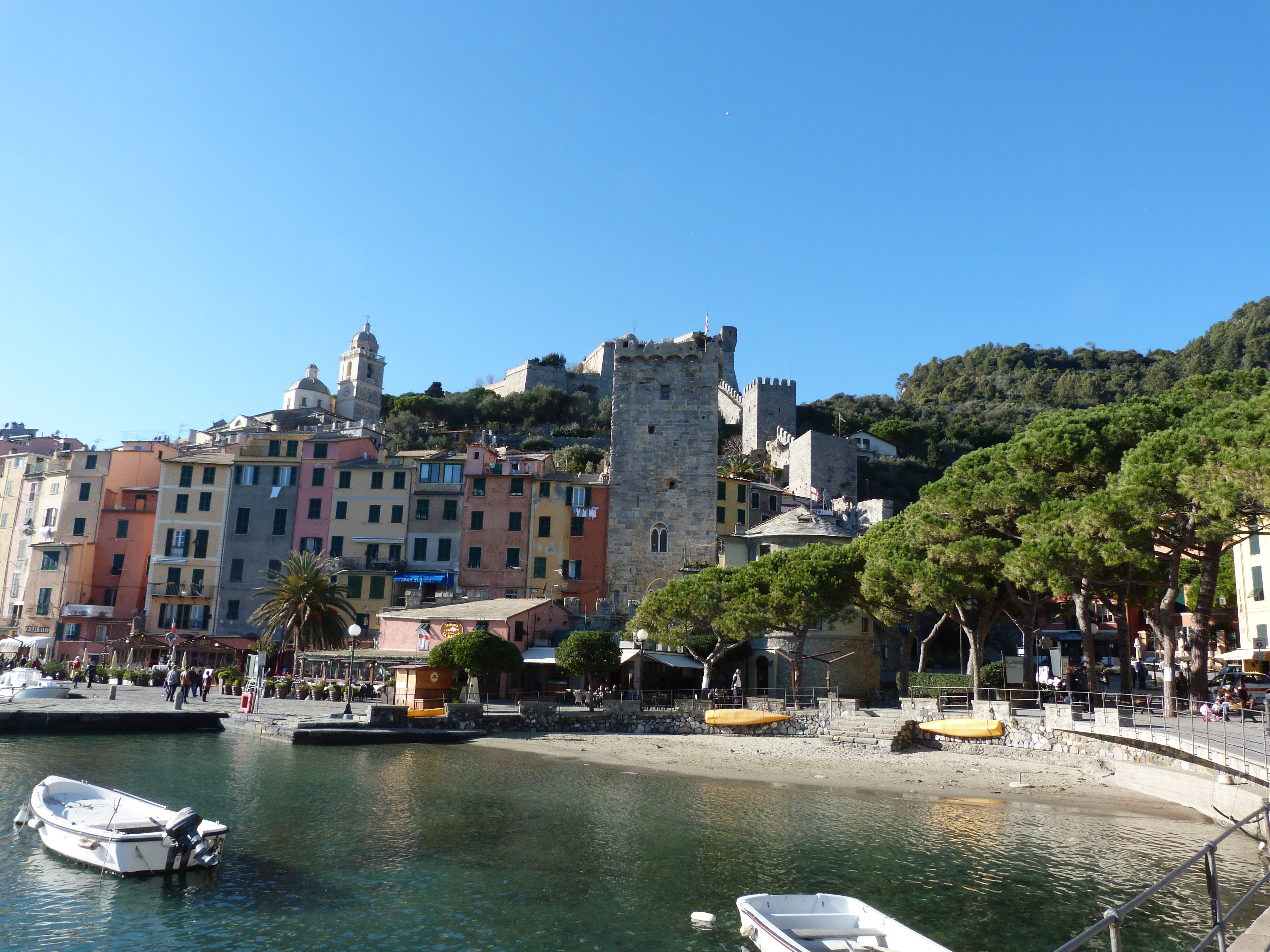
A piazza runs the length of the town, with restaurants spilling out into the sunshine. Fishing boats bob on the docks and ferry people over to the island of Palmaria, directly across from the town. It is a picture perfect Riviera town.
The Romans built an outpost here as a base en route from Gaul to Spain. The Byzantines, Lombards, the Genovese and Napoleon all passed through, leaving their marks. We walked around the piazza with our jaws dropped. It was our first experience of this kind of Mediterranean beauty.
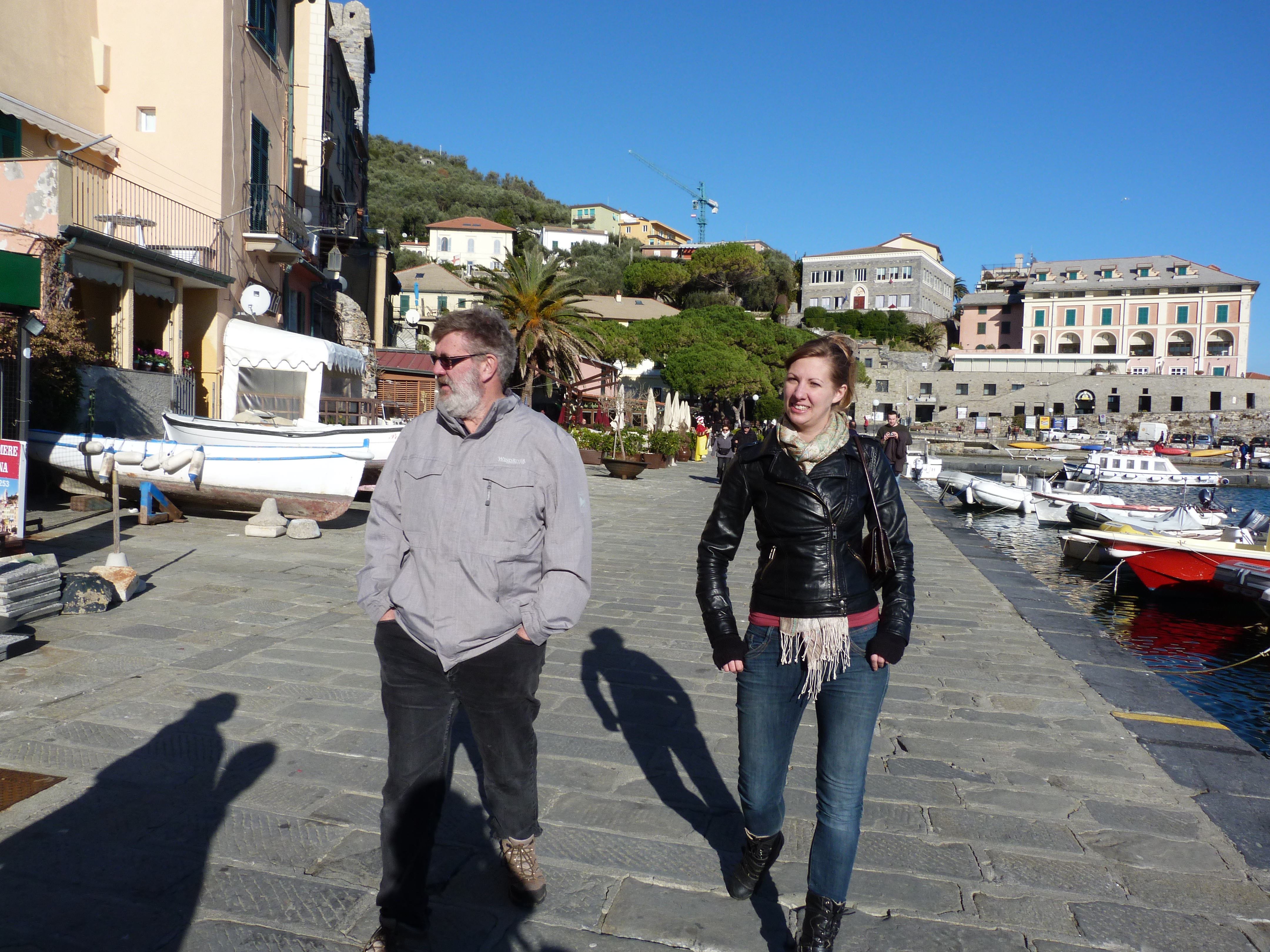
Tim & Maddy walking by the docks
The path led upwards on cobbled steps to the Chiesa di San Pietro.
Chiesa di San Pietro
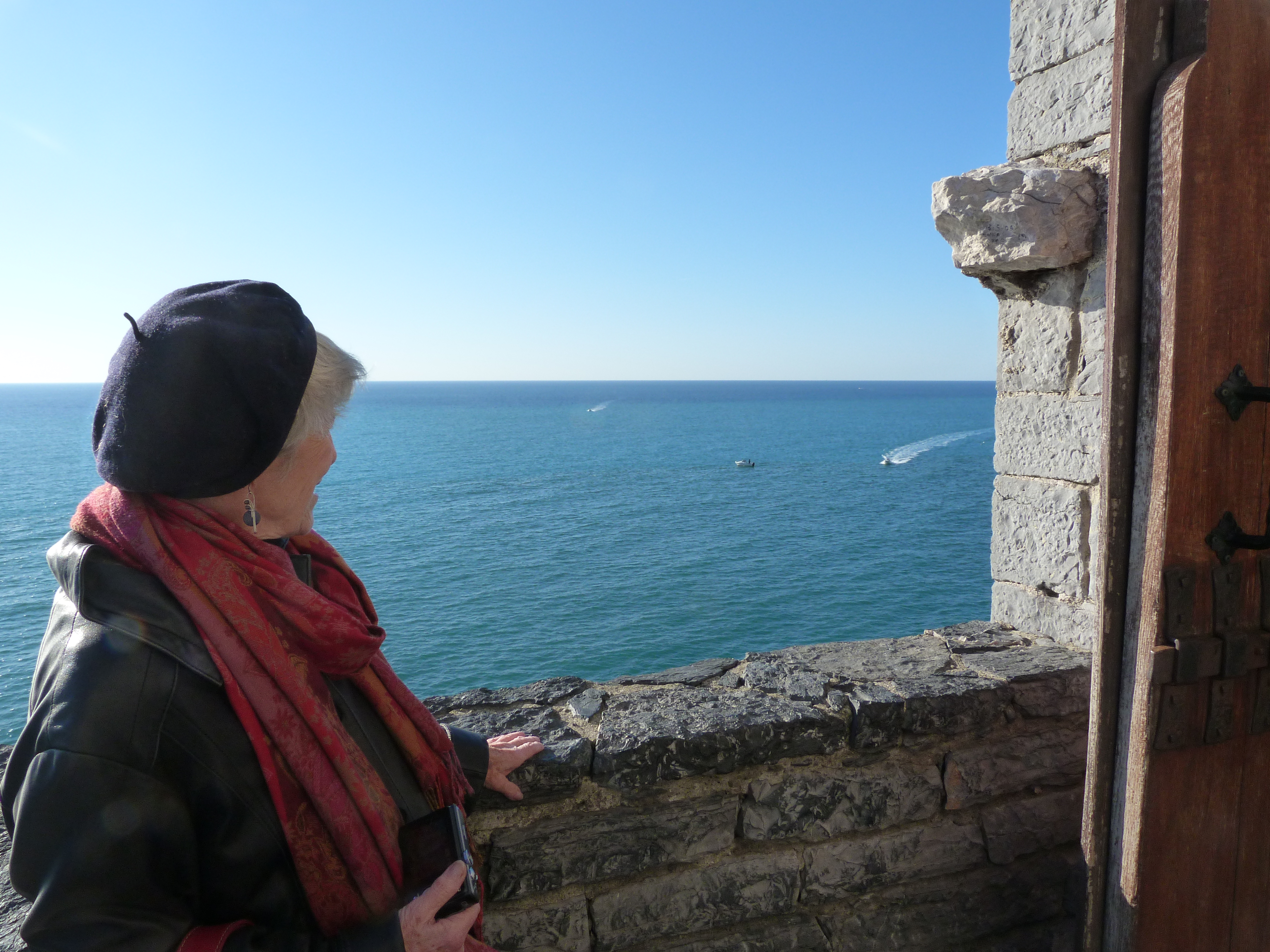
Traces of a Roman temple have been found here. The temple is thought to have been dedicated to Venus from which came the name “Portus Veneris” — Porto Venere. Like most sacred places, successive generations have added and adapted according to needs, and so the Chiesa di San Pietro is a mixture of Romanesque and Gothic styles. Built of white and black marble in the Gothic-Genoese style, it sits right on the edge of the water. A “back door” leads out to a small stone platform overlooking the bay. A perfect sun trap.
Mother Laurie Lewis behind Chiesa di San Pietro
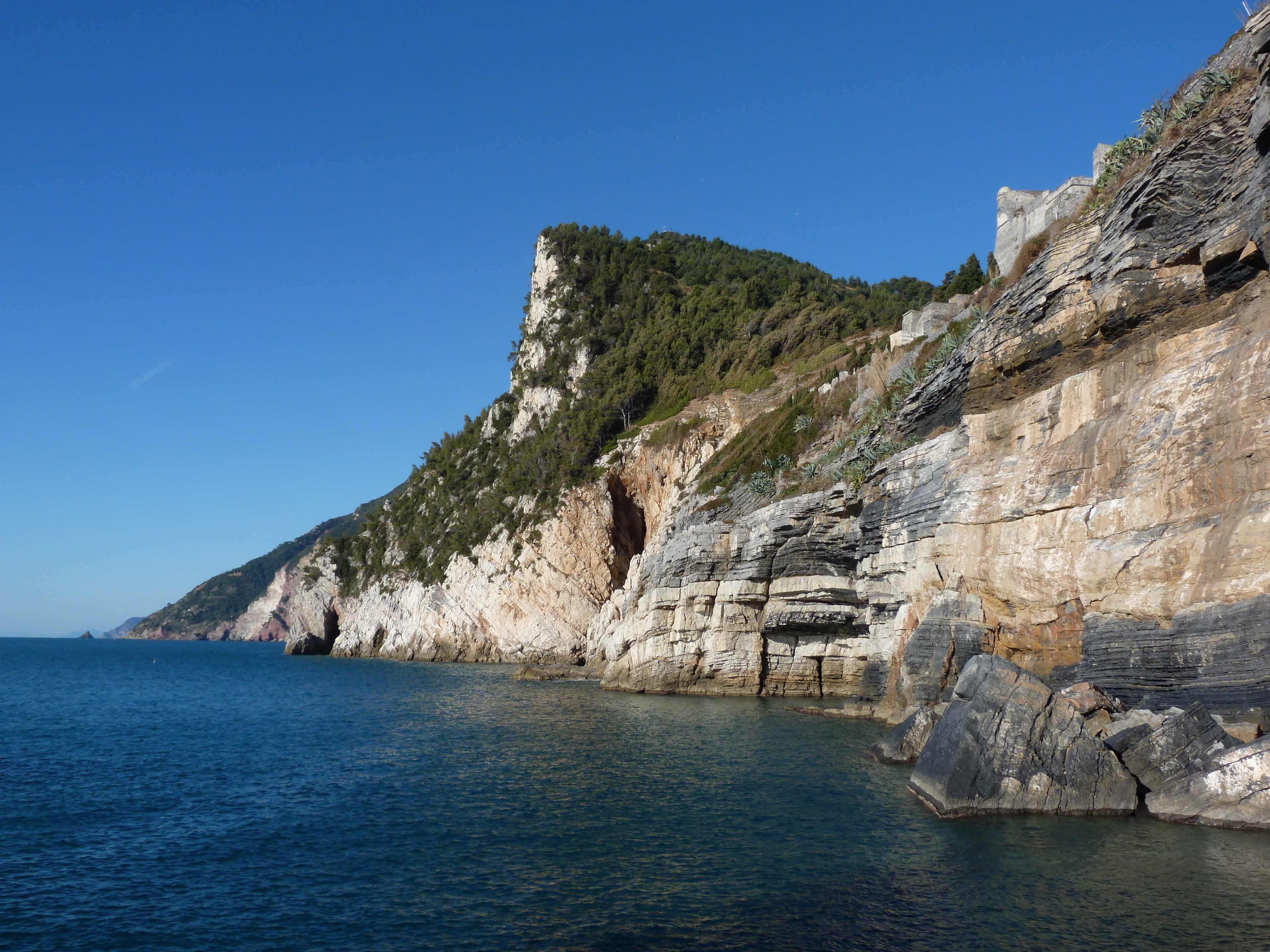
The church sits on the edge of a large square with access to the Grotta Arpaia. The Grotta Arpaia opens out to the other side of the promontory and has steps walking down to the rocks below.
Grotta Arpaia
The Grotto is dedicated to the poet Byron. Byron and Shelly both spent a lot of time in Portovenere and in Lerici. Byron made this grotto famous by swimming from here around the promontory and on across the bay to Lerici. Shelly was not so lucky, nor so adept at swimming. He drowned in the bay when his boat capsized, sailing from Lerici.
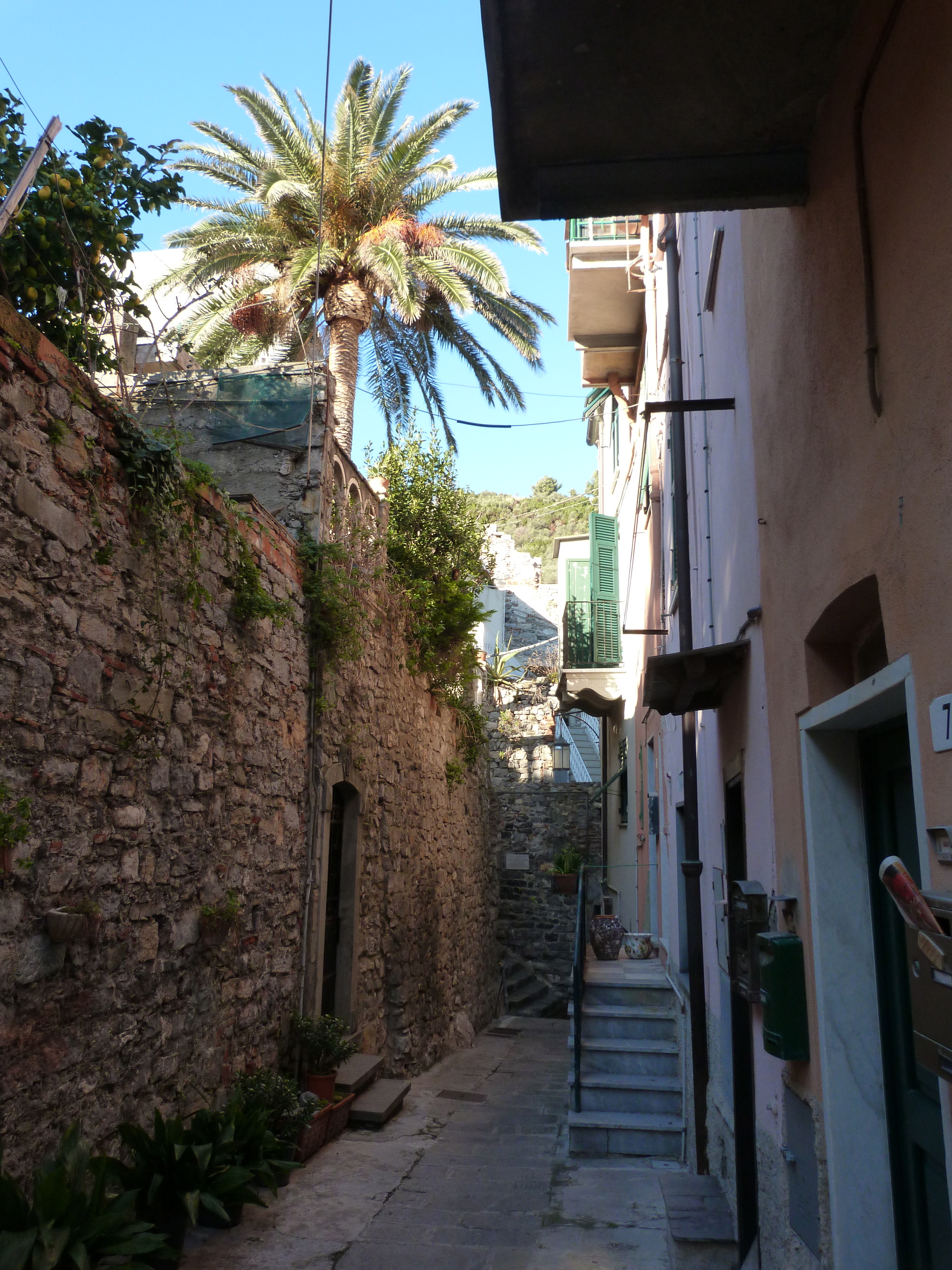
We explored the winding cobbled streets, with homes, shops and restaurants tucked into narrow alleyways and along steep stairs.
Narrow streets winding up the cliff
A labyrinth of walkways led us to the Chiesa di San Lorenzo, built in 1130. Tim & I were passing by on an upper level right beside the bells as they started to chime. We were almost deafened by the sound. But we were close enough to hear, well, really to feel, the harmonics of the two toned bells. An extraordinary experience.
Chiesa di San Lorenzo,
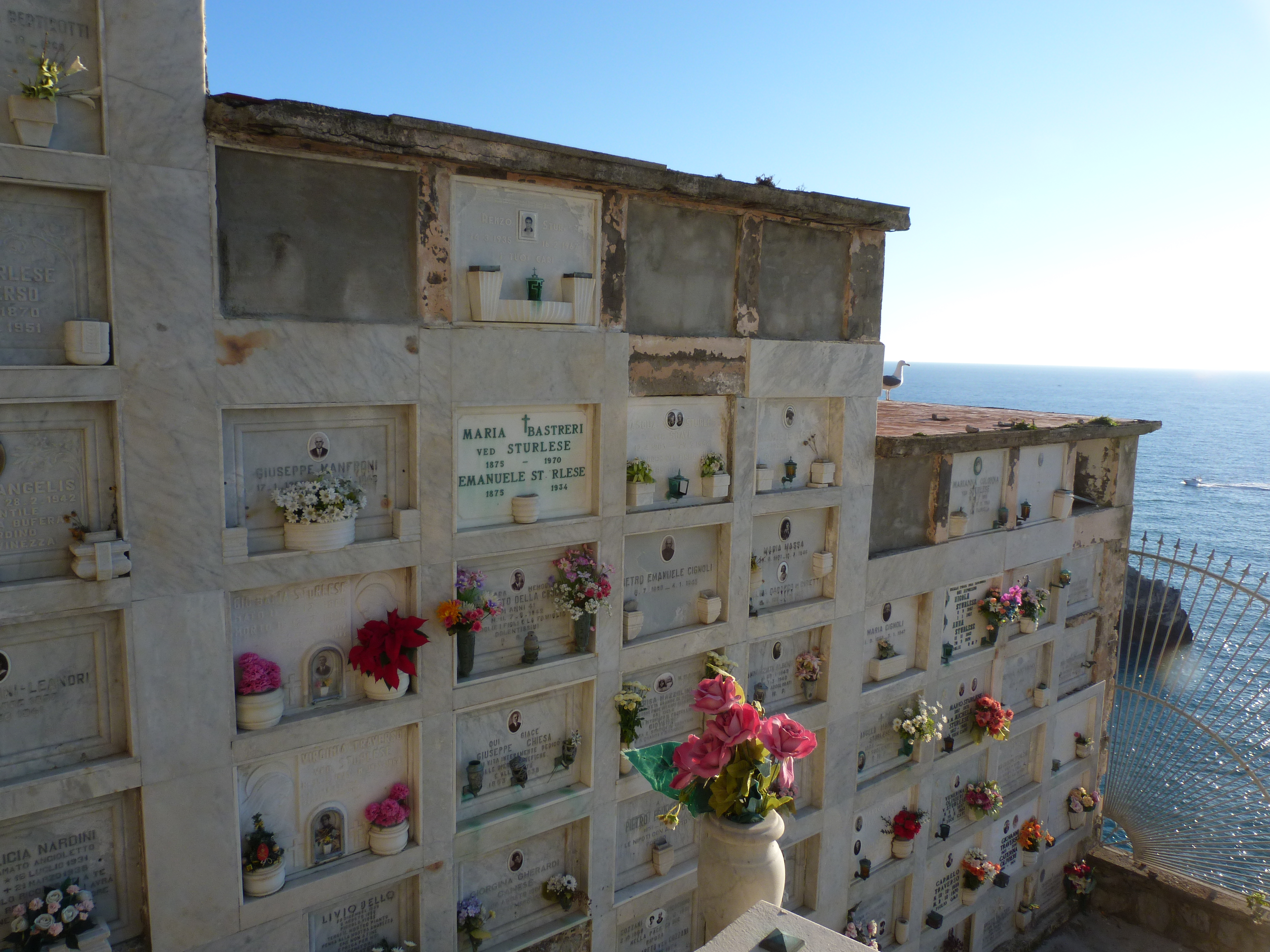
We walked higher, to the outer ramparts of the Castle, built in 1161. But rather than go in, Tim & I became distracted by a cemetery on the edge of the cliff below the castle. The cemetery has a few mausoleums, but the final resting places are mostly in marble walls facing the ocean. Apparently there is a rotational system – for the first generation after your death you get a fairly prominent position. Gradually, your remains are moved to one of the less accessible places. All in all, we think it is a lovely place to honour the memory of a loved one.
A beautiful final resting place
We ended the day thoughtfully, and happily bundled our family back to the villa for dinner.
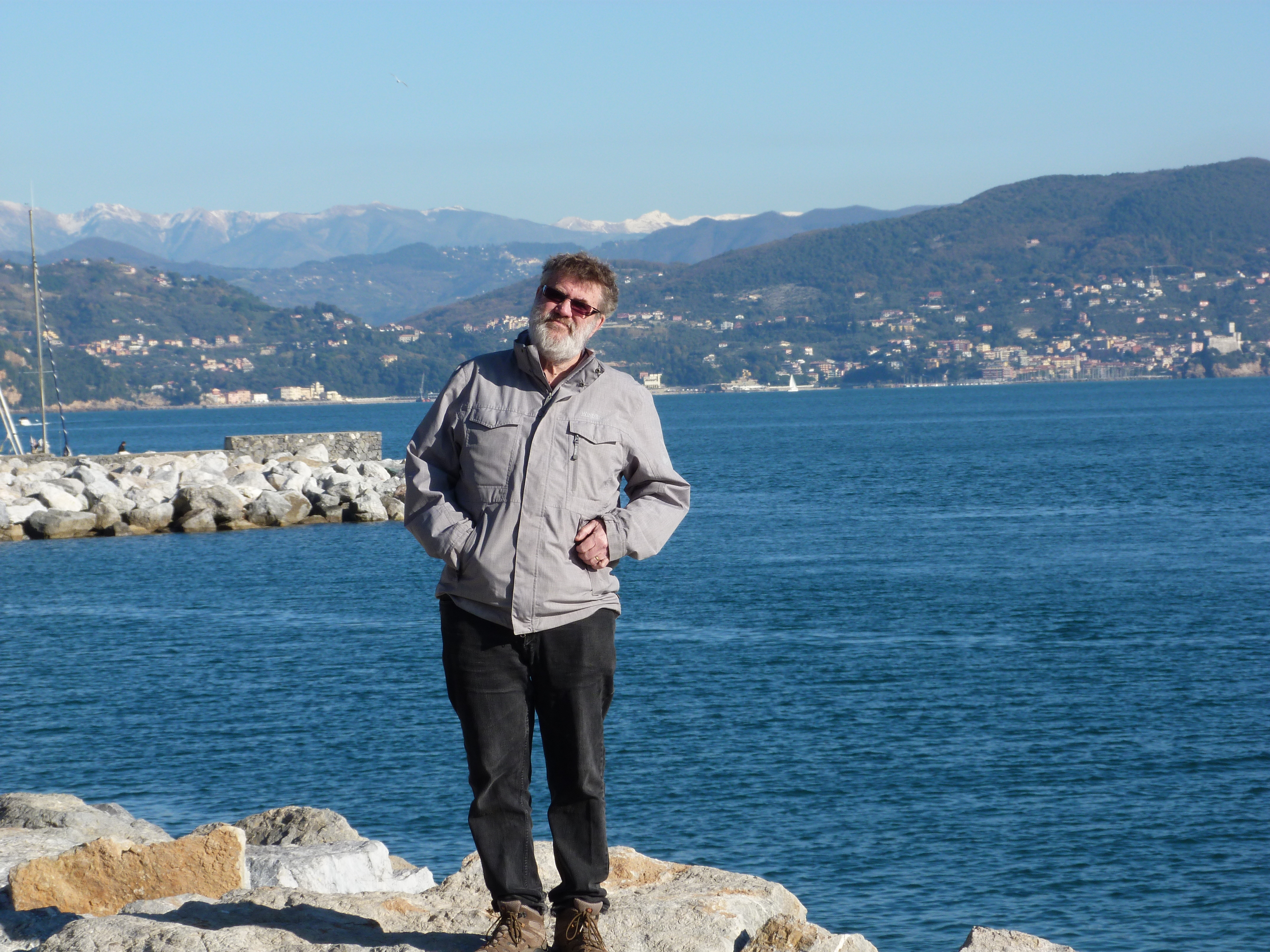
Tim on the dock of Portovenere, Lerici in the distance across the bay
Before coming to Italy, we warned ourselves that the end of December would be wintery and cold. We were prepared for grey rain, but decided that the weather didn’t really matter. We thought it would be fun just to be together, eating wonderful Italian food and drinking local wines.
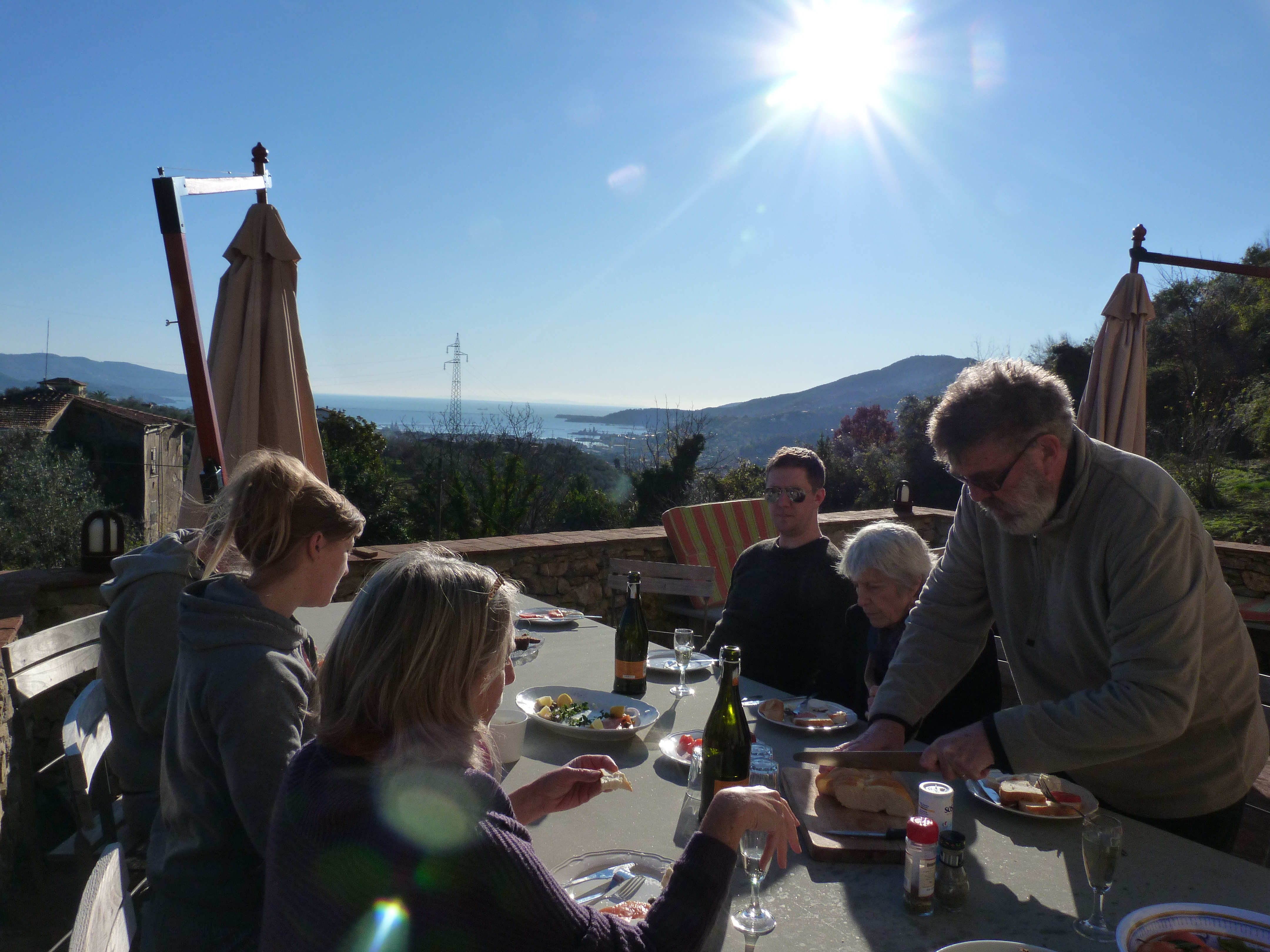
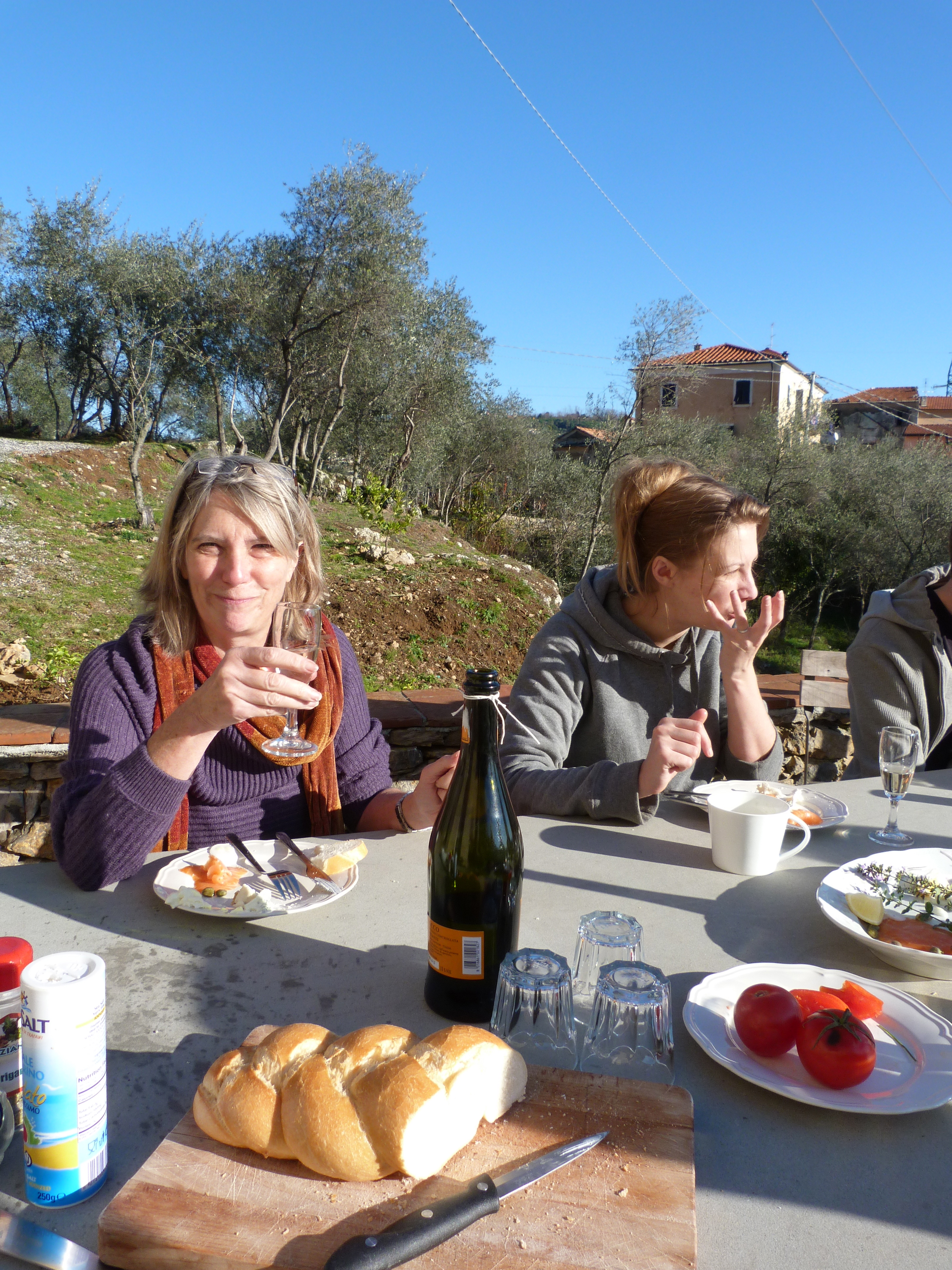
What we had not expected were hot sunny days, breakfasts and lunches on the terrace and long walks on the hillsides. Christmas Day broke with a thunderously beautiful sunrise. Unbelievably, it was warm enough for us to have our Prosecco, bread, cheese and smoked salmon sitting out on the terrace overlooking the sea. Church bells chimed as we launched into our Panatone.
Breakfast on Christmas morningCelebrating with Prosecco
The villa is right beside the AVG, “Antica Via del Golfo”, a centuries old trail that connects surrounding towns and villages. Walking down it, we can get to La Spezia in about 15 minutes. Walking up takes a lot longer, and is brutal on the thigh muscles. It is really steep. But when we are on the path we invariably meet someone much older than us walking comfortably, not breathlessly panting as we are. We’re always greeted by a cheery buon giorno, or buona sera. So walk up we do, as often as possible, if only to save face and justify the huge quantities of food we can not resist eating.
The AVG also gives a unique opportunity to hike up the mountain and explore remote villages with breathtaking views. The path crosses a zig zag road with hairpin turns, clearly beloved of Italian drivers. It is the kind of road that Italian movies make famous. But walking the path gives you time to explore and see the pace of other people’s lives.
A view from the AVG, with a view of the La Spezia Gulf
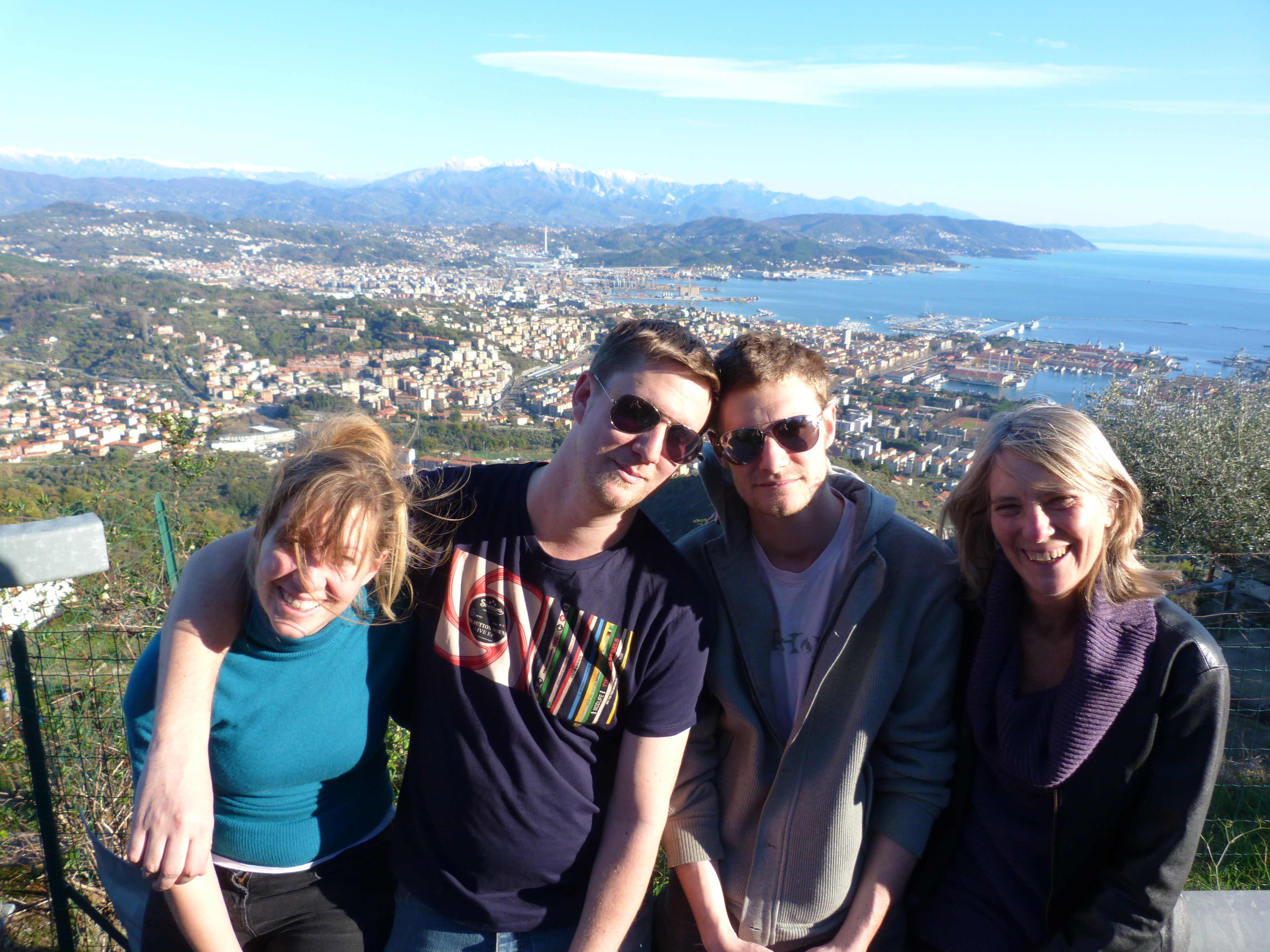
On Christmas morning we headed up, unsure of where it would take us but mostly just wanting an excuse to walk and talk in the sunshine. We walked higher and higher up the mountain, surrounded by a feeling of celebration and the joy of being alive. We may see each other all together only once a year, but we know how to reconnect quickly, on a mountain top.
Maddy, Xan, Lewis and Amanda. Christmas morning in Italy
Our Christmases have always looked a bit like an archetypal Christmas card. We decorate a tree with ancient ornaments, curl up by a roaring fire, and watch puffy snowflakes weigh down the enormous pine trees outside our windows.
But we knew that this year we would break with tradition. Since we are on the road, we decided that we would all gather as a family in Italy. Through the magic of the internet we found Villa Maggiano, a luxurious villa outside of La Spezia on the Italian Riviera. We headed there from our various parts of the world to rendezvous for Christmas.
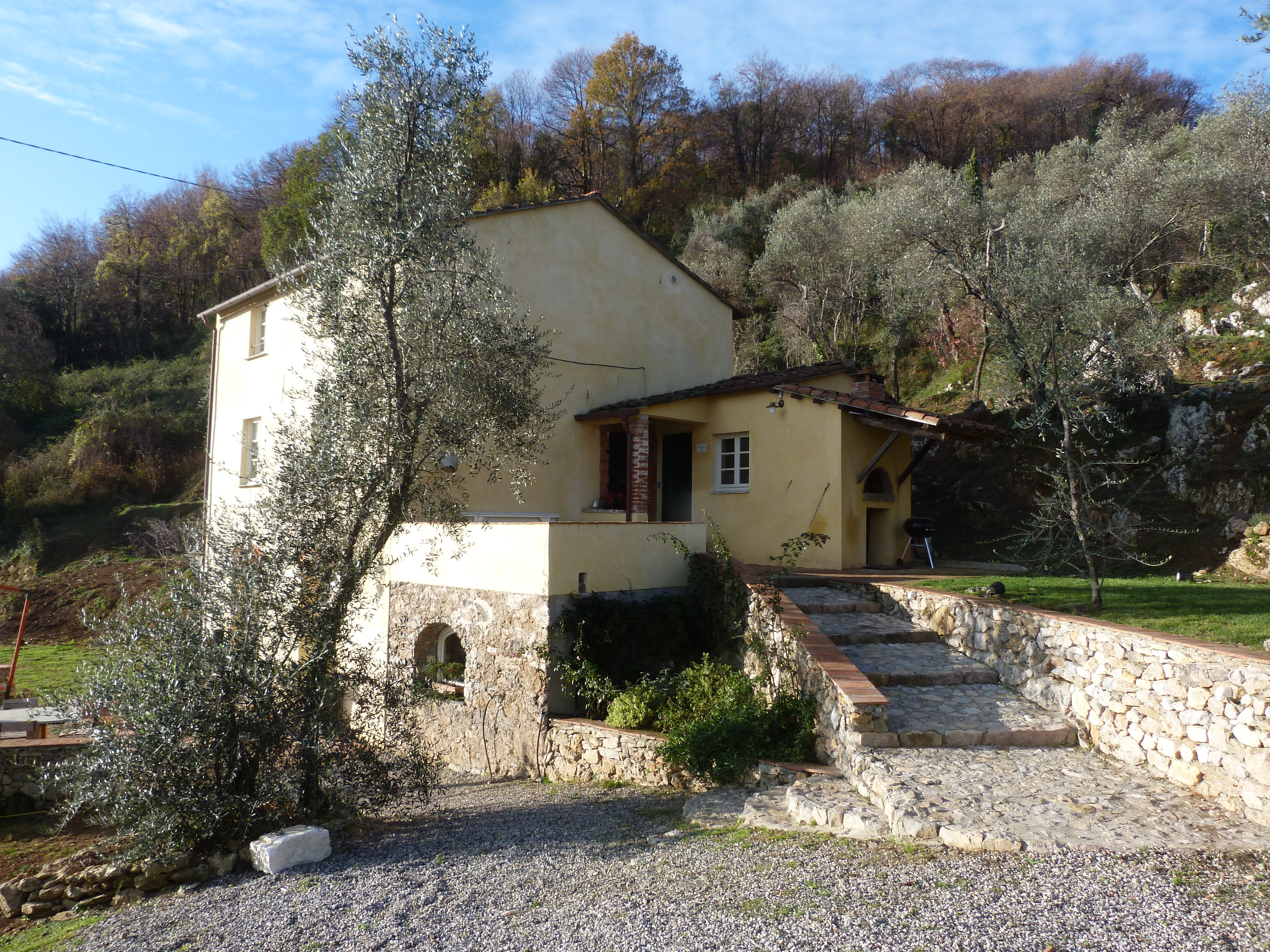
La Spezia is a busy little city of 95,600 about an hour’s drive from Genoa, on the Ligurian coast. Tim and I flew from London into Genoa, and rented a car to drive to the villa. It had been 5 months since I had driven a car and the twists, turns and roundabouts were sobering, to say the least. On the edge of the city, we headed up a mountain and, fourteen hair-pin turns later, found ourselves at The Villa Maggiano.
Villa Maggiano
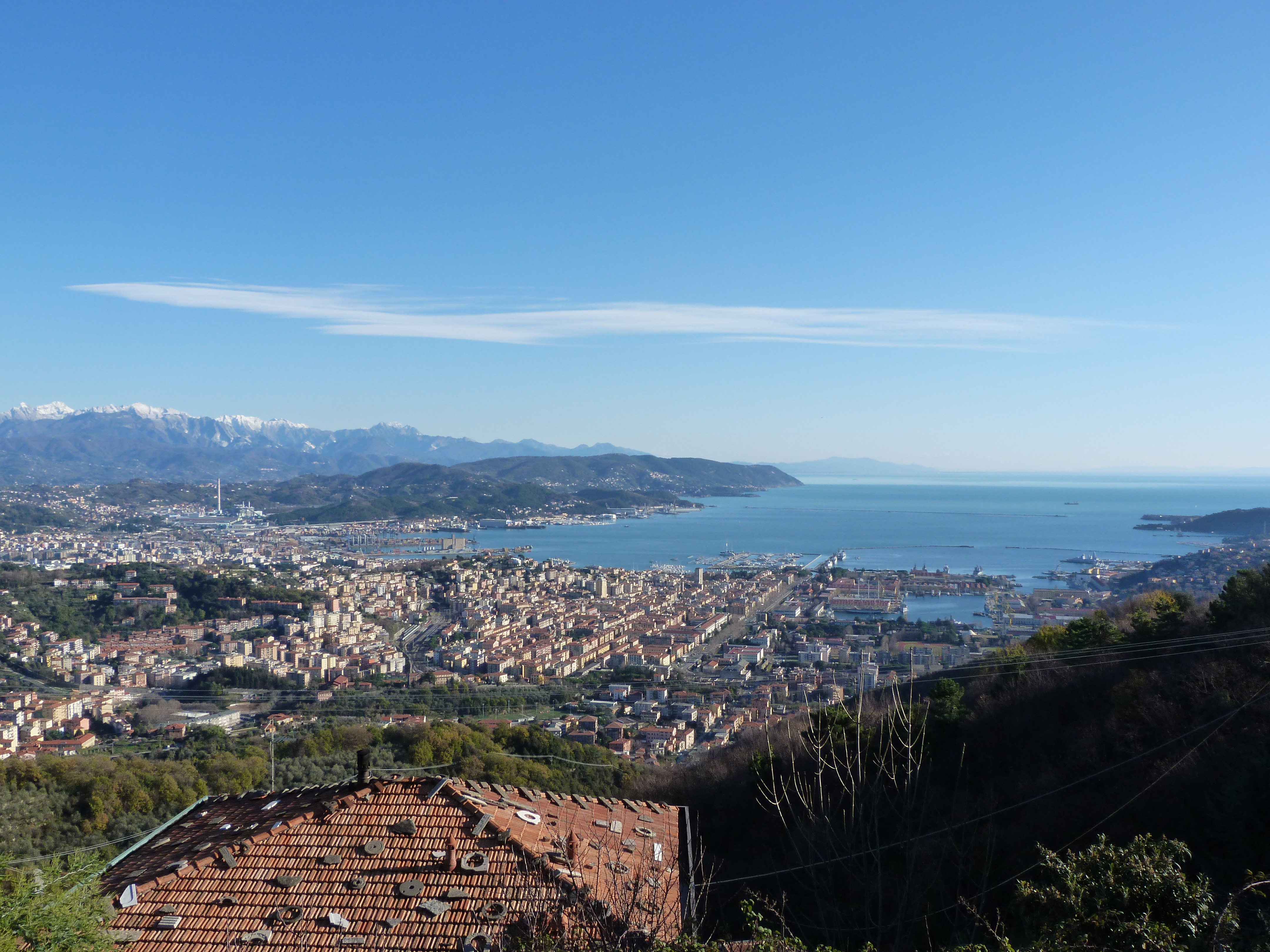
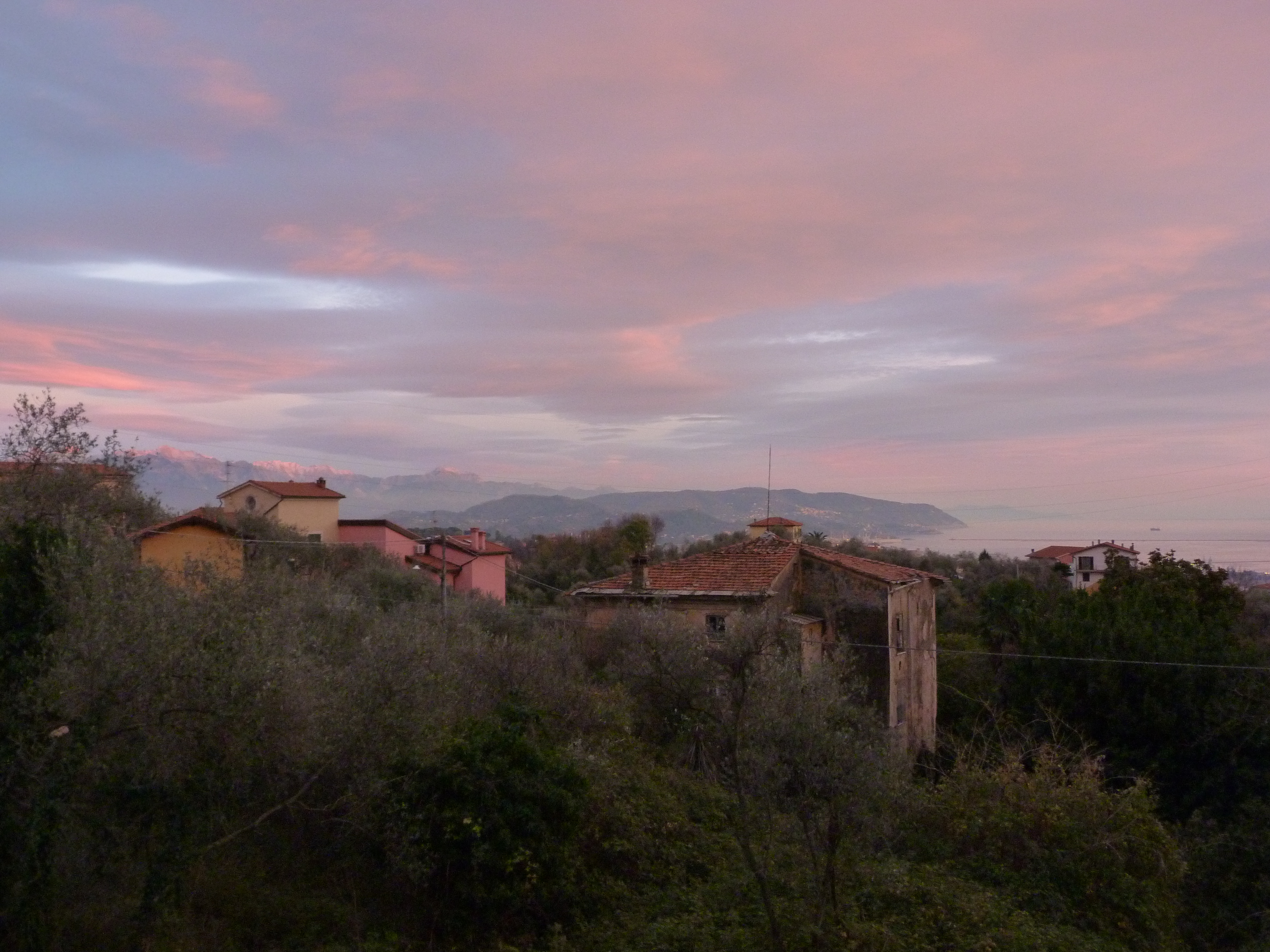
Set in an olive grove, the villa comfortably sleeps 8 and has a large brick terrace that looks out over La Spezia and the Golfo dei Poeti. Naval and container ships crisscross the bay. The Appennino mountain range in the distance changes colour throughout the day as the sun moves across the horizon and reflects off of the snow capped peaks.
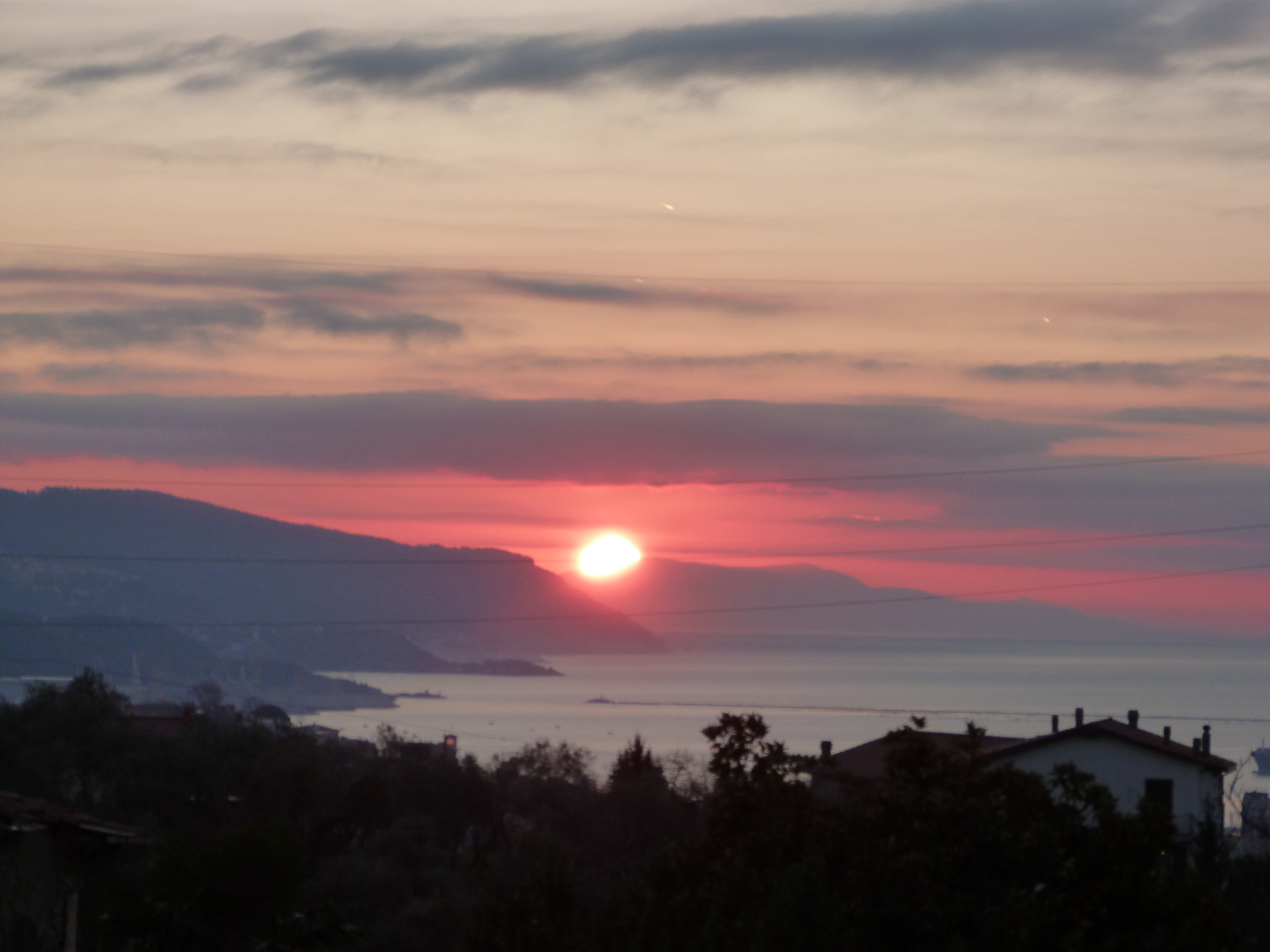
Sunrise over the Golfo dei Poeti
Each bedroom of the villa has a view of the sea and the mountains, and every morning the sun shocks us awake by its beauty. Every night, lights twinkle on the hills and the shoreline, and the mountains fade into silhouette. Could we ask for a better place to spend Christmas with the family?
Our host, Sarah Ferrari, had decorated the villa with poinsettias, wreaths and Christmas ornaments. She greeted us with a large basket of Italian goodies, and wine from the family vineyard, making us feel at home and ready to kick off the festive season.
Tim and I had a couple of days in which to prepare for Christmas Eve, when the family would all be together at last. We headed down to negotiate the vast market in the centre of La Spezia. This is not a tourist area, and few people speak English. Neither of us speak Italian but we figured out how to ask for ingredients, how to ask for more, how to ask for less. As La Spezia is on the coast, there were about a dozen fish stalls filled with mounds of Branzino (like sea bass), Baccalà (dried salt cod), scampi, mussels, squid, cuttlefish, swordfish, tuna and eels, still moving on their icy bed. There were aisles of cheese and meat stalls with fresh mozzarella, Parmigiano (Parma is just down the road), various ages of Pecorino, Gorgonzola, Prosciutto, Carpaccio, and many things we couldn’t identify. There were rows and rows of fresh fruit and vegetable stalls, nut vendors and olive merchants.
The sun starts to set as we look out from the terrace
We tried (unsuccessfully) to stop ourselves from buying too much. But Christmas is a time for eating and drinking. And a gathering of the Lewis/Wynne-Jones clan happens only once a year, which justifies all kinds of excess. With an over-full larder, we created our Christmas Eve feast.
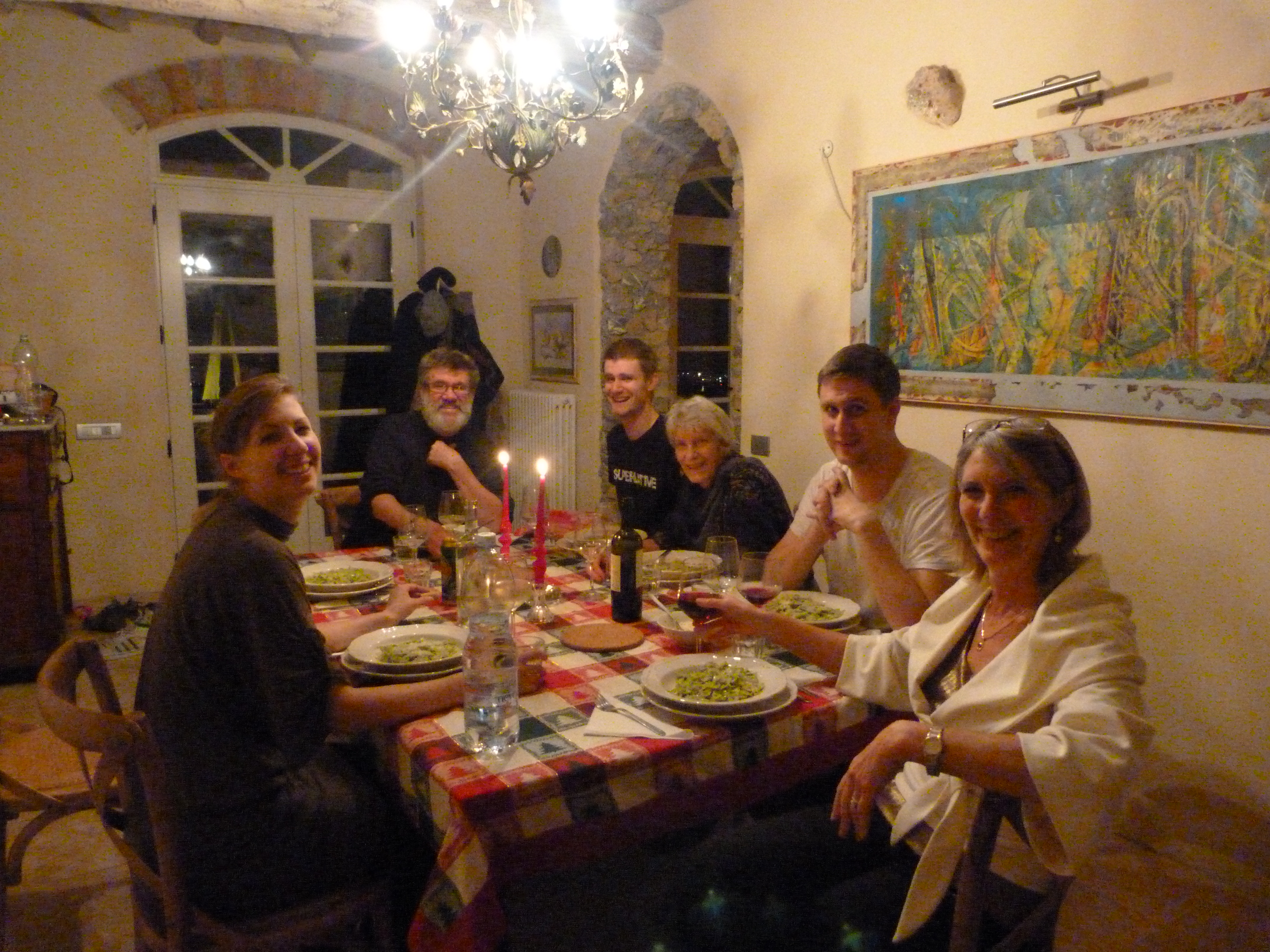
Opening the first of a number of bottles of Prosecco (a case of 12 for 15 euros) we began with an antipasto of olives, marinated artichokes, roasted peppers and fabulous focaccia bread. La Spezia is known for its focaccia and it is deliciously oily and salty, with chunks of olives imbedded into the dough. We followed this with a simple Pesto alla Genoese. This is the region that invented pesto and we bought a big tub of it at the market. It was like no pesto I have ever made or tasted before. Unlike other basils, Ligurian basil is grown organically and out of the direct sunlight to keep it fresh and sweet. The result is a smooth and lemony pesto.
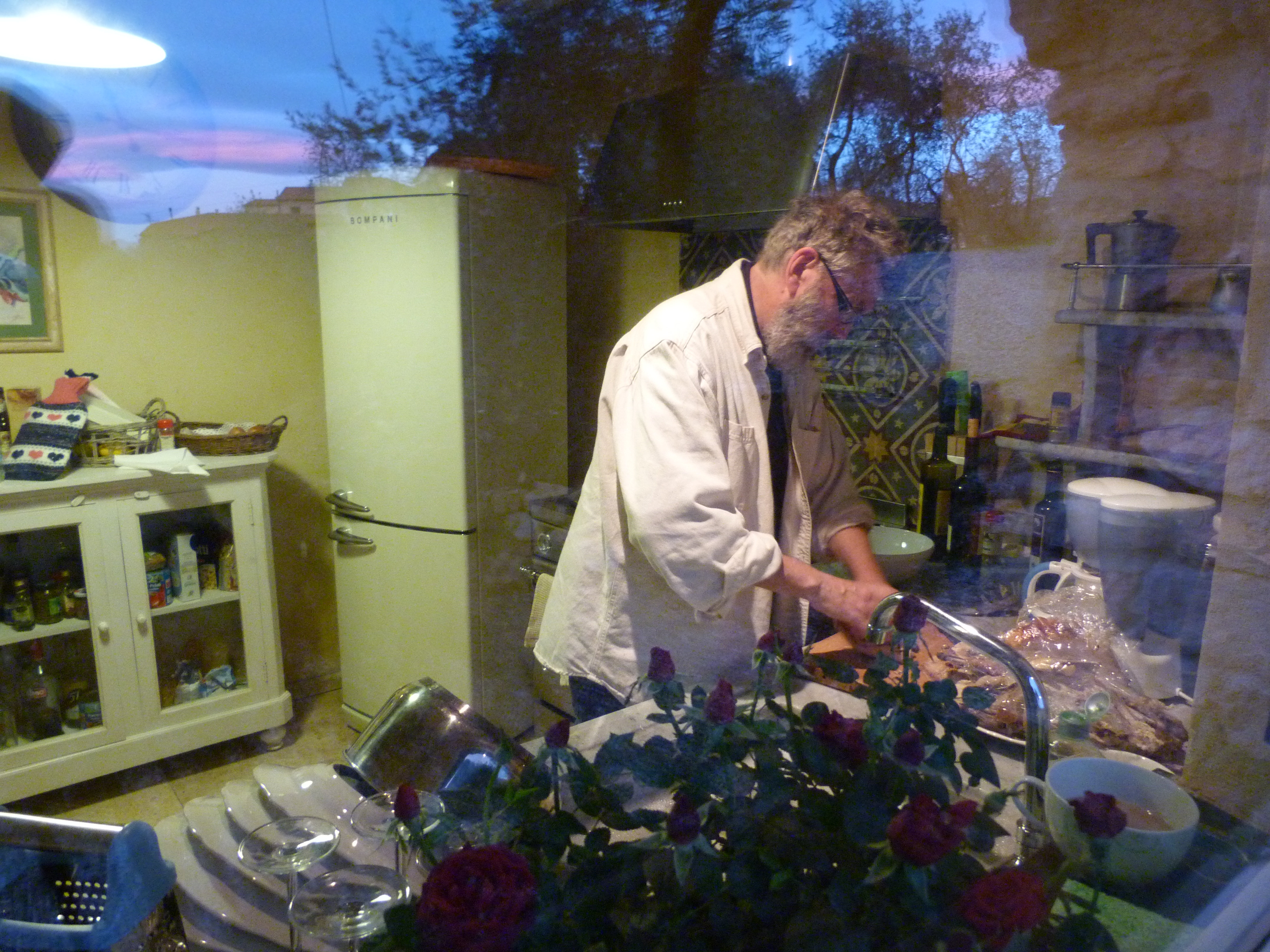
Looking through the window at Tim cooking, the sunset reflected above
We followed the pasta course with Tim’s fabulous “Melanzane (eggplant) alla Parmigiano”, which he has perfected over the last month, and slices from a buttery and soft pork roast that we had bought from the neighbourhood Macelleria (butcher), rolled with garlic and rosemary.
A light salad of mixed greens from the market cleansed our pallets. Amongst other greens, I had bought a lettuce head that was yellow, flecked with magenta. I don’t know what it is called, but it was slightly bitter and so beautiful.
Christmas Eve feast at Villa Maggiano
We finished the meal with some fruit, biscotti and dessert wine. Fireworks were exploding over the bay, and the bells chimed from numerous churches. In several of the coast towns below us, they were welcoming the arrival of the baby Jesus from the sea. “La Madonna, San Giuseppe e Gesu Bambino arrivano dal mare”.
Not a snowflake in sight. Our family Christmas spirit burned bright.
Cardiff (Caerdydd) is the capital of Wales. A city of approximately 850,000, it is going through quite a renaissance and is visited by over 18 million people annually. The city is billed as a “city of arcades”, and at this time of the year all of those arcades are in full Christmas glory. Walking in the centre of town, we went from arcade to arcade filled with unusual and tempting stores.
An Arcade lit up with Christmas lights
The decorations definitely lightened the gloom of the gray rainy skies.
By the time we headed to Cardiff Bay it was getting dark, as it does at 4:00 in November. Before the Second World War, Cardiff was the biggest coal port in the world. But of course its importance as an industrial centre made it a prime target during the war. 2100 bombs fell on Cardiff and decimated the port and many civilian areas of the city.
The bay has undergone massive renovation in the last few years. The focal point is the new Millennium Arts Centre, a startling and massive arts complex dedicated to theatre, dance, opera and music. There was nothing on that we particularly wanted to see that day, although we were very tempted by Deffro’r Gwanwyn, the Welsh version of Spring Awakening. But it was amazing just to see the building, especially lit up in the dark of the night.
The Millennium Centre
While walking among the shops and pubs by the bay, a lovely young Welsh woman came over to offer us freshly baked Welsh cakes, made down the street at “Fabulous Welshcakes” Now, I have made Welsh cakes every March 1st (St. David’s Day) for the last 28 years but I have never had them “in situ” so to speak. So I was thrilled. She invited us back to the store for more cakes and “Bubbly” – Welsh cakes and bubbly!! Who could refuse that?
For those who haven’t had a Welsh cake, it is a kind of tea cake, with currents, cooked on a griddle and always best fresh. I had tried some earlier in the day from a bakery at the market, but they were several hours old and by Tim’s estimation not as good as mine. These fresh ones, however, were very good and of course went beautifully with the bubbly. I am fairly proprietorial about my Welsh cake recipe, but I will give it to you as long as you promise to make them to share!
Warmed by cake and bubbly, we worked our way to a much less touristy part of town, Canton, where we ensconced ourselves at the “Chapter Arts Centre”. This fabulous arts complex was started almost 40 years ago, when a group of artists purchased an old school from the city. It is a thriving arts community with 3 theatres, 2 cinemas, a gallery, studios, 2 bars, a cafe, over 60 cultural workspaces. The night we went it was filled with people and was clearly an exciting place for artists from all disciplines to meet and work together. We saw “Resistance”, a movie set in Wales during the Second World War. It is posited on the idea that Germany has invaded Wales and all of the men from one village have disappeared underground. It is a story about how the women cope, and don’t cope, with the invasion. A good story and a great vision of the Welsh countryside, if you have a chance to see it. You might want to make a plate of Welsh cakes to eat while you watch.
A creature in Bute Park, on the way to the museum.
The next day we walked through the park to the National Museum where we began to understand the history of Wales as a series of constant invasions. Roman, Norman, English – it is a country always under siege of one kind of another.
One of the reasons we wanted to stop in Cardiff was to go to the Royal Welsh College of Music and Drama. Students from the Masters in Musical Theatre program were doing a production of “Merrily We Roll Along”, a musical by Stephen Sondheim that we love, but have never seen. “Merrily” is famous for closing after a 2 week run on Broadway in 1981. Kind of a cult classic amongst those who know it, Sondheim has been re-working it and we were interested to see it live.
The RWCMD is housed in a brand new, huge, arts complex beside the park in the centre of town. We arrived early so that we could sit in the café with a glass of wine and listen to some jazz. Students from the music department were performing as part of their course work, and we were treated to standards, bee-bop and contemporary jazz as 6 different student groups performed. Great to be reminded of just how hard jazz is, and to see these young students keeping it alive.
“Merrily” was great. The students were very accomplished and passionate about their work. It is a school I would definitely recommend to anyone considering a career in musical theatre. And it was great to see how “Merrily” actually works. We both cried through “Not a Day Goes By” . If you don’t know it, you can listen to Bernadette Peters singing it.
We devoted our last morning to the castle in the centre of town. Cardiff Castle dominates the city and its history. Fortifications were built here by the Romans in 55 AD, the Normans in 1081, and subsequent English builders continued to make it a defensive barricade to protect their interests and keep out the rebellious Welsh.
The Norman Castle keep
In the 19th century the 2ndMarquess of Bute turned it into a Victorian extravaganza.
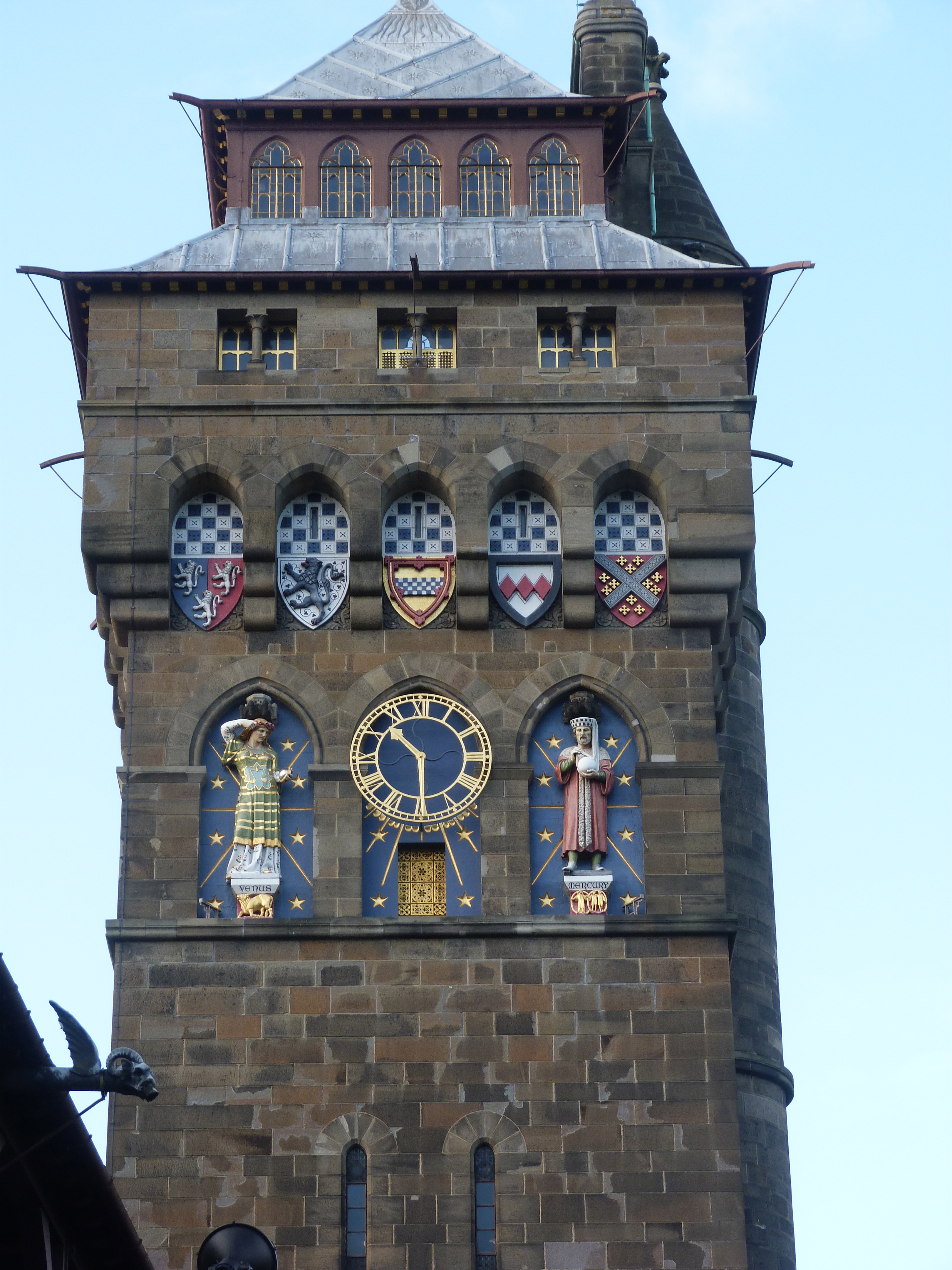
The Victorian Clock tower connected to the castle wall
Bute is said to be the “father of modern Cardiff”, building docks and railways to export Welsh coal. He amassed a huge fortune on the backs of the Welsh coal miners and set about building a lavish castle. Working with the designer “Capability” Brown, he had the grounds of the Norman/Roman fort excavated and re-built, creating gardens and vistas for his castle.
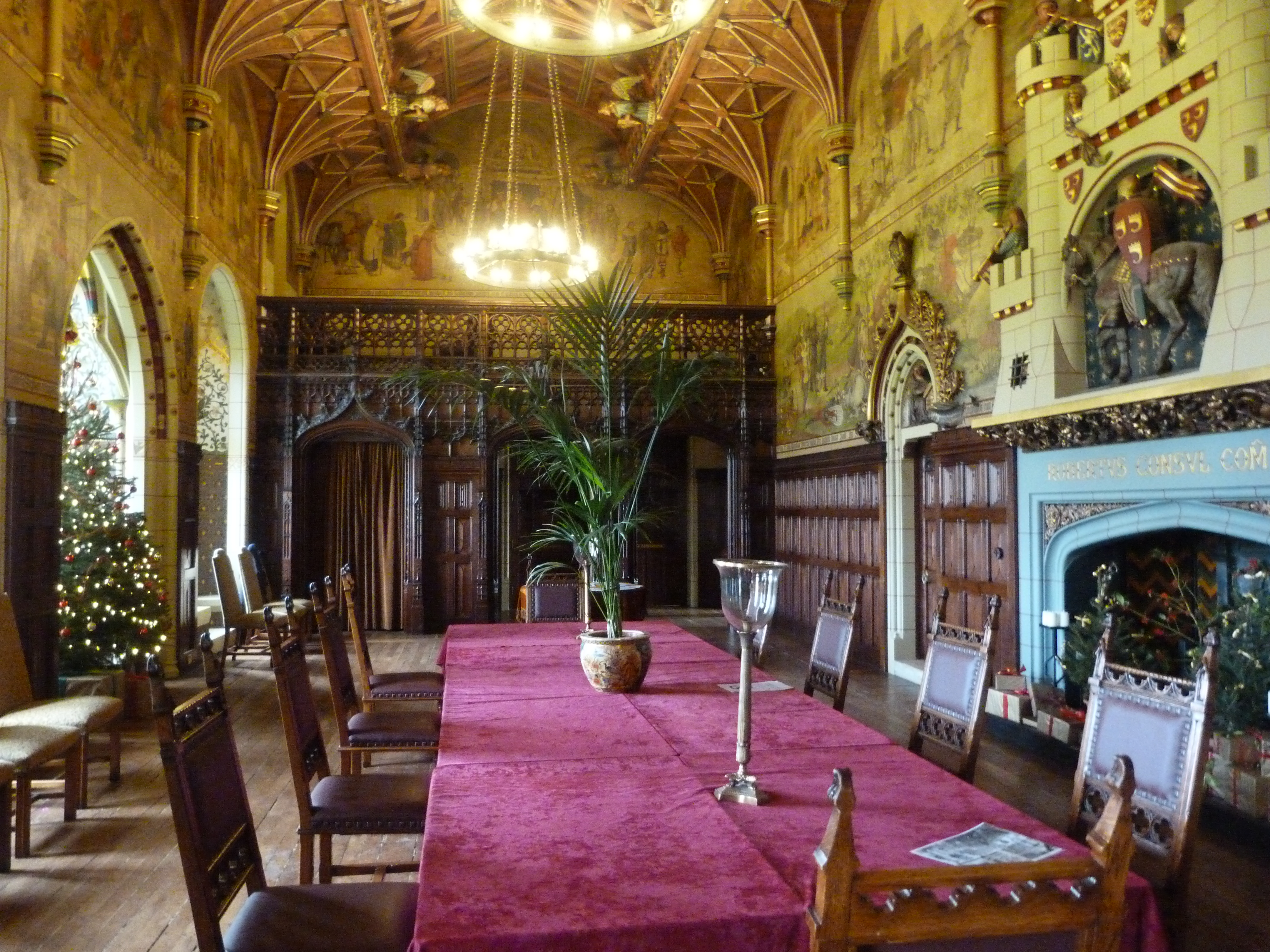
The Victorian Banqueting Room
The banqueting area is still in occasional use by the Royals (and apparently can be rented by mere mortals for £500 per hour).
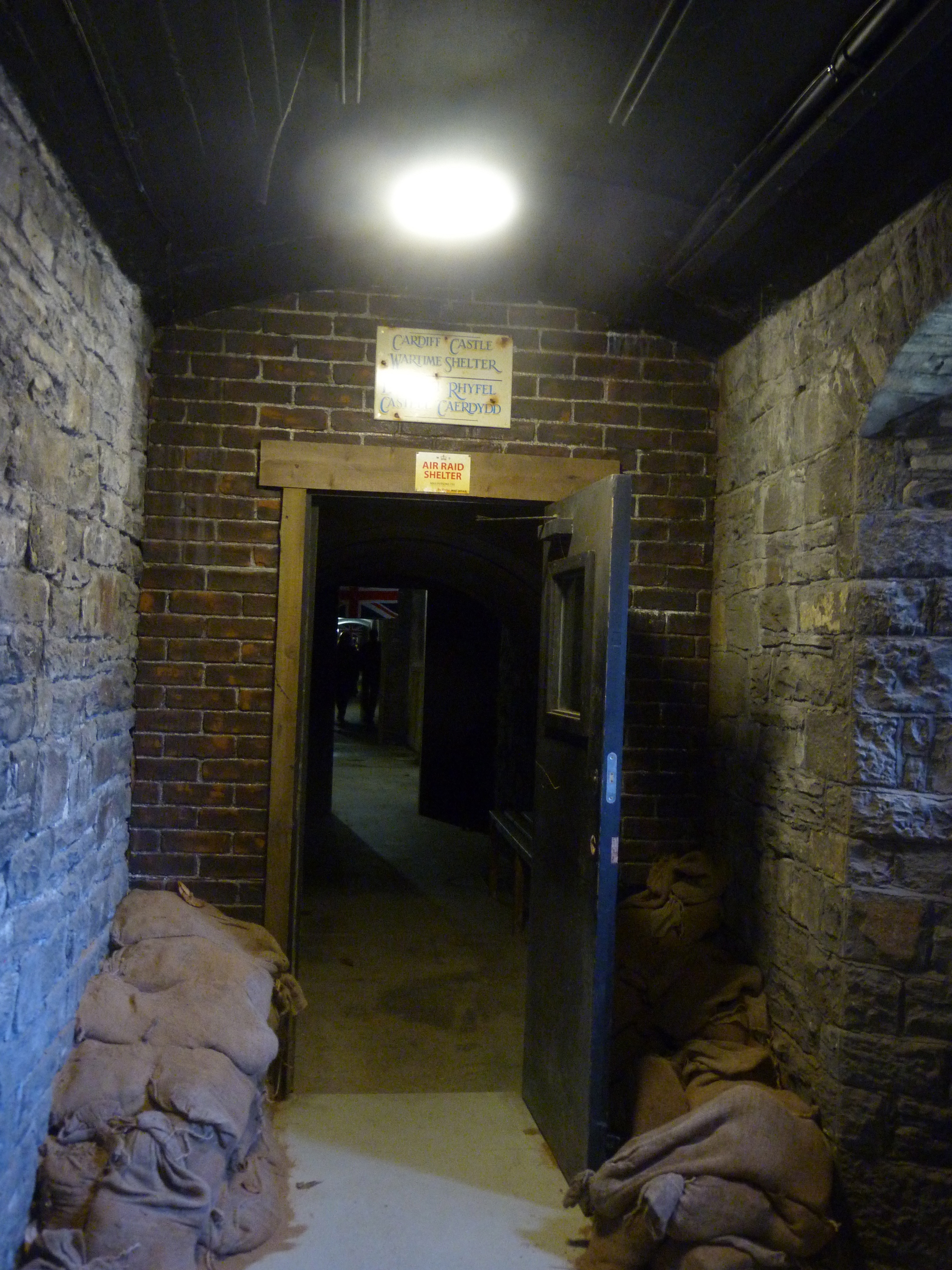
During the war, the Bute family built air raid shelters under the embankments. It was the safest shelter in the city and housed 1800 people during the raids.
Air Raid Shelters in the embankments
In 1947, the Bute family gave the castle to the people of Wales. It only took 2000 years.
Lion: one of the animal sculptures on the castle wall.
With the name “Wynne-Jones”, you know that Tim’s family is Welsh. His father was born in Wales, and going there was an important part of this trip. We also wanted to walk on whatever coastline we could get to. So we headed out to discover what we could of the Pembrokeshire Coastal Path.
The Pembrokeshire Coastal Path comprises 186 miles of south west Welsh coastline. It is remote and, in November, isolated. We decided to base ourselves in the city of St. David’s (Tyddewi) in case the weather turned bad and we had to just curl up with our books instead of walking. Late November is very much the off-season and we weren’t sure what to expect.
St. David’s is the UK’s smallest city. With a population of 1,800, it seems miniature in all respects.
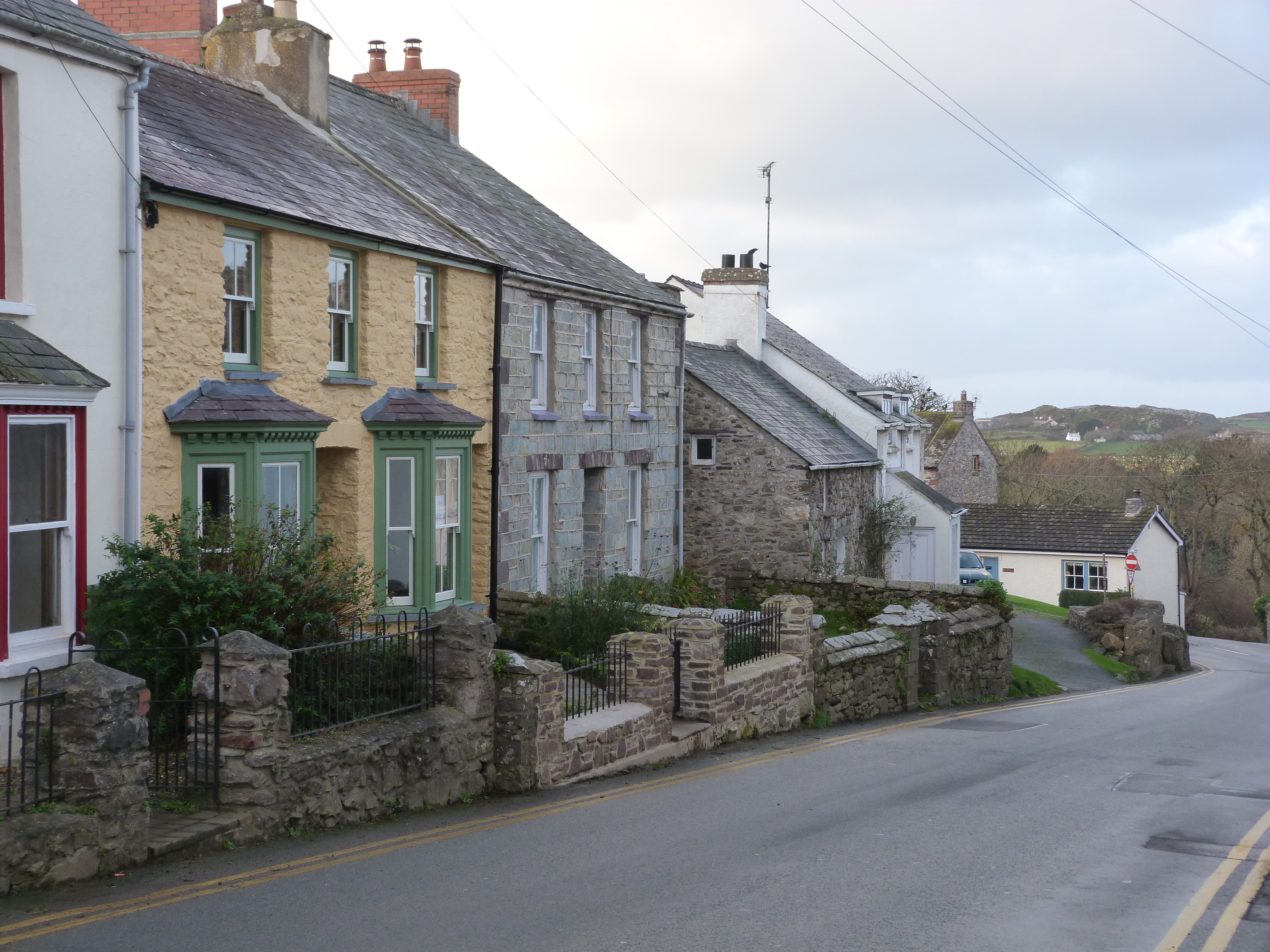
Tiny cottages nestle together on two main streets, and you can circumnavigate the whole city in about 10 minutes of walking.
St. Davids/ Tyddewi
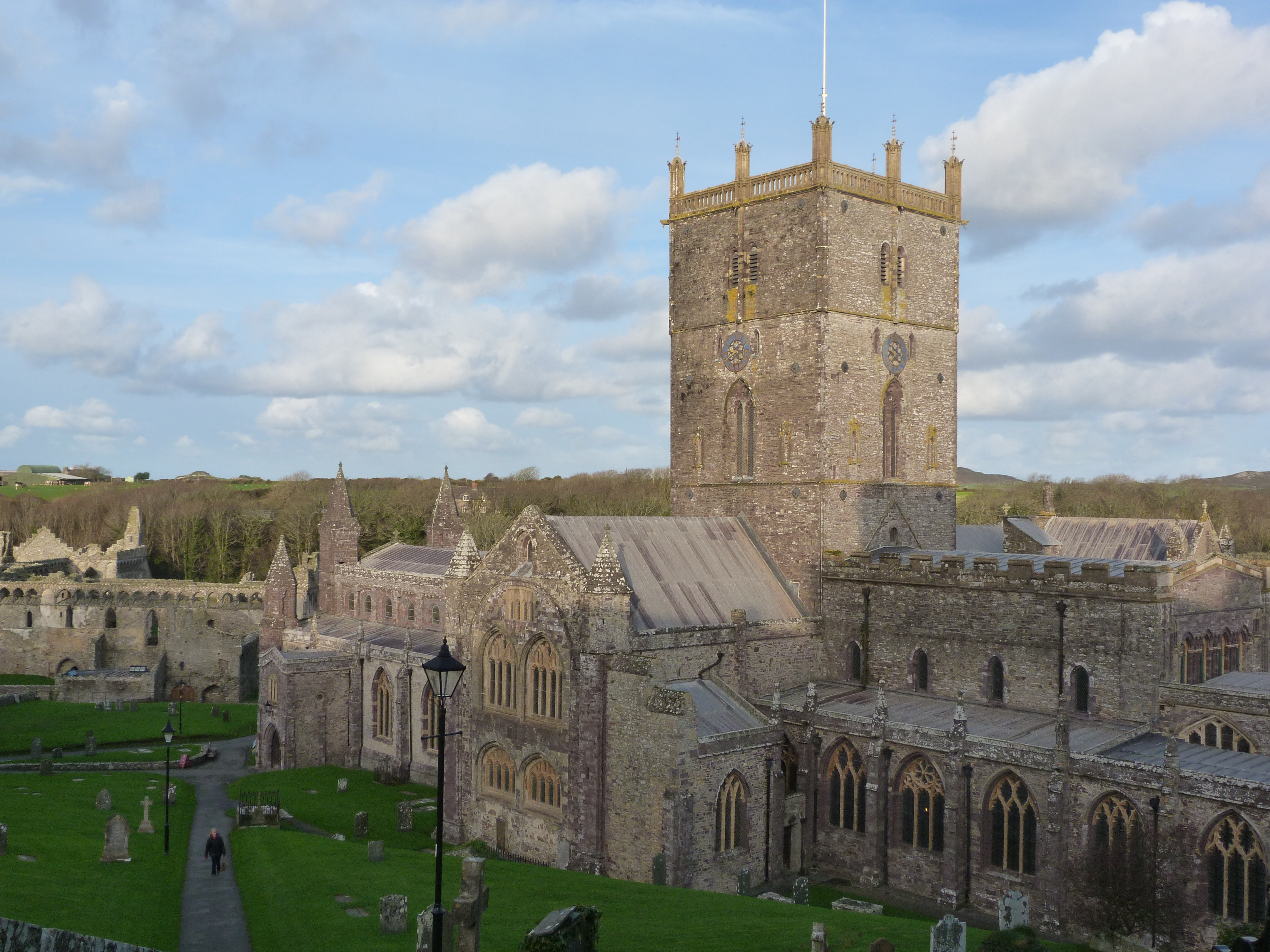
St. David himself established a monastery here in 589 AD, and it has been a place of worship ever since. The city status is due to its large and impressive cathedral.
St. David's Cathedral
St. David’s Cathedral was begun around 1180 AD. An extraordinary feat of workmanship, the cathedral has beautifully carved and painted ceilings, tile floors, mosaics, sculptures and tombs throughout.
Inside the Cathedral
In the 14th century, Bishop Gower secured the importance of St. David’s when he appealed to the Pope to agree that two visits to St. David’s equals one to Rome. This means that pilgrims can be as blessed by visiting St. David’s twice in their lifetime as they would be by visiting Rome once. “This pilgrimage and the wealth that pilgrims brought though their gifts granted the bishops of St. David’s enormous power and wealth” (from the Treasure exhibit, in the Cathedral) The wealth of the cathedral is evident. Pilgrims, and tourists, have kept the Cathedral alive, and it is very much at the centre of the tiny city’s life.
But our days were spent appreciating a much older and more rugged beauty. Wales is a land of mystery and legend, and the Coastal Path, with 58 beaches and 14 harbours, has many stories to tell.
We began our first slightly rainy day with a visit to the superb tourist information centre. We picked up the path about ½ mile from the centre and found ourselves overlooking Caerfai Bay.
Tim about to take off in the wind, with Caerfai Beach beyond
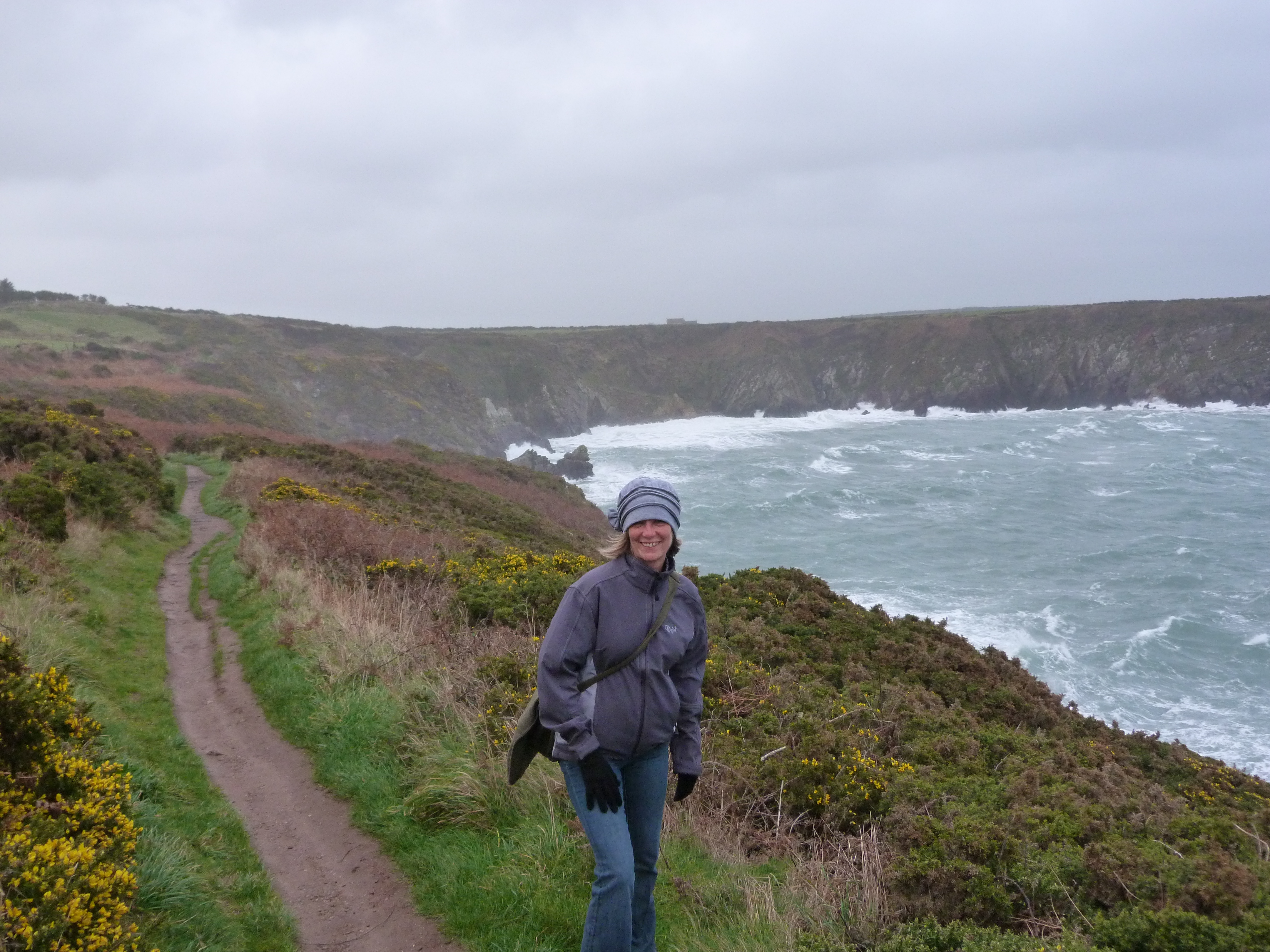
The wind was fierce, but not cold, invigorating, not overwhelming as we set off along the edge of the cliffs.
Setting off on the path
The walk took us to the most westerly chapel in Wales, St. Non’s.
St. Non's Chapel
St Non was St. David’s mother and a nearby fresh water spring, credited with many miracles, is said to have sprung up at the moment when St. David was born.
The present day St. Non’s chapel was constructed from stones of the old chapel, built around 1300. A tiny refuge, we were surprised to find lit candles and offerings to the Saint with not a soul in site.
The chapel at St. Non’s isn’t used for regular service in the winter because the rains come through the 2 ½’ thick walls, despite the waterproofing. Coming out of the chapel, the rain hit us sideways from the sea and we didn’t have much on in the way of waterproofing. So we decided to abandon the path and head back to St. David’s.
We were drenched when we walked into the Farmer’s Arms, but after a bowl of leek and potato soup and a pint of Double Dragon we were dry, and so was the weather. A bit of sun came out so we headed out of town again, about 3 miles out, to join up the path at Whitesands Bay.
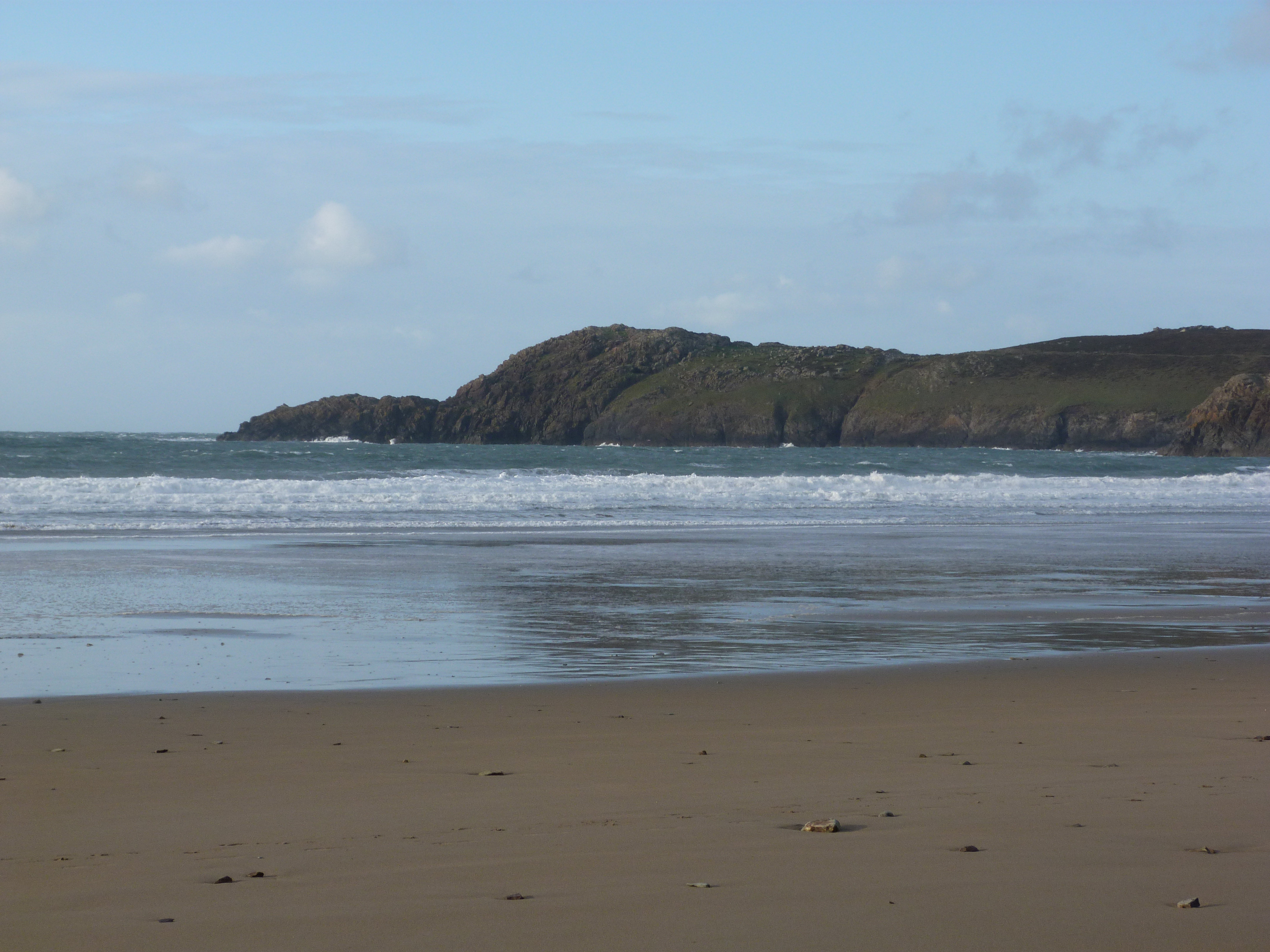
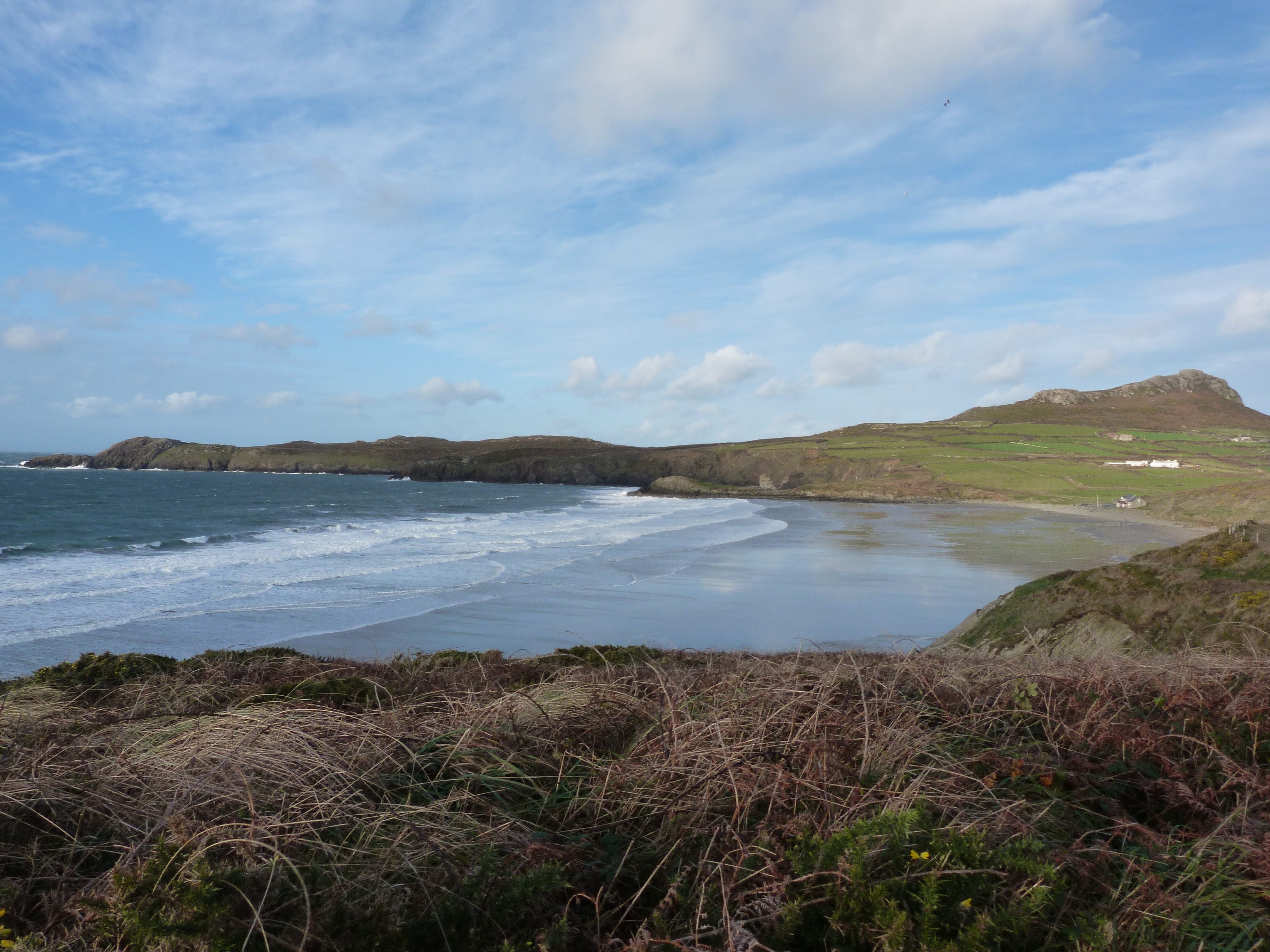
Whitesands Bay
Whitesands is breathtaking. Tradition has it that St. Patrick left from Whitesands on his mission to Ireland in 430 AD.
A long, pristine white beach with huge crashing waves, bordered by hard edge cliffs, we had the place to ourselves.
We worked our way back to the path, skirting the edge of the cliffs.
Whitesands Bay from the coastal path
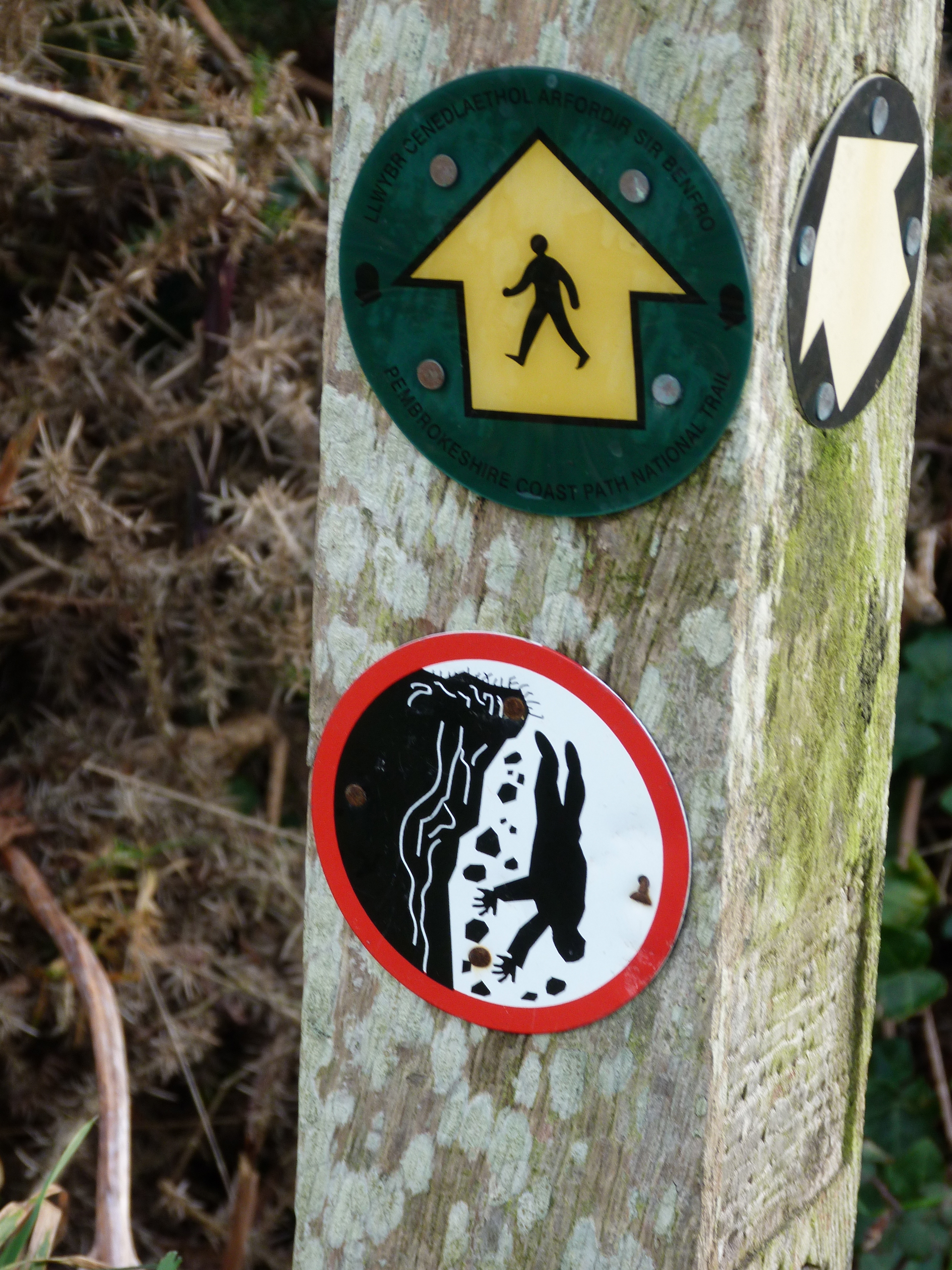
The views are unbelievable. It is the kind of place where people go to extremes to get good photos – apparently a prominent photographer was swept to his death by the fierce winds while trying to capture a perfect shot. Signs remind us: “Cliffs kill! Keep to the path”. We did.
In case you can't read the signs
We walked as far as St. Justinian’s where there is a lifeboat station, built in 1869, tucked into the inlet. St. Justinian was St. David’s friend, a strict ascetic who lived on Ramsey Island. Legend has it that his disciples beheaded him (he was apparently a bit too strict!), but he picked up his head and walked across the water over to the mainland to die, where a chapel was built in his name.
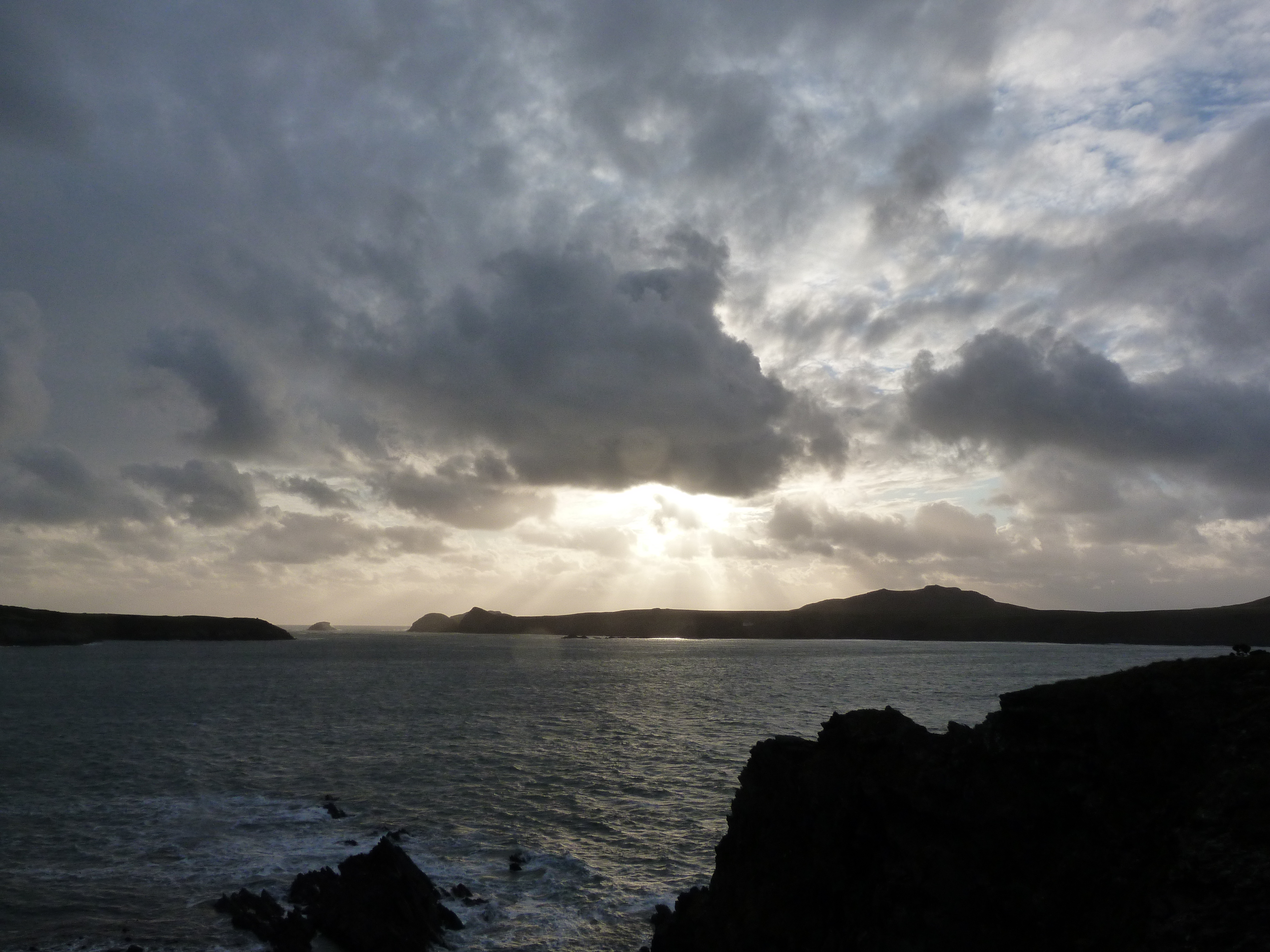
Light fades quickly on these short winter’s days and we didn’t want to be on the cliffs at night.
Late afternoon on the path
So we headed overland back to St. David’s, where even in the off-season we are able to find an excellent Indian restaurant that served a brilliant curried fish dish with coriander, lemon and smoked paprika – Tarkary Basa – like nothing I have ever tasted.
The next day dawned sunny and dry, so we picked up the walk at Porth Clais, a harbor featured in the Mabinogion (a famous collection of Welsh legends). It was the landing place of a giant boar, pursued from Ireland by King Arthur. More recently (18th century) it was an important trading quay with lime kilns in active use until the beginning of the 20th century. It is a perfectly hidden, tiny harbour, and from April to October it is the launch for boats and kayaks that head out to Ramsey Sound to see porpoises and seabirds.
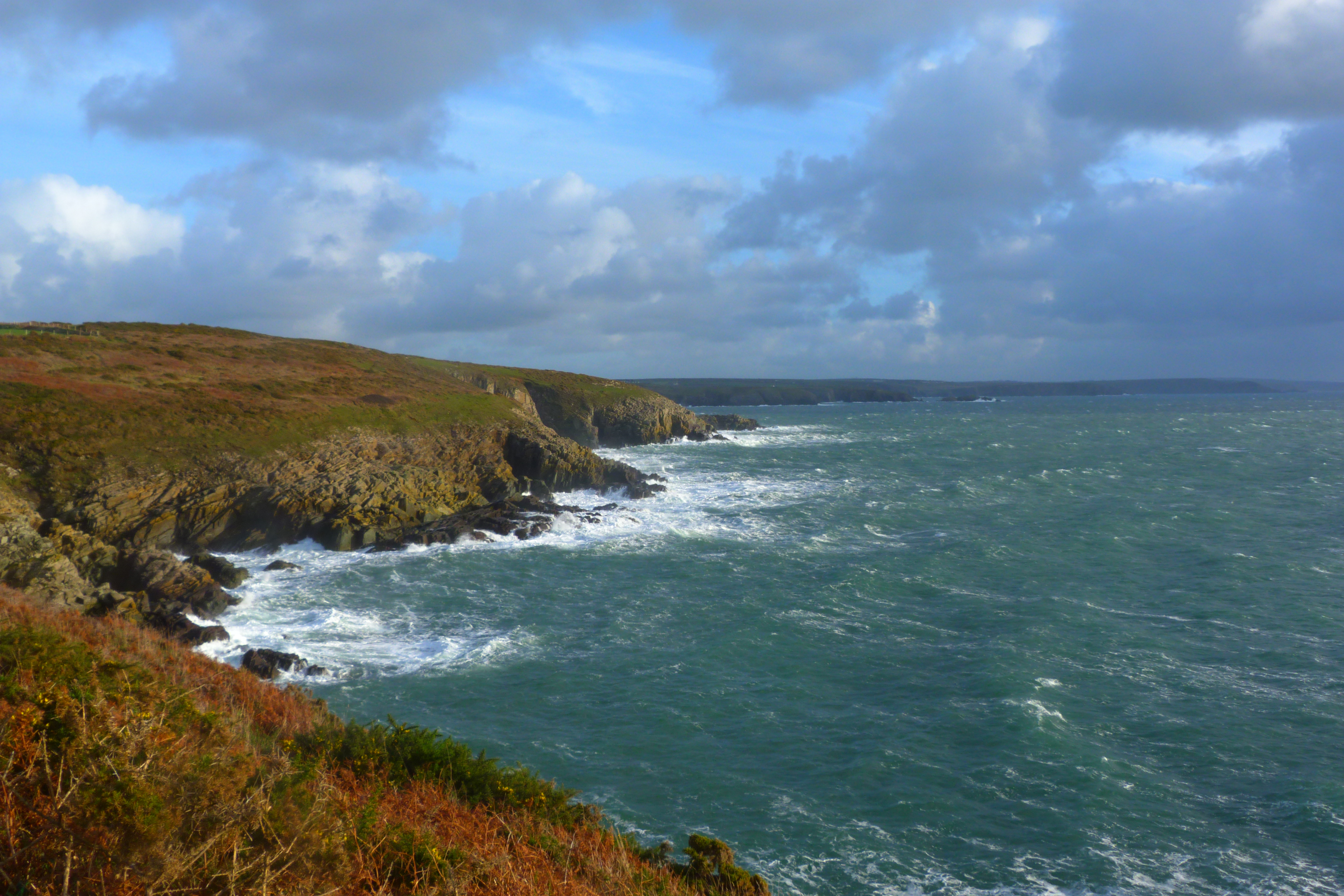
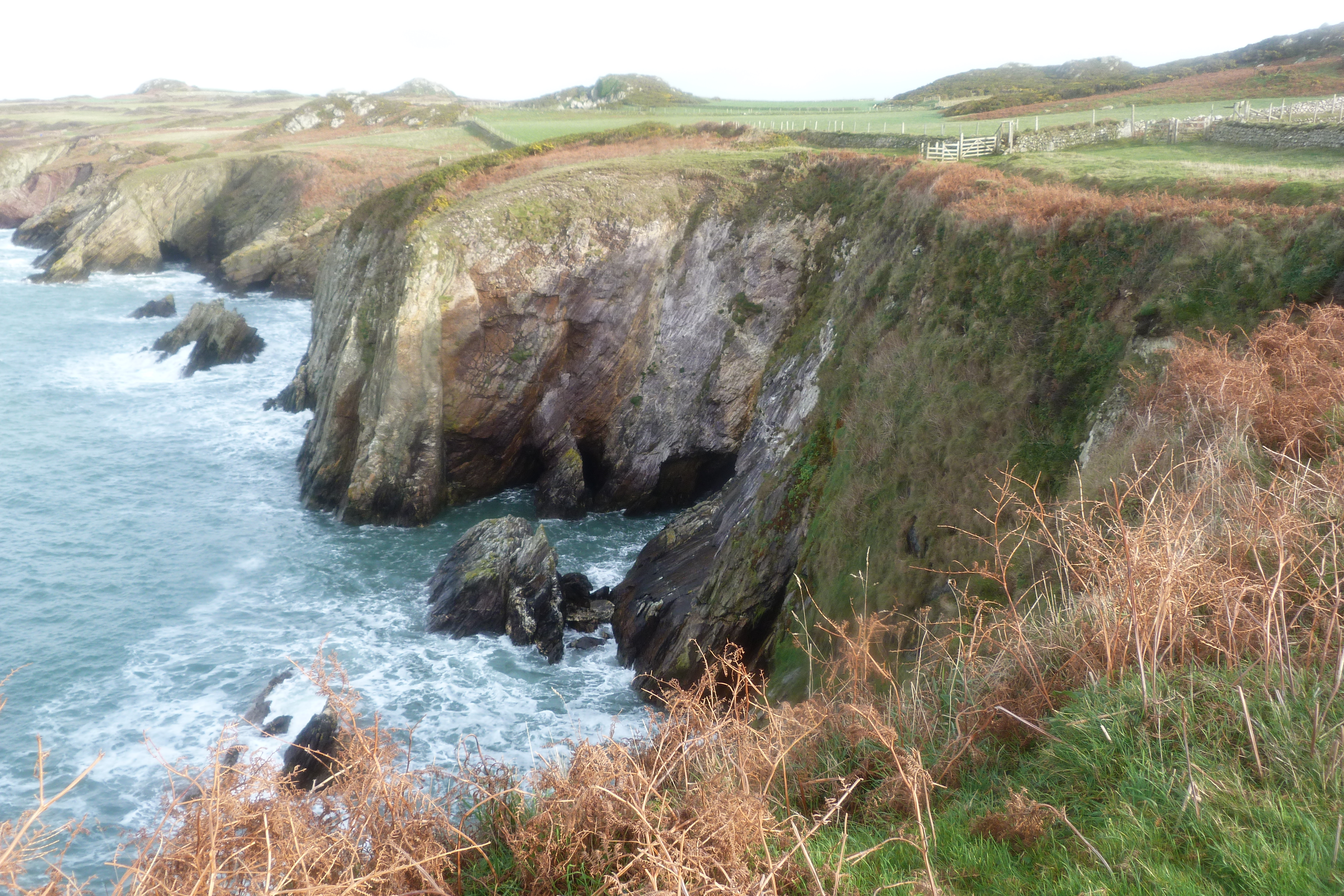
The waves crashed, the wind blew and a new breathtaking view was around every corner.
The water changes colour with the light
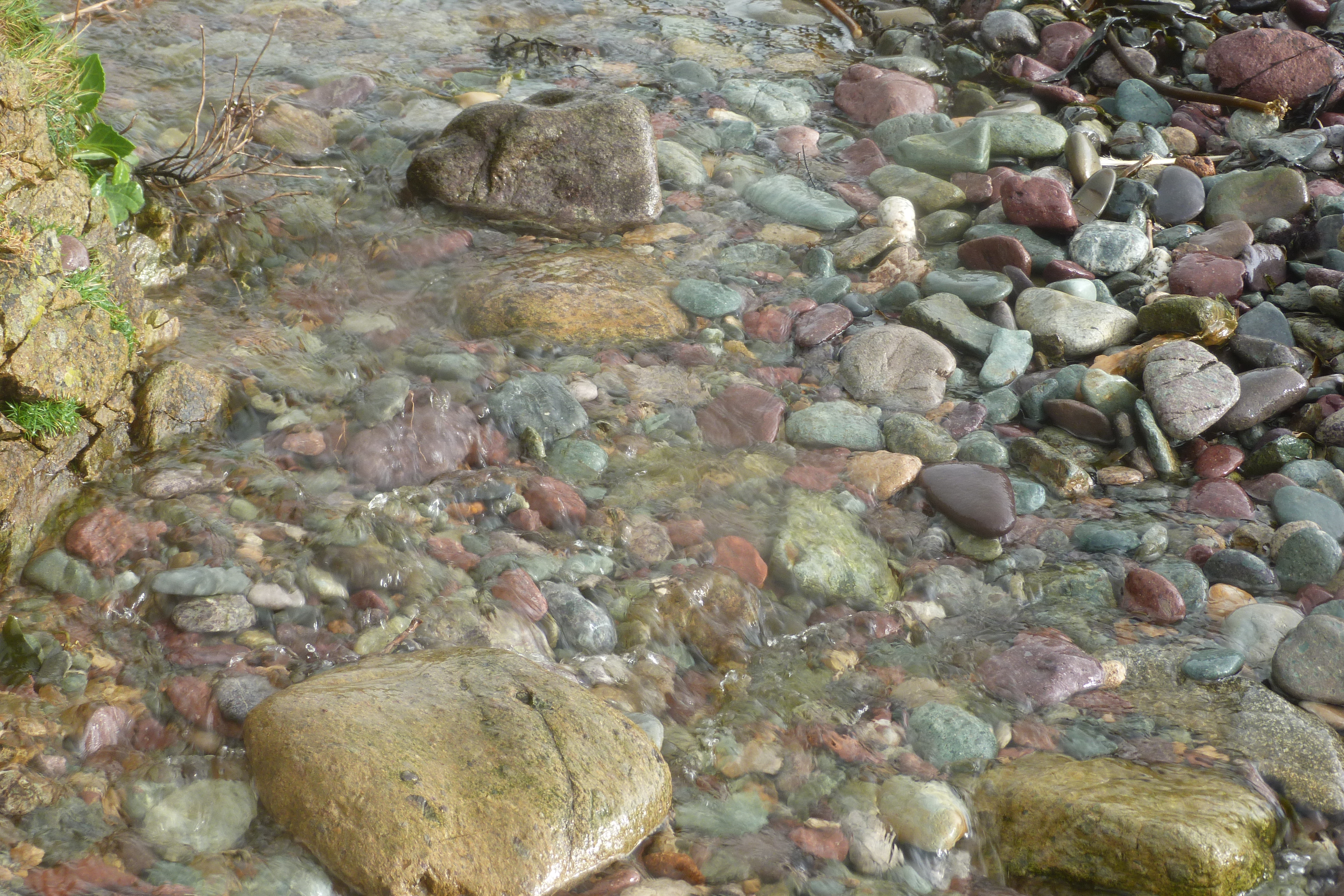
From Porth Clais we walked to Porth Lisky, a bay filled with red and green pebbles formed from Pre-Cambrian ash and lava.
Rocks on the beach at Porth Lisky
The rocks are beautiful and the colours gleam like jewels as the water flows over them. We were treated to a sun shower, and although wet again, we were delighted by a rainbow overhead. The wind dried us quickly as we proceeded along the coast.
Remains of Copper mines, Ramsey Island in the distance
We passed 19th century copper mines, and the sheltered bay of Carn ar Wig, used by ferry boats since the 13th century. But the weather started to turn again, and we decided it was time to turn away from the shore, inland back to St. David’s where a late plowman’s lunch at the Farmer’s Arms awaited. We had met only one person on the path in our two days, Jimmy from Montana, who had devoted the whole month of November to this walk. He was heading to St. David’s with his life on his back (tent, cook stove, sleeping bag, everything). We couldn’t imagine what it is like to camp out in this constant wind! It was Jimmy’s last night before heading back to the States, so we shared a drink together and got advice for our next coastal walk.
The day ended with Evensong at the Cathedral. Even as an agnostic, I felt blessed.
It never ceases to surprise me that Britain is both large and small at the same time. It’s like a magic box. Some journeys are interminably long and complicated. But then there are times when you can go from London to an entirely different city for lunch, then be back in London in time for cocktail hour.
Such was our experience when we were invited to lunch with writers Jill Patton Walsh and John Rowe Townsend in their home in Cambridge. Tim has known Jill and John for years and I was very much looking forward to meeting them and to seeing Cambridge.
As a North American who grew up at a time when educational systems were under scrutiny (when I was a teenager I propped “Teaching as a Subversive Activity” by Neil Postman, on my desk as a flag to my decidedly out of date high school teachers), it is hard for me to understand how generations of people in the UK are affected by their university status. Getting into Oxford or Cambridge is the single most determining factor for the outcome of a life. That’s not to say that all Oxbridge grads are successful or happy. Only that the experience will mark (and some say mar) them for life.
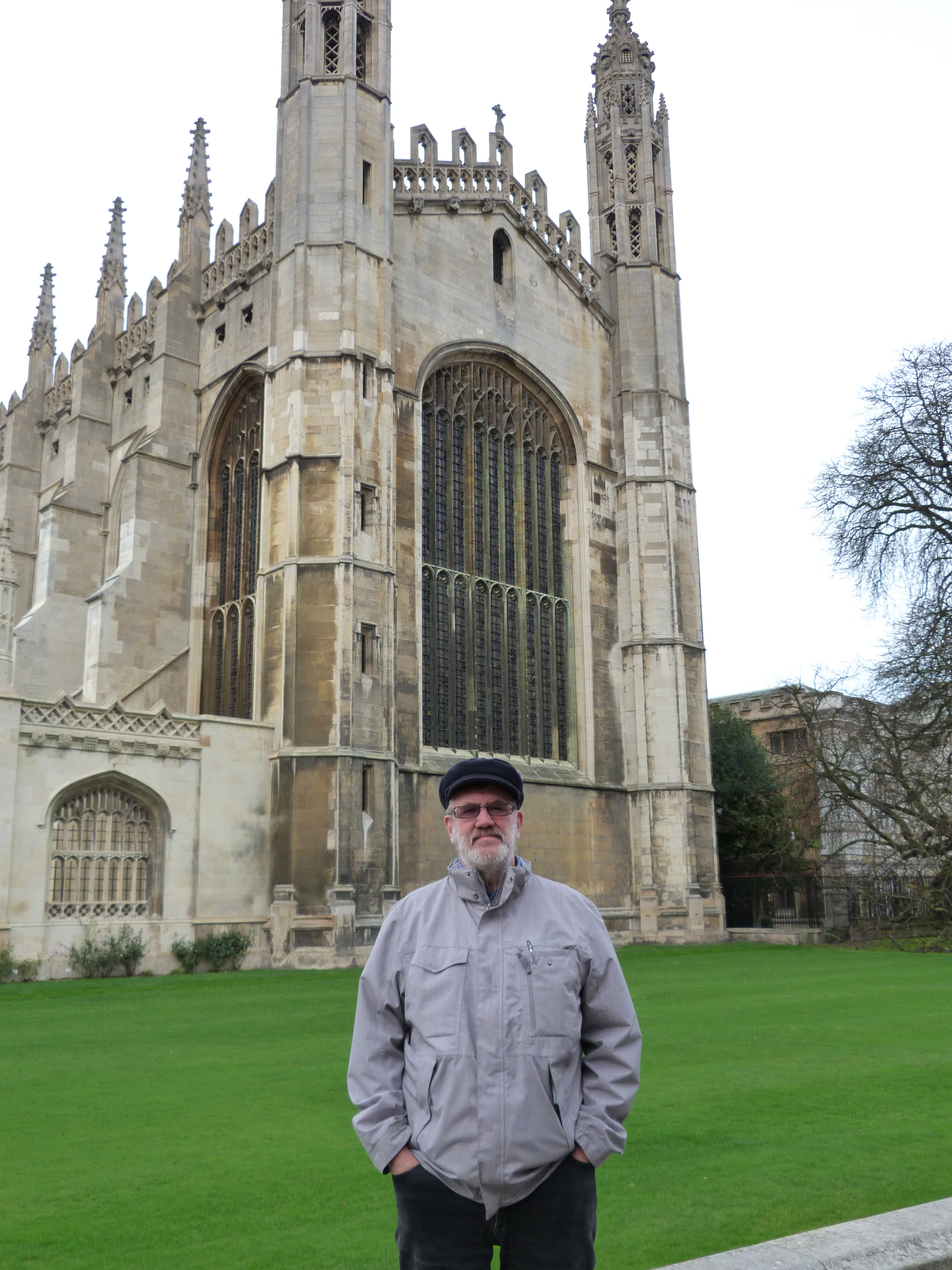
Tim in front of King's College, where he had hoped to sing as a choir boy
Cambridge is an exquisitely beautiful city with the university at the heart of everything. College after college proudly declares its noble patrons. Inner quads are immaculately kept.
One of the quads
Shops in the city centre are exquisitely tasteful, filled with expensive clothing, jewelry, handcrafted shoes and gifts one imagines visiting parents purchase.
The high street, filled with Saturday parents
History, and privilege is everywhere, as is the craftsmanship that creates these buildings, carvings and ornaments. But there is also a marvelous eccentricity about it all.
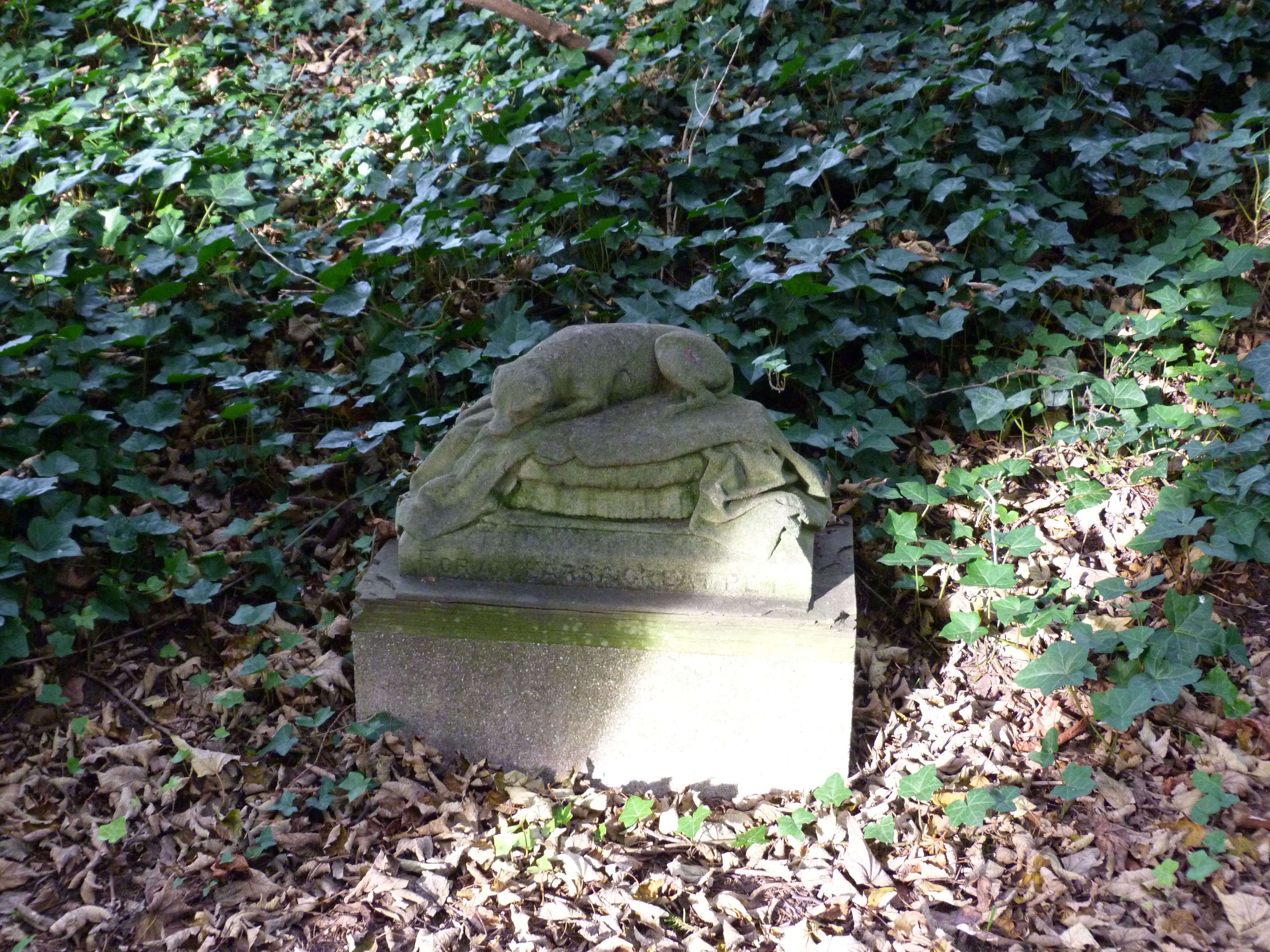
A tomb for a beloved 19th century dog
Walking through a peaceful path in Magdalene College, we came upon a few tiny, tasteful, carved memorials. A late 19th century graveyard for beloved pets.
Inside the Round Church, the second oldest building in Cambridge
Gargoyles, faces and impressive statues watch you from every angle of every building.
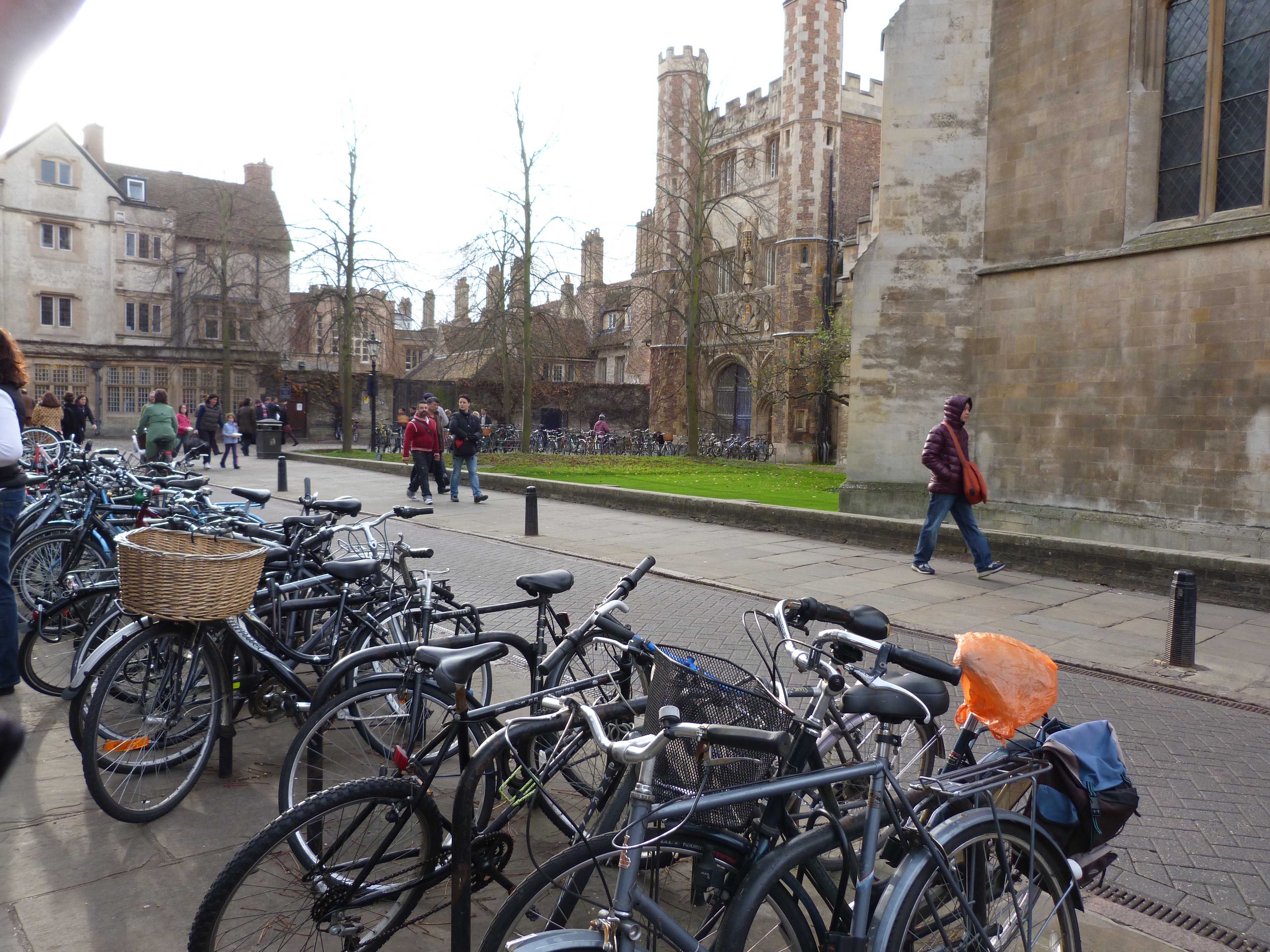
The streets are cobbled and cut off to car traffic. Thousands of bikes are chained up outside of the colleges and students whizz past, scarves identifying their colleges flying in the wind. They rule the road and low betide anyone stepping off the curb.
A city of bicycles
Is it any wonder that these young students feel and behave in an elitist fashion? That the city exudes a rarified atmosphere guaranteed to make us mere mortals envious? It is the epitome of a combination of wealth, intellectualism, beauty and youth. All we could do was to watch it all go by, and feel like somewhat lesser humans.
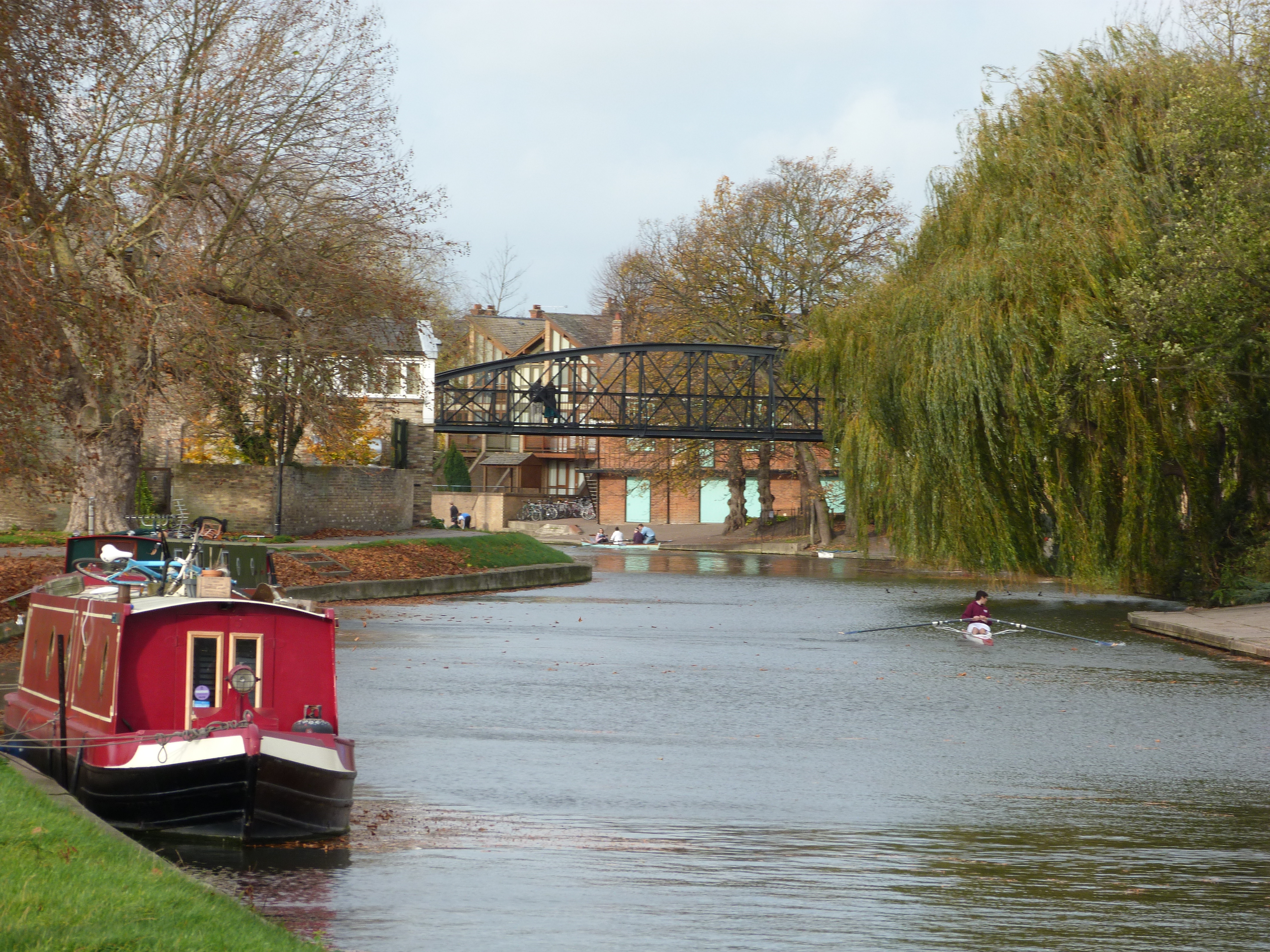
The river Cam. Even in November the rowers and punters were out.
But then we went to visit Jill and John, in a house that overlooks the river. They are as marvelous as Tim had led me to believe. It was a fabulous visit that blended politics, children’s literature and food. Salmon with wild rice, followed by a delicious apple tart (When I asked Jill about the apples she replied, “I always use Bambery apples when I can. They are perfect for apple tart”) and local chesses, including a particularly scrumptious Wesleydale with apricots. All enhanced by a delicious white burgundy supplied by their wine club.
We may not be a part of the Cambridge “set”, but for one lovely afternoon, we were fully welcomed and at home there.
I decided I needed to take a trip to visit the Occupy London Stock Exchange (LSX) site at St. Paul’s Cathedral. For those who don’t know, this London Occupy site has been the focus of an important discussion about the role of the church in people’s lives. Three high-ranking church officials resigned over the mismanagement of the protest movement on their doorstep, and for weeks a debate has raged over the position of the church in defending the needs of the poor.
As I write this, an eviction notice has been served, and a legal case is proceeding, but for the moment the Occupy site remains. It continues to be a peaceful, and respectful protest. From what I can tell, the media has gone from being cautiously supportive, to openly negative and nasty, and currently to blithely ignoring the continuation of the Occupation. Next week however, on November 30th, a country-wide general strike is called for. I suspect we will be drowning in a sea of contradictory media reports and opninons.
On the day I went to St. Paul’s, the fall wind had picked up. It was sunny, but sudden gusts picked tents off of the ground, fluttering them 5 feet in the air before dropping them down again on the cobblestones.
Looking from the steps of St. Paul's to the Tent City University
A well-organized information tent was connected to “Tent City University”, a tent space dedicated to encouraging research, thought and intelligent discussion. “Needs” boards were posted (First Aid supplies, kitchen supplies) as were volunteer opportunities. I had heard that a newspaper had been produced a few days earlier and asked if I could see a copy. It is an impressively produced, well-written journal. This is a very organized movement, and their dedication to education and discussion is paramount.
There are speakers and events every day at LSX. On the day I was there, Manuel Castels was speaking. Castels is a sociologist and an expert in the field of information technology and society. His “Information Age Trilogy” is one of the most frequently quoted sources for understanding contemporary communication. He was visiting the site en route between Barcelona and Los Angeles and he spoke about strengthening the connection between the urban space and cyberspace. The Occupy presence will create change through the lateral thinking possible in cyberspace. But it is still essential to initiate the dialogue in the urban environment. He stressed the need to avoid violence at all costs, suggesting that if the movement was evicted from St. Paul’s “there are lots of other churches in London”. Smaller groups could occupy more locations, and remain connected through the internet. This would not dilute the movement. It will only grow in strength. He spoke about the need to stay connected, “our imagination and our courage should do the rest”.
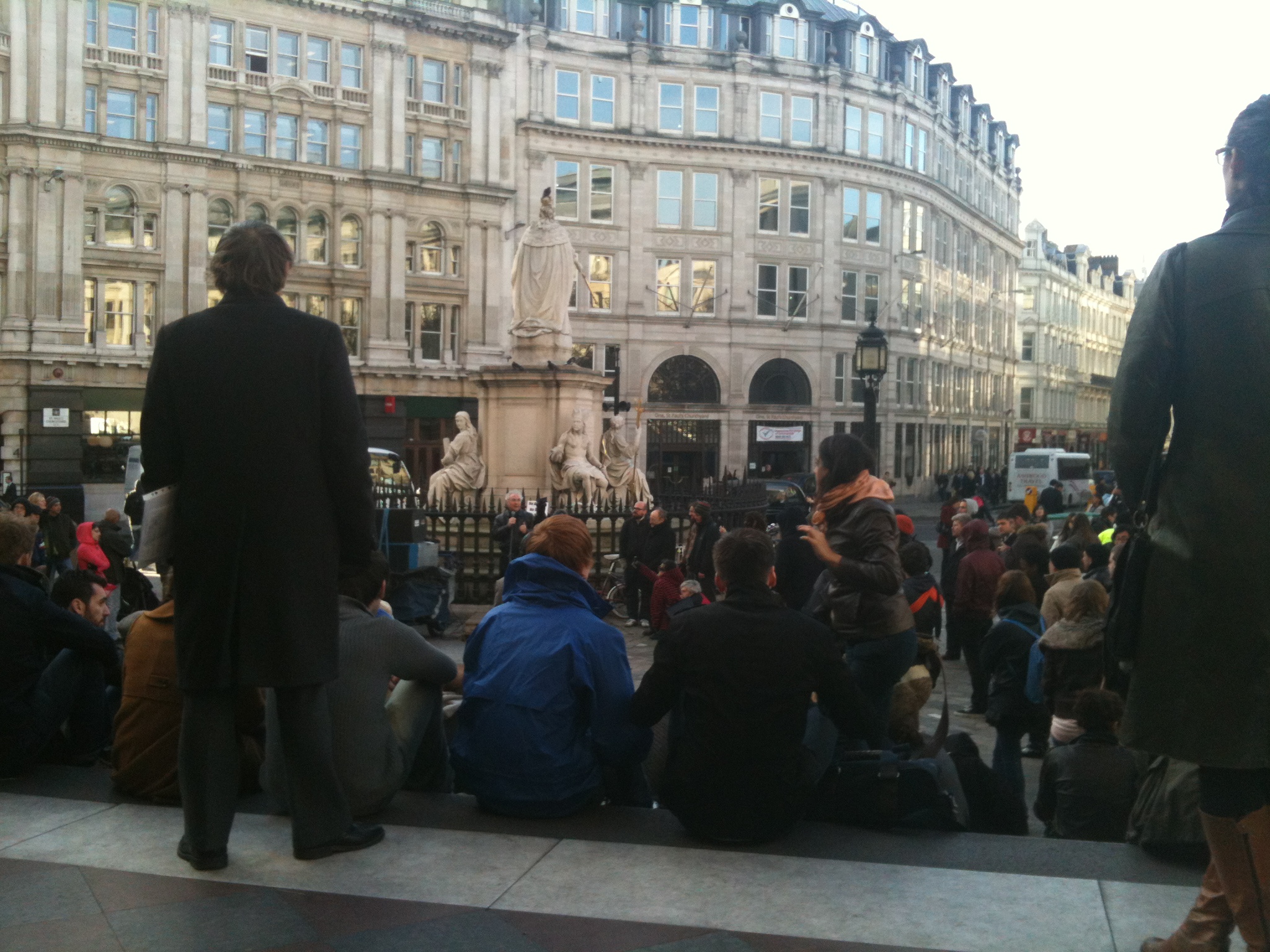
The lunchtime crowds listening to Manuel Castels
Following Castels was the daily meeting of the General Assembly. I must admit that I haven’t been following the political structure of the Occupy movement closely. While I have been reading the media, I haven’t been following the actual source. Writing this blog is a way of beginning to put things into a perspective for myself. Those of you reading the blog in other countries will have heard other stories, and may have other responses to the movement. But I am impressed by the intelligence and innovation of Occupy London, and by their honest desire to work from a consensus basis.
Having had my own experiences trying to operate an organization through consensus, I know how very difficult it is to get anything done in this way. So I was really encouraged to hear that there are daily facilitation training sessions to help people to learn how to keep the “flow of information and the flow of action though the consensus process”. They recognize that the Occupy movement represents all segments of society and therefore there will be many different perspectives and beliefs. But as one speaker from the General Assembly said: “Deep political disagreements shouldn’t prevent us working together”.
It is, as a journalist recently remarked, a very young movement, one that is still finding its feet. Yet it is already a complex societal structure, with a plethora of different working groups (ranging in topics from finance to health to media). Looking at the calendar of events for next week, I can see a full schedule of presentations and open discussions on such topics as “social dreaming”, “overcoming negativity” and “the misery of job insecurity – a catalyst for social change?”.
Perhaps most surprisingly, and most excitingly, every effort is being made to remain inclusive. There were recent media statements about “undesirables” at the camp site. An offensive article in the London Evening Standard with the headline: “Needle bins at St Paul’s camp to beat junkie health hazard“ prompted a statement from the camp: “We have never sought to hide the fact that some of the more vulnerable members of our society have sought solace at our camps, not so much for the food and shelter we provide as for the sense of community we have established in contrast to their experience in wider society.”
What I saw at LSX was noble, and fascinating. It seems clear to me that we are witnessing the birth of a new form of political expression that will use the internet to reach its ultimate manifestation, whatever that may be. Hopefully it will be a peaceful revolution.
“Occupy London is a place where everyone is valued for what they contribute to our society and everyone is encouraged to participate in that society to the best of their ability. We are very clear about the standards we expect but we are, above all, inclusive. That is something to be proud of.”
The Leonardo Da Vinci show at the National Gallery, “Leonardo Da Vinci: Painter at the Court of Milan”, is billed as “the most complete display of Leonard’s surviving paintings ever held” and has been the talk of the town since it opened. Advance tickets were sold out immediately, but the Gallery reserved 500 tickets per day, released on the day. The box office opens at 10:00 a.m and you are advised that you’ll spend about an hour and a half in line.
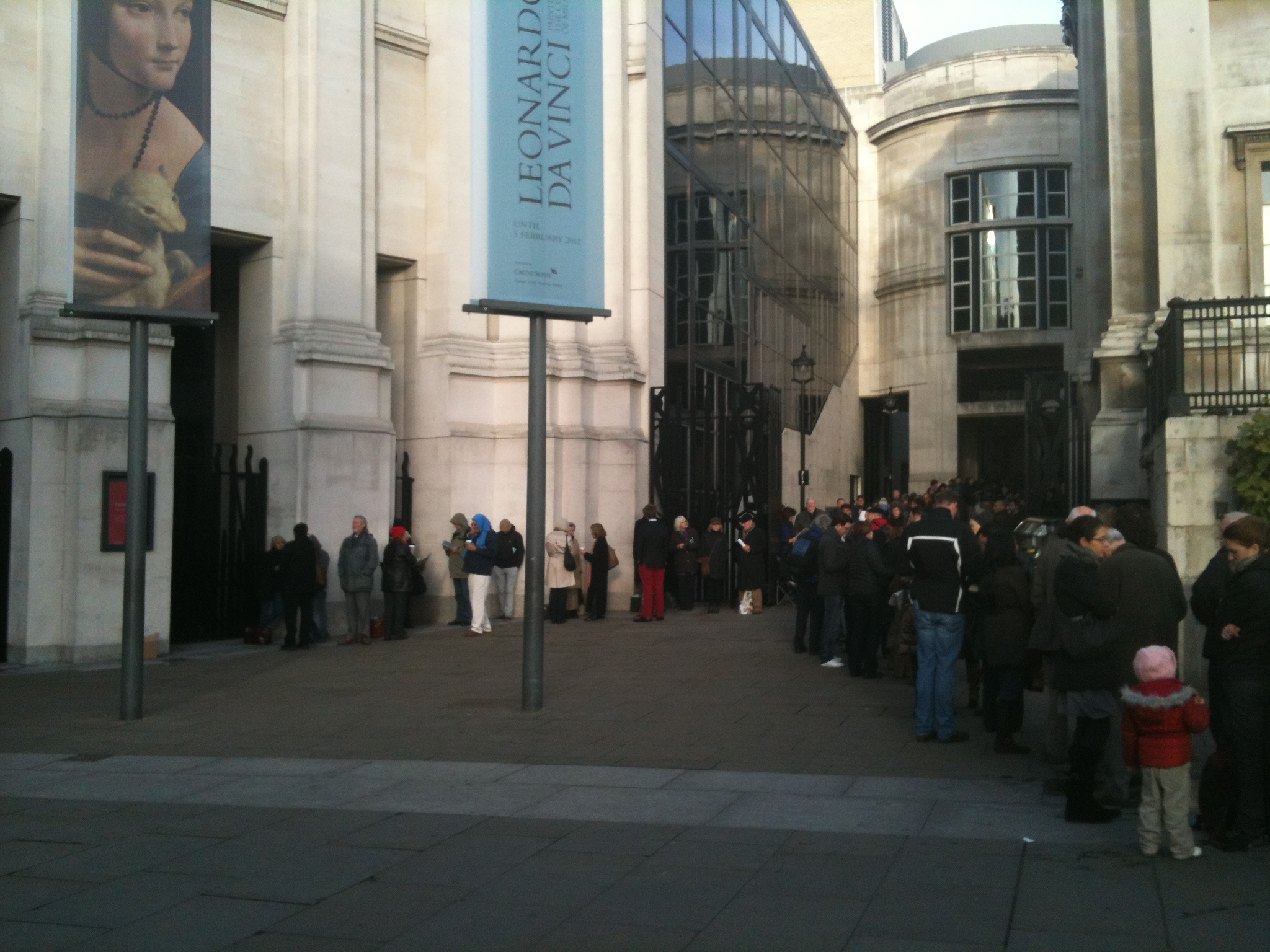
Tim got to the Gallery at 8:00 a.m. and there was already a good line up. He was told that he would get numbers 84 & 85, so he settled into coffee and chat with others in the queue, shivering in the November wind.
By the time that I arrived at 9:30, with more coffee, there were over 400 people in line.
The line up at 8:00. It goes way back under the archway
There was a vendor selling coffee and breakfasts, gallery staff giving everyone regular up-dates, and reading material about the show was provided to help us while away the time. The English really do know about queuing and there was an atmosphere of camaraderie and friendship.
We got in to see the show at 11:00. Inside, it was easy to feel claustrophobic. You could really only see the pieces by staying in the flow of the line up, moving slowly along the walls. I allowed myself to go into a calm state, reading the information, spending as much time as I needed with each drawing and painting, the crowd sometimes moving past me like a river gently bumping past a stone.
The show was a revelation. “The Lady with the Ermine” is hailed as the “second-most famous woman in Leonardo’s life”. It’s an astonishing painting of Cecilia Gallerani, 16-year old mistress of Ludovico Sforza, Da Vinci’s patron. In the painting, she is gazing off to the side, an ermine in her arms. It’s a provocative and mysterious portrait. She and the ermine (the symbol of purity) are said to be looking at Ludovico off stage, the light in the painting emanating from him. It is the first time that the painting has been exhibited in Britain and she is definitely the star of the show.
My favourite piece is “The Burlignton House Cartoon”, an unfinished drawing of the Virgin Mary, sitting on her mother’s lap (St. Anne) with the infant Jesus and St. John the Baptist beside them. There was a beautiful sketch of the same scene as well. The great maternal love in the pictures makes me weep. He catches a beautiful, human, relationship between Mary and her baby that is timeless.
There was a fabulous display of his sketches for the saints in The Last Supper. Da Vinci stressed the importance of gesture to show character: “A good painter is to paint two main things, namely, man and the working of man’s mind. The first is easy, the second is difficult, for it is to be represented through the gestures and movements of the limbs”.
A quote from his notebook reads like a playwright, taking notes. You get a vision of Milan, 1493, as Leonardo was contemplating gesture and groups of people: “One who was drinking and has left the glass in its place and turned his head towards the speaker. Another, twisting the fingers of his hands together, turns with stern brow to his companion. Another with his hands spread open shows the palms, and shrugs his shoulders up to his ears, making a mouth of astonishment. Another speaks into his neighbour’s ear and he, as he listens to him, turns towards him to lend an ear, while he holds a knife in one hand, and the other the loaf half cut through by the knife. Another who has turned, holding a knife in his hand, with his hand a glass onto the table.”
We left the Gallery feeling very full.
Having feasted our eyes, we decided to go to St. Martin’s-in-the-Fields for an evening concert as part of the “Just This Day” project. “Just This Day” is dedicated to promoting “Stillness” and in particular, “Silence in Schools” Apparently, recent studies show the benefits of “strong silence”, a deliberate and focussed stillness, to include higher exam results, increase in self-esteem and a decrease in negative behaviour.
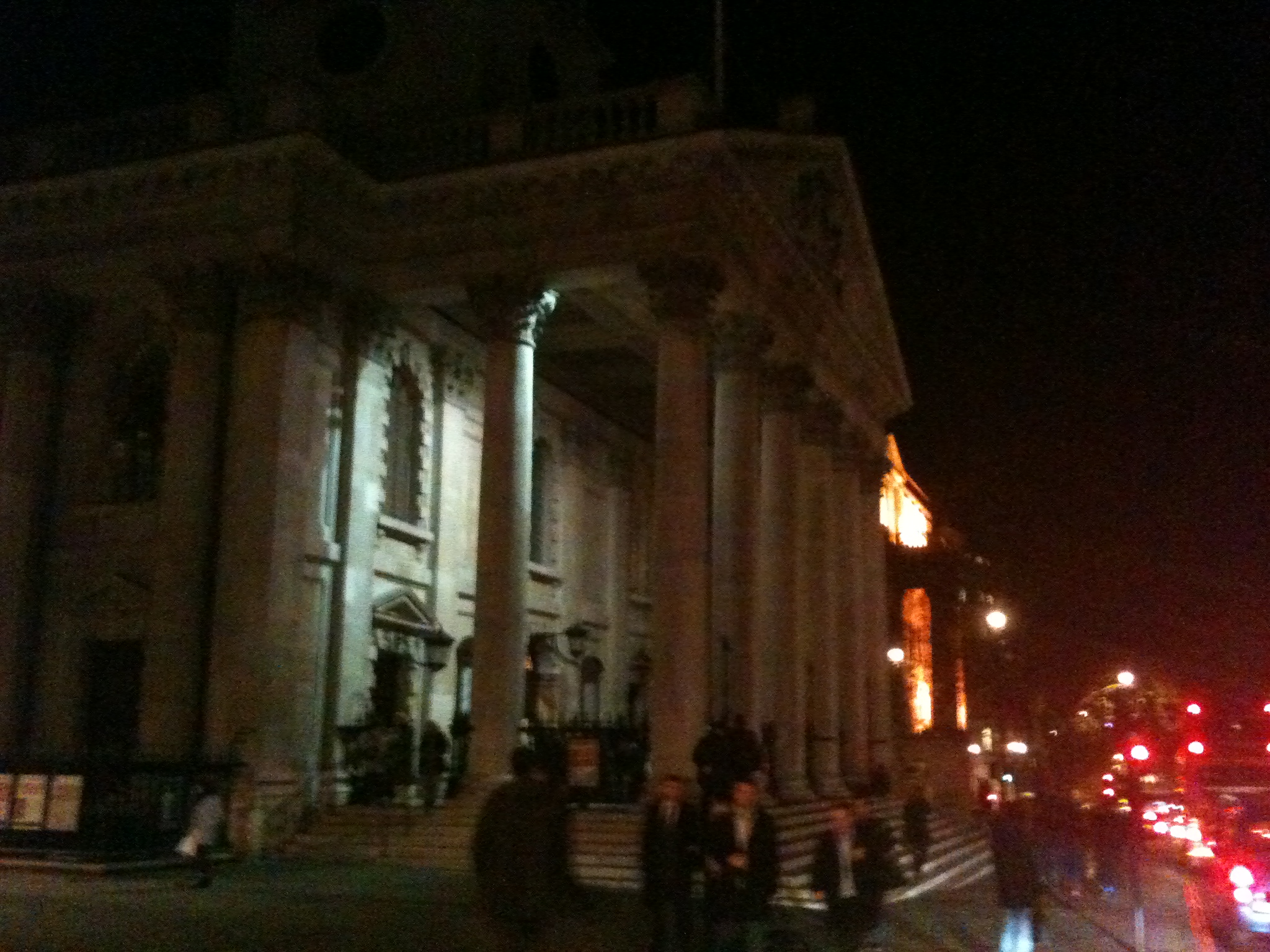
St. Martin’s is in the heart of busy London, yet is known as an oasis of calm. The church was hosting “Just This Day” — a day of silence and discussion of stillness. But we knew none of this at the time. We just arrived. As the concert began, we were requested to sit, and feel the stillness. Why is it that stillness feels so much more profound when it is enjoyed together with several hundred other people?
Outside St. Martin's-in-the-Fields, after the concert
We were treated to an evening of music by Arvo Pärt sung by the “Choral Scholars of St. Martin’s-in-the-Fields” and played by the Ceruti Quartet. There was early Renaissance music sung by Dame Emma Kirkby and played on the lute by Jakob Lindberg, and a piece by contemporary composer David Stoll, “The Practice of Mediation”. It was all sublime. Music of the spheres. Spiritually uplifting.
We walked back to Waterloo station over the Millenium Bridge, the lights of the southbank reflecting in the water, happy and still in the middle of the city.
After a morning exploring the treasures at the Marche des Puces in Restigne, Bryan, Peta, Tim and I drove to Bel-Air. Our task for the week was to wash all of the inside beams, and to put everything away for the winter. Although we arrived to a cold house, we got the wood stove burning and it was soon it toasty and warm.
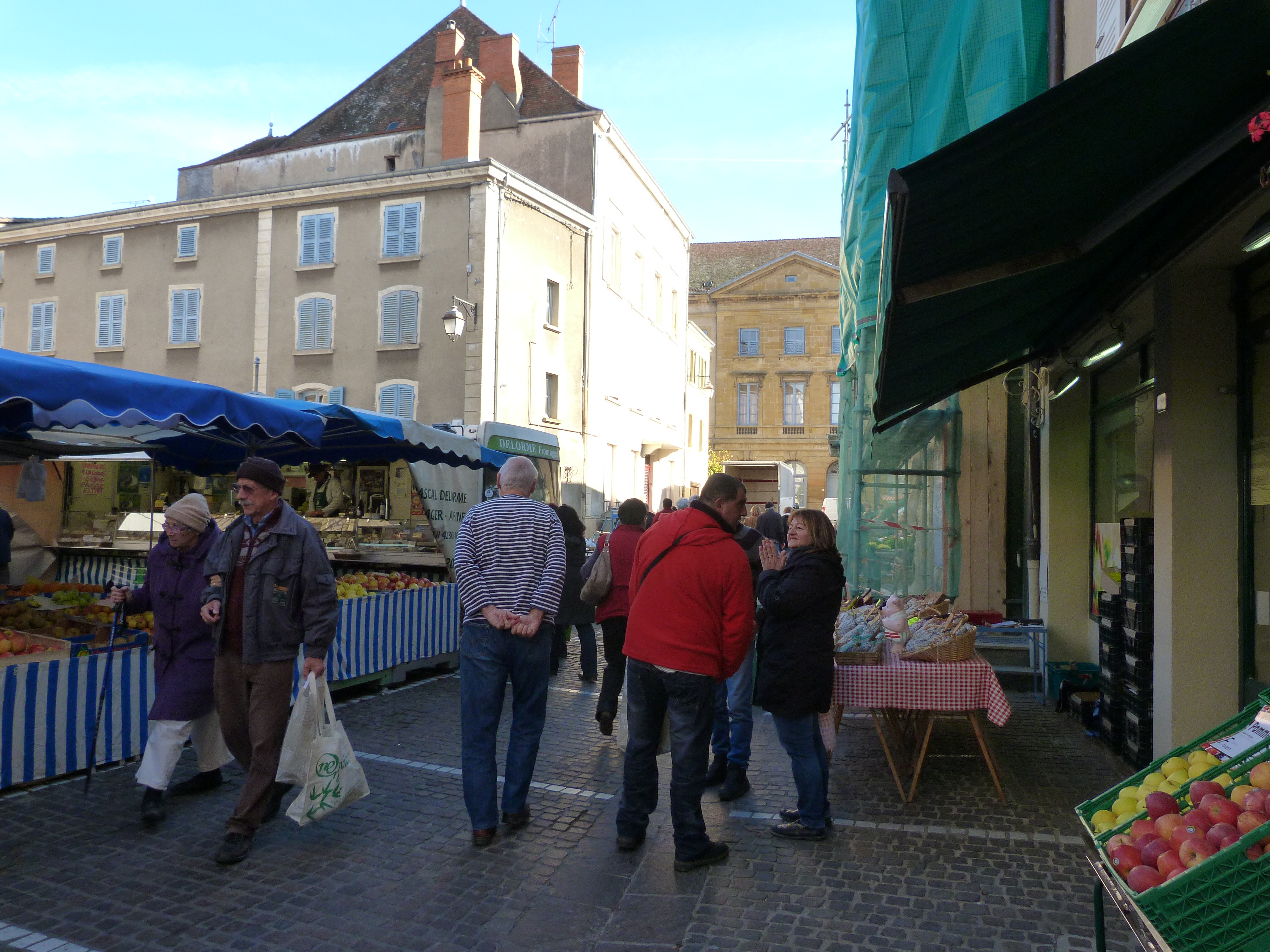
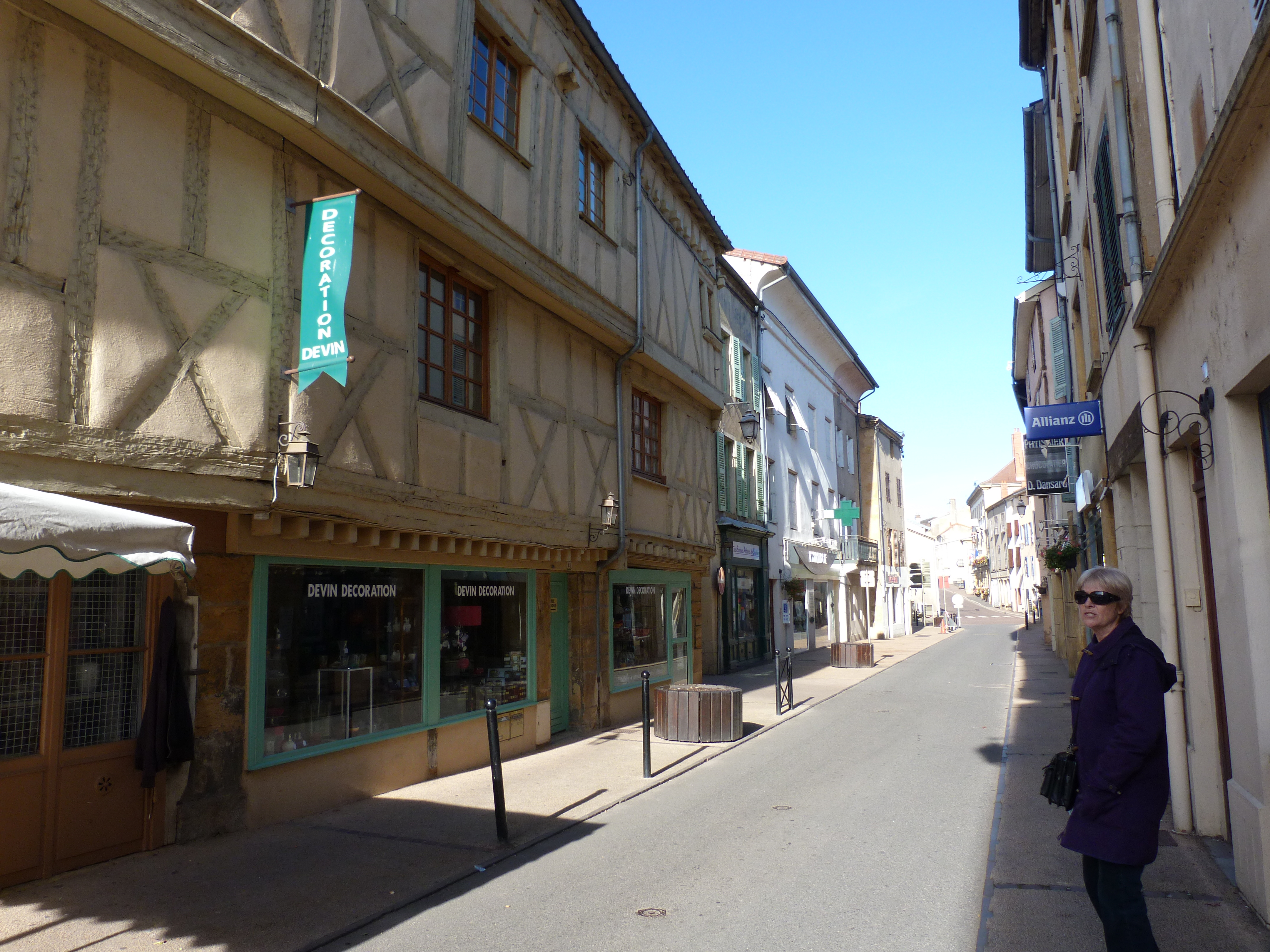
Of course the best part of being in France is market day. Mondays are market days in Marcigny, a little village of about 2,000 people, about 20 minutes away. The town has beautiful architecture that is well looked after.
The market in Marcigny
The Marcigny market is my favourite thus far. It was small, yet filled with stalls of delicious foods. Huge lettuces, about the size of the largest platter in my kitchen. Every vegetable imaginable – incredibly fresh and healthy-looking. A cheese vendor who sold the most remarkable Cantal Entre Deux (my new favourite – it’s a semi-hard cheese that is savory and earthy), a chèvre, aged, dry and nutty, and a runny, creamy something covered in ash that we didn’t get the name of but which we fought over with a passion. We bought some saucissons (dried sausage), selecting one with wild boar and one with Myrtille berries, and some delicious, dense whole wheat baguettes. Clothes, CDs, handbags mixed with food stalls wafting the delicious smells of paella, roast pork and cooked potatoes. Bryan decided to splurge on a treat that he has always wanted to try – Calamari Farci, calamari stuffed with vermicelli, mushrooms and spices. (Good, but not great. An unusual choice for a French market, but reflecting a Vietnamese influence perhaps). We walked by rabbits, pigeons, chickens and budgies in cages. Peta and I found cute winter hats, 2 for 10€ (about $12), perfect for the cool fall air.
It was about 11:00 in the morning when we finished, and we popped into a café for coffee to warm us up. Most of the people at the other tables were drinking small tumblers of white wine. By the time we left at mid-day, the market stalls had been packed up, and people had vanished from the streets.
Marcigny and Peta. Everyone has gone home to have lunch.
Our days at Bel-Air were spent scrubbing and cleaning, except for the day we were invited to lunch at Suzanne and Christian’s. Their friends Monique and Jean Michel were also visiting, and the meal certainly stretched our meager French to the limit. Both Tim and I feel constantly embarrassed by our lack of French, and are very shy in social settings. However, along about the third bottle of wine, both we began to understand far more of what was being said, and were able to contribute with more enthusiasm (but with just as many faults!).
Suzanne served us appetizers (salted cashews, spicy crackers, slices of a bread, like a brioche, with ham and cheese) while Christian served Crémant. First course was a delicious seafood tarte, with a dollop of mayonnaise, olive and an Auxerrois wine (Vin des Fossils, 2010) from the Loire. Everyone we have visited in France is proud to share local produce with us, and it is one of the great pleasures of the trip to be able to try so many new foods and tastes. Suzanne and Christian had just returned from the town of Charlieu with a specialty from the Loire – Andouille. Andouille is an aged sausage, made from, as far as I can tell, the neck and lungs of pork, and possibly beef as well. It is a very old recipe, carefully guarded. “Une recette tirée des grandes traditions gastronomiques Charliendines qui date de la nuit des temps, des hommes fidèles et rigoureux de cette douce alliance vous garantit ce résultat exceptionnel.” (which translates roughly as: “A recipe drawn from the Charliendines culinary traditions, which date from the dawn of time. Add to this men faithful and rigorous, and the combination guarantees this exceptional result.” The translation is rough, but so is the original!) Suzanne served the Andouille with the traditional boiled potatoes, and sauerkraut cabbage casserole. The Andouille had a dark, extraordinary flavor. Deep, slightly smokey and aged. Like nothing I have ever tasted. Served with a special Macon-Cruzille, 2008.
The entre was followed by the cheese platter (another new favourite – Délice de Bourgueil – an amazing creamy cheese, somewhat similar to the St. Andre that we get at home). The meal was topped off with chocolates and coffee. There were other wines, other tastes. Too much for my already struggling brain to remember. Local foods, local wines, new friends who are very much of the terroir. A lunch from which we rolled home around 5:00 p.m.
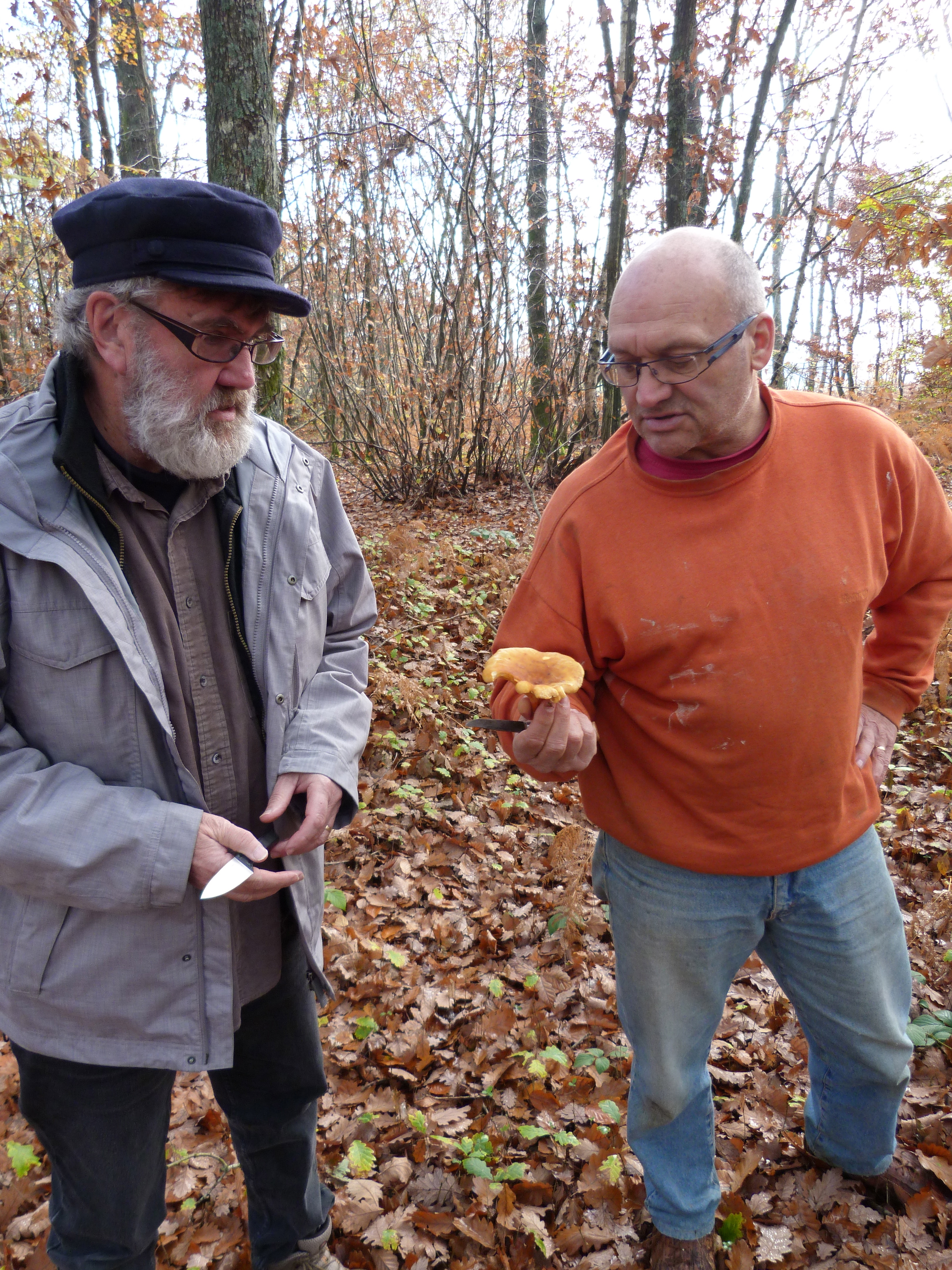
Understandably, we needed a good walk the next day. The weather was lovely, and Christian offered to take us mushrooming in the nearby woods. Finding mushrooms is akin to the proverbial needle in a haystack – at this time of year they are buried beneath mounds of fallen leaves, often camouflaged the same colour. The day started promisingly, with a large Chanterelle – a mushroom that Christian knows well.
Christian shows Tim a Chantarelle
But although we found many mushrooms after this first, they were mostly inedible and potentially poisonous. However, they were very beautiful and unusual (I never knew that there were mauve mushrooms!) and after a while we developed a “catch and release” attitude. The joy of being out and tramping directionless in a fresh wood made the adventure rich in every detail.
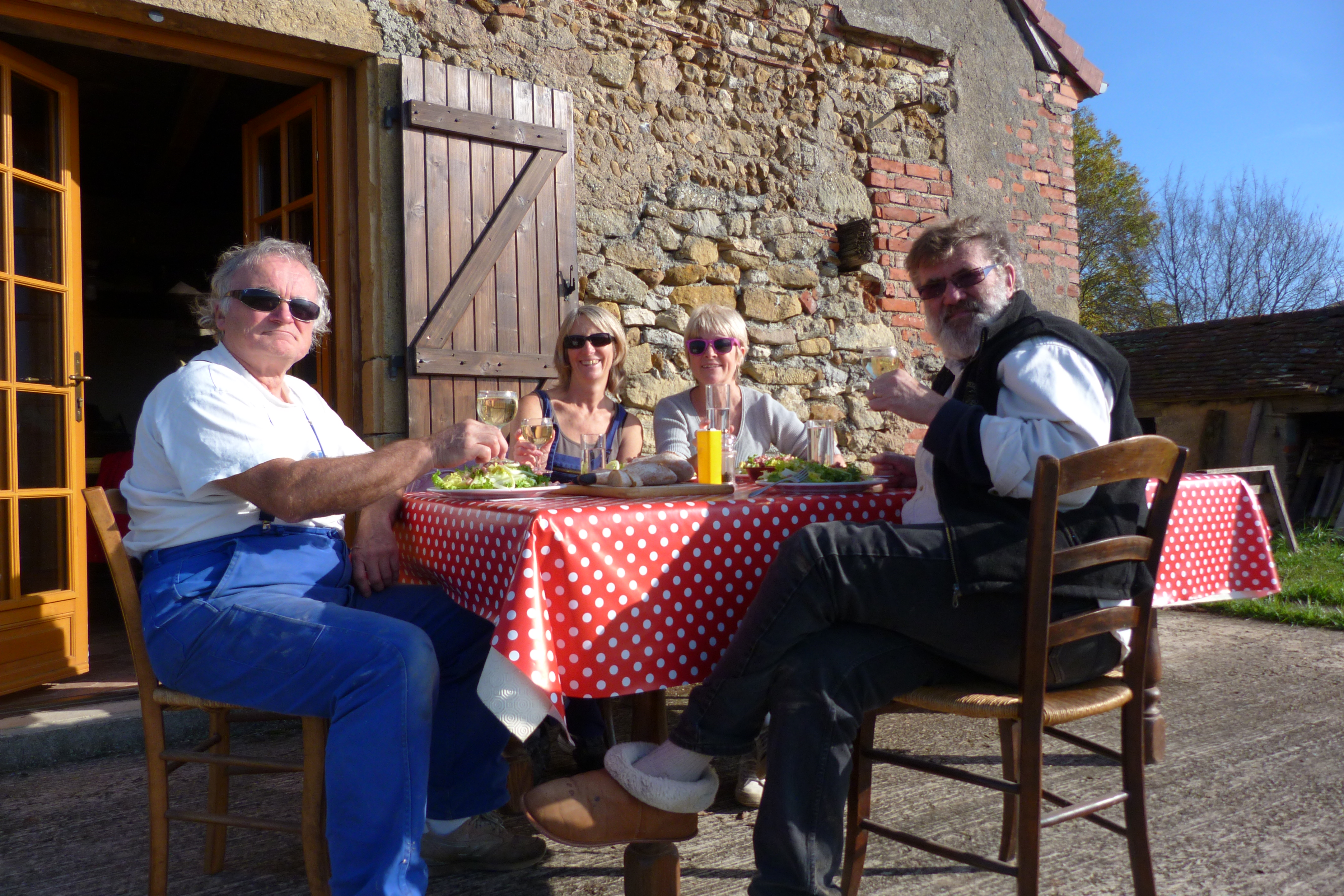
The next day, the last of our week’s visit, the weather went from nice to spectacular. Unbelievably for late November, we took the big kitchen table out into the sunshine and had a lunch of Frisée salad and white wine, basking in the hot sunshine and overlooking the fields of Burgundy. The grey skies of London seemed a very long way away.
Peta and Bryan invited us back to France, to help close up the house for the winter. The trip coincided with a visit to friends in the Loire area, in a small village called Restigne. We were thrilled to be invited to see another part of France with new culinary, and vinicultural, treasures.
Françoise and Pierre live in a house that they have marvelously restored, complete with courtyard, gardens and guesthouse.
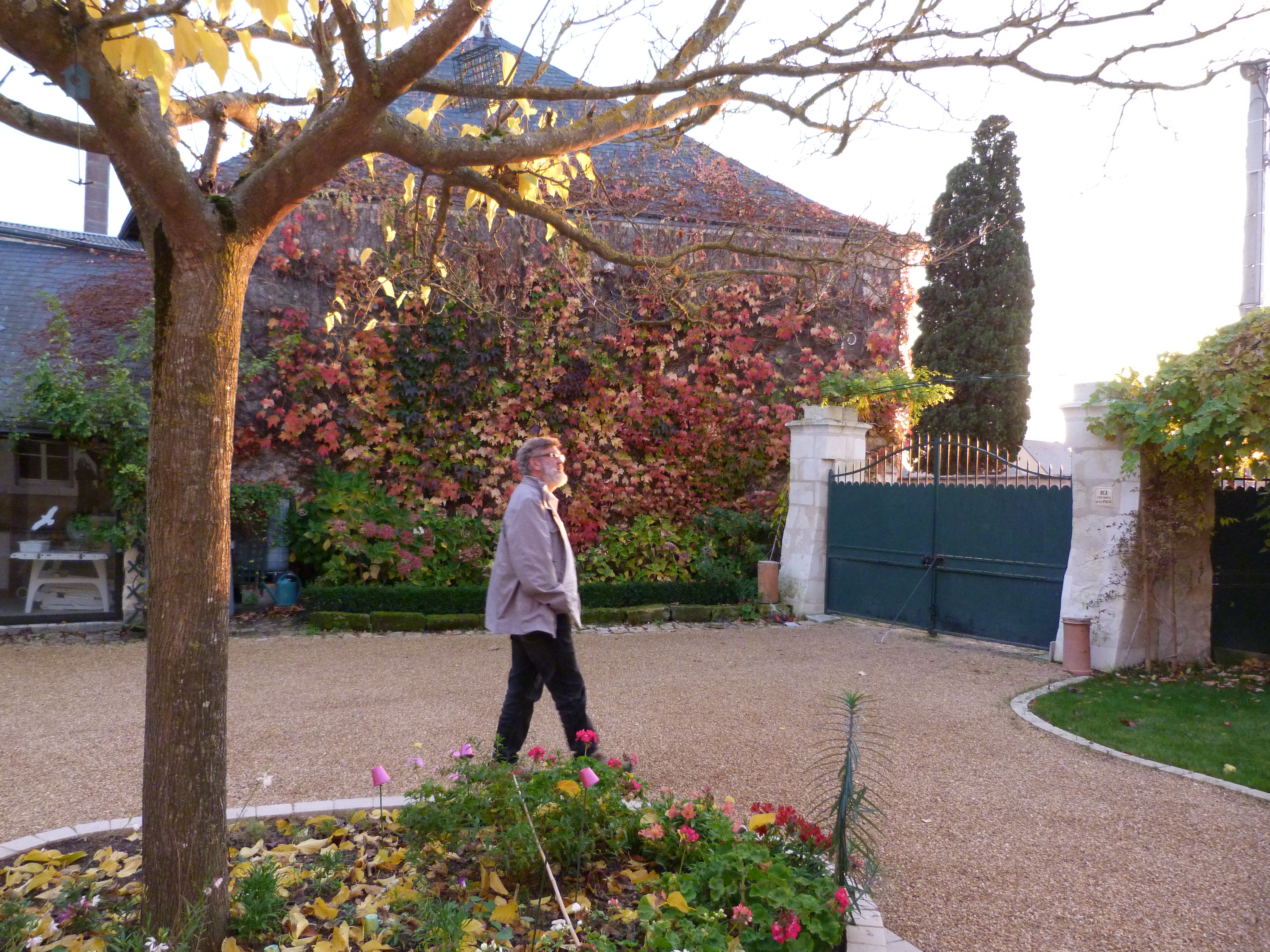
Tim in Françoise & Pierre's courtyard
Restigne is only several streets long and surrounded by vineyards.
The main corner of Restigne, with sign posts to local vitners
The nearest city is Tours, and Françoise offered to take us there so that we could go to a craft show to see the work of local artisans.
I have participated in a number of craft shows myself, and I was really intrigued to see the similarities, and the differences, at L’Art au Quotidiens in Tours.
Amongst the many wonderful potters, jewelers and clothing designers were fine furniture makers and restorers able to appropriately re-paint or re-plaster your 16thcentury home. The show was housed in the Vinci Centre International de Congrès, a contemporary building in the centre of town. In the middle of the building there is a large, ultra modern theatre, which was converted to a restaurant for the duration of the craft show. Large tables were set up on the stage where we had a lunch of an extensive salad buffet, hot entrees and seemingly endless glasses of white and red wine. A pianist played American jazz standards on a keyboard set up in the theatre seats. The French really do up a craft show in style.
Our lunch on the stage of the theatre
I have always wanted to visit Tours because of a beautiful manuscript that I studied many years ago, done by Alcuin of York in the 9th century at the monastery of St. Martin of Tours. It is one of the most graceful of the Carolingian manuscripts and is one of the reasons why humanist lettering styles are as appealing as they are.
The cathedral in Tours
Tours did not disappoint. It has a lovely old centre and on this warm November bank holiday (Armistice Day) there were hundreds of people out walking. Françoise told us that people are always out strolling in Tours.
Tim and Bryan in Tours
It’s a very friendly atmosphere. We stopped for coffee in the square, so that we could watch the world pass by.
Back in Restigne, the village is only large enough to support a single Boulangerie, a Charcuterie and a small chapel. But once a year the village is home to a mammoth Marche des Puces, and we have come to help Françoise organize her stall. But before we got started with collecting treasures from the attic and guest house, Françoise took us to see the caves outside the village.
Seven hundred years ago, when people started building in this area, they found large deposits of limestone from which they could easily cut blocks for their houses and Chateaux. They soon realized that when they took the blocks out, they were creating useful spaces. These spaces became caves used for storage, and in times of war, entire villages hid in the caves with their livestock. Today, the caves are still in use by the local vitners. Thousands of bottles can be stored at perfect temperatures. Aside from wine storage, caves are also used for a huge wine industry, as well as large (and rather legendary) parties and often for extra living spaces.
Françoise took us out of the village.
The vineyards outside Restigne
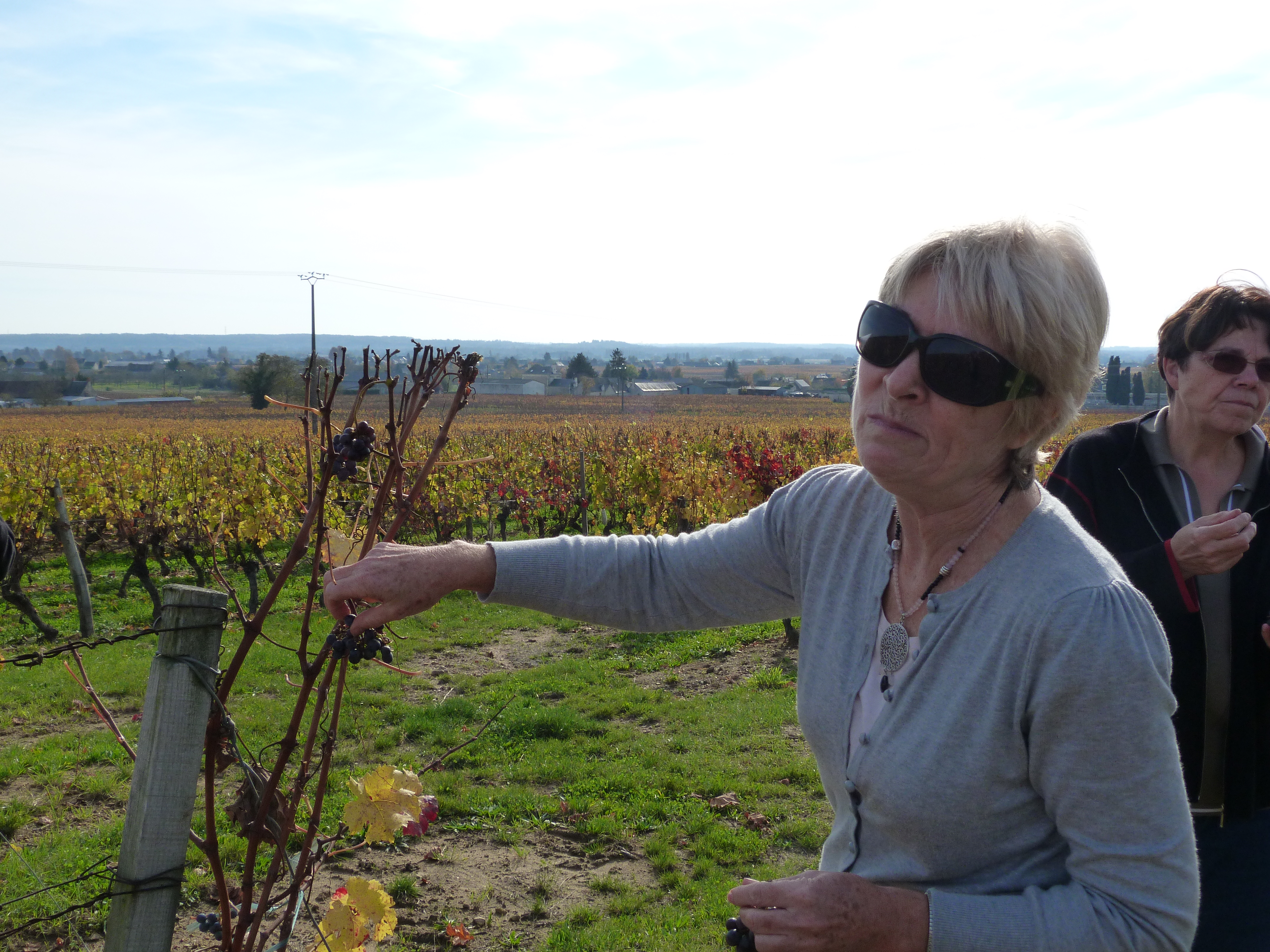
There are vineyards everywhere. As far as the eye can see in all directions. There are a few bunches of grapes left on the vines. They are sweet and warmed in the autumn sunshine.
Peta sampling the grapes in the sunshine
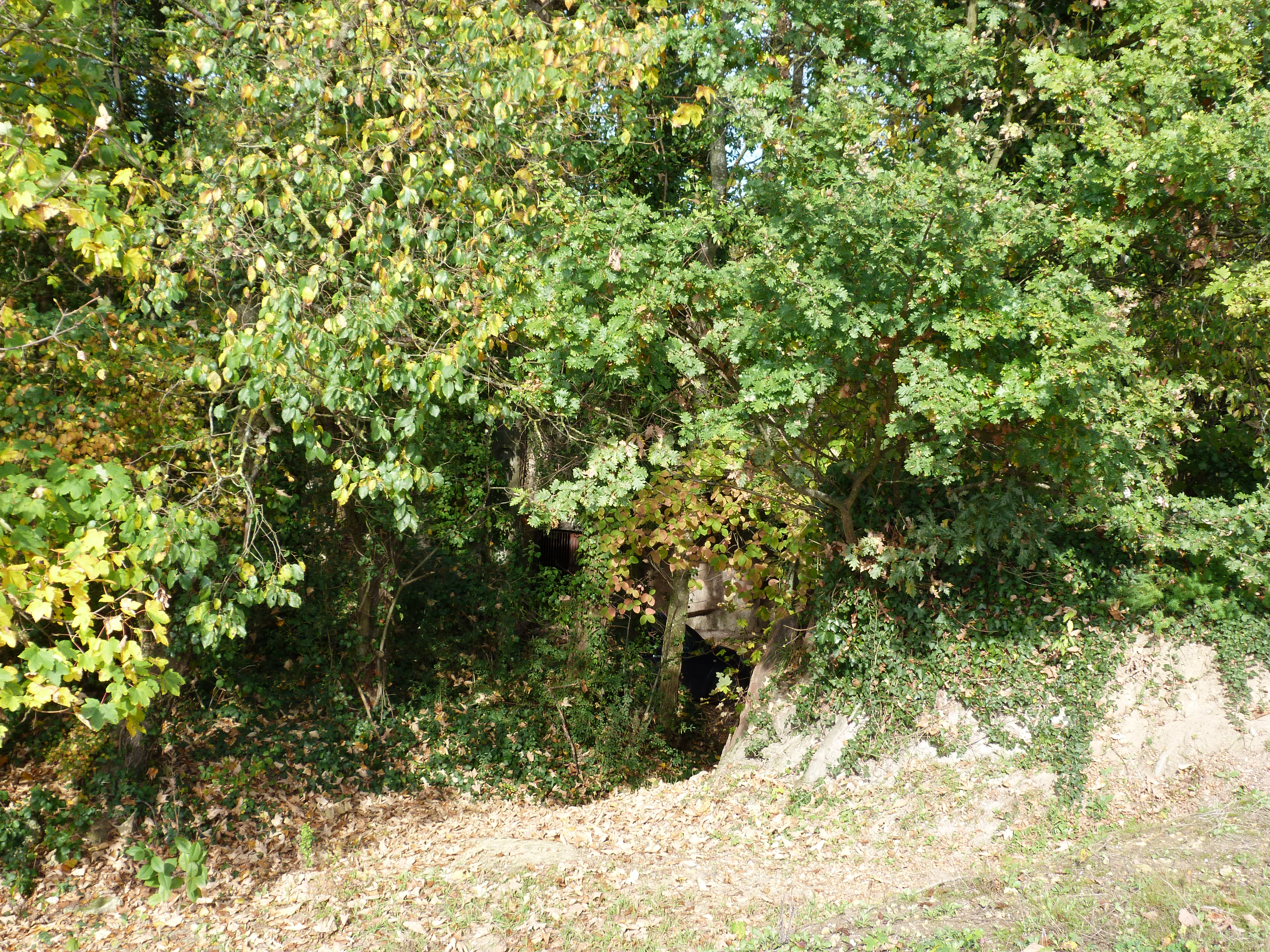
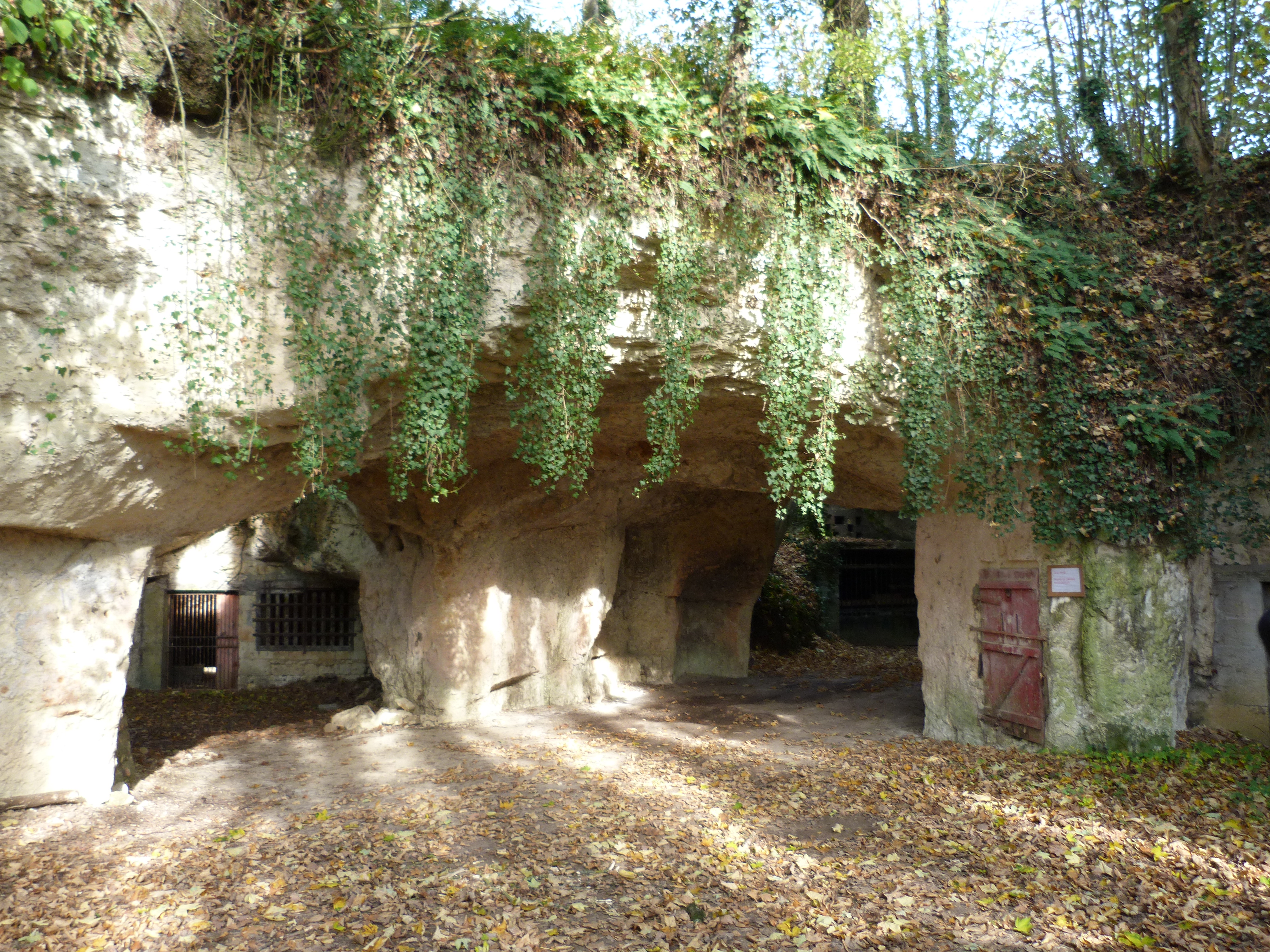
Along the sides of the fields, invisible unless you know where to look, are the caves. They are completely hidden away in the landscape.
The invisible Caves, in the fields outside RestigneThe EntrancesAn archway leading to the caves
Back at Françoise and Pierre’s, we got a tour of their cave, tucked right under their house.
Dinners chez Françoise and Pierre are marvelous affairs, where we sit at table for many hours. We drank various vintages of the delicious Cabernet Franc that is made in the fields just beyond the village and stored below. There were numerous courses, concluding, always, with cheese platters followed by a dessert. As ridiculous as it may seem to bring cake to the French, I had made my favourite chocolate torte, Bonnie Stern’s California Chocolate Pecan Torte, (thanks to my wonderful friend Hinda who emailed me the recipe just in time) to give to Françoise and Pierre. Thankfully, the recipe is astonishing and the cake came up to their culinary standards. It helped that it was made with good French chocolate.
In response to my cake, the next day Pierre purchased a Galette Bourgueilloise – a specialty of the region. Where the chocolate torte was heavy and rich, this was such a light confection that you could almost believe you were eating flavoured clouds. Extraordinary. It, like the wine of the area, has an appellation controlee. Unique to the region, it is a very good reason to visit again.
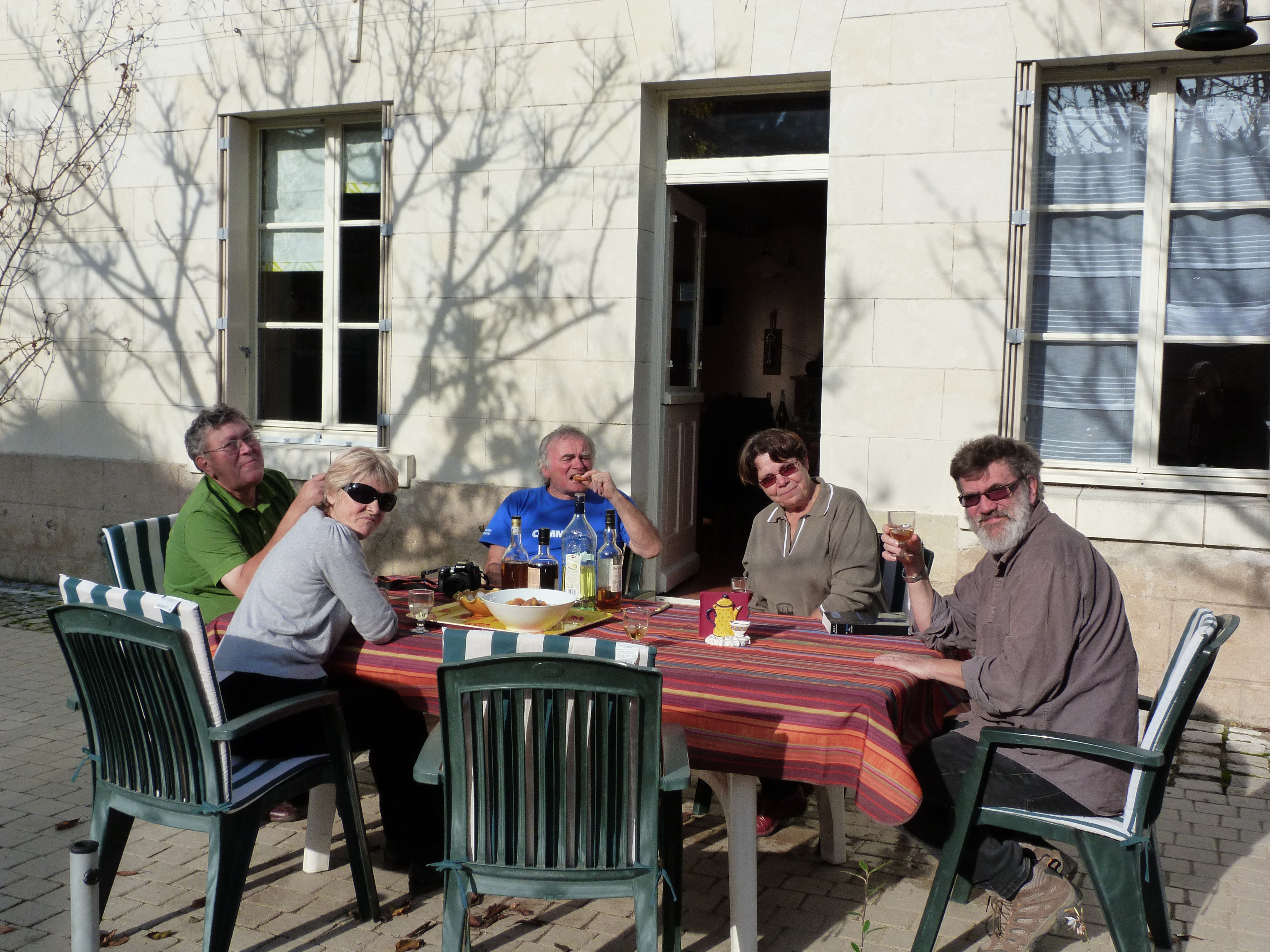
Aperitifs with Peta, Pierre, Bryan, Françoise and Tim in the courtyard in Restigne
















 Stepping off the Treadmill