It’s said that the codebreakers of Bletchley shortened the war by two years.
Bletchley Park. It is the stuff of legends. The codebreaking headquarters that changed the course of the Second World War. A place so secret that husbands and wives didn’t know of each other’s involvement. A place of mystery and of tremendous excitement. A place where imagination and scientific minds met to solve life and death problems.
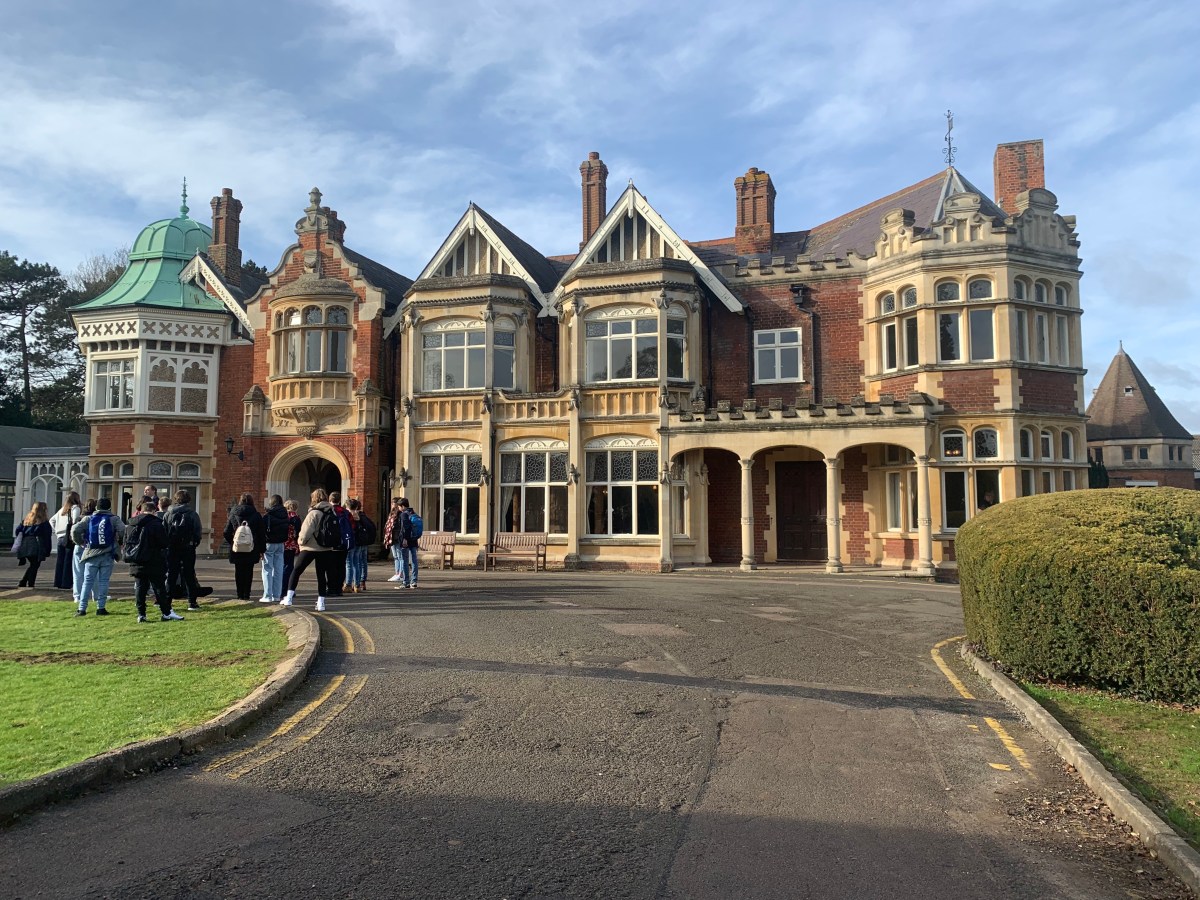
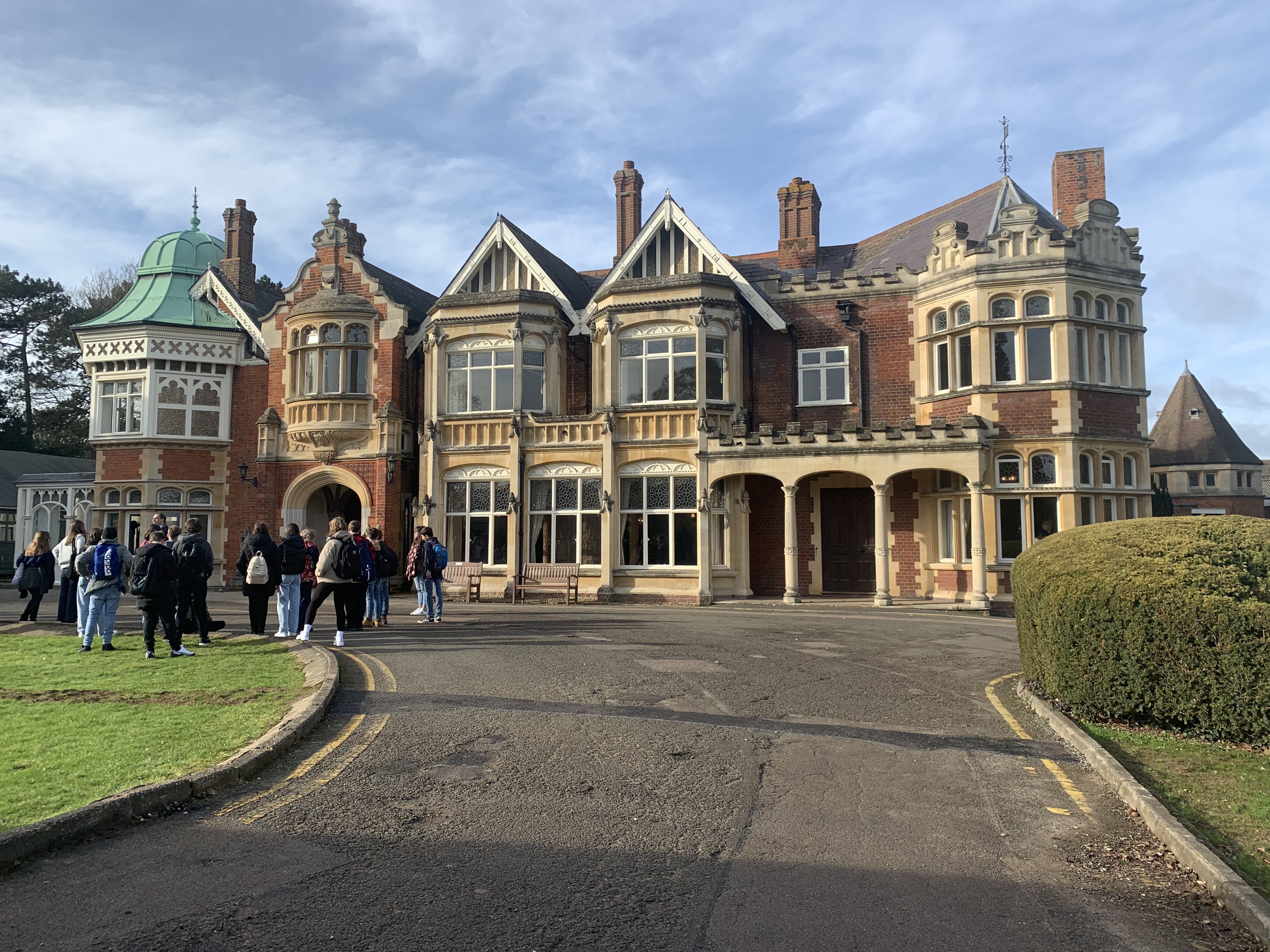
The Mansion
The British Government bought the Bletchley Park estate in Buckinghamshire in 1939 to house the Government Code and Cypher School (Actually, Admiral Hugh Sinclair, head of the Secret Intelligence Service, seems to have bought it privately to get the whole thing running –– or perhaps because he saw a good real estate deal. But that’s another story…) Initially, a small group of people, chosen for their skills with languages and numbers, were hired to work there. They were told to sign the Official Secrets Act before they were given any information. They had no idea what they were hired to do.
There were 185 people working at Bletchley in 1939. By 1945, there were almost 9,000. Three quarters of those people were women. Yet the existence of Bletchley remained a secret until 1974. Even to this day, people who worked there won’t tell you what they did.
Now, it’s a heritage national museum. Exhibits lead you through the daily processes from message reception to codebreaking and translation. Messages weren’t intercepted here – it was far too dangerous to have a radio station at Bletchley. But a team of thousands of couriers arrived day and night at the gates, bringing morse code radio messages that had been intercepted by operators throughout the country. In fact, our tour guide’s father had been one of those bicycle couriers, delivering coded messages to Bletchley.
Tim at the main gate where couriers arrived.
After the Bletchley codebreakers and translators received the message and decoded it, they needed to re-package it to make it seem as though it came from British spies. This way, the Germans wouldn’t find out about Bletchley. In fact, few people in the British government knew. It was this level of secrecy that made it a success. Something almost impossible to imagine in the age of Twitter.
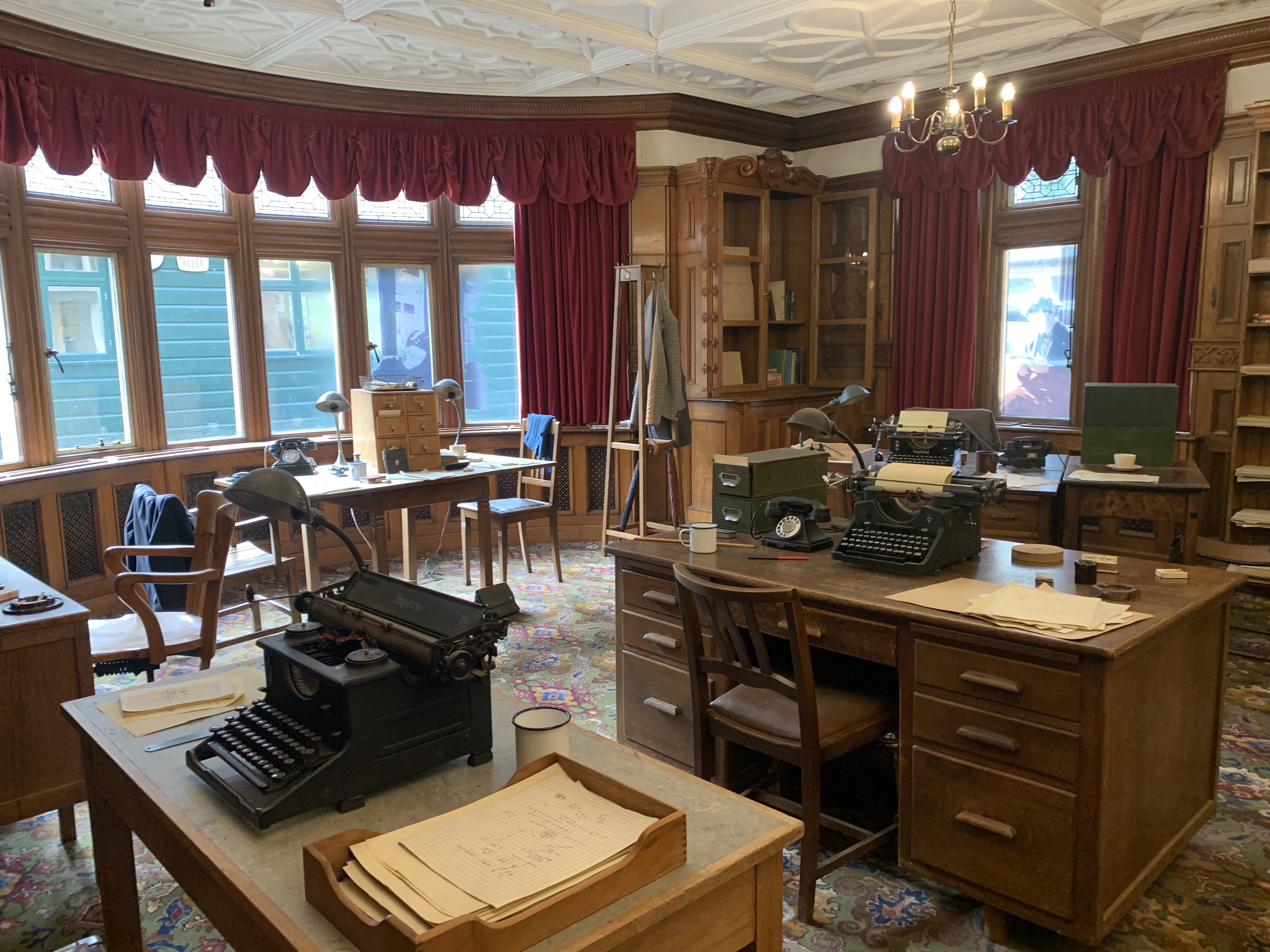
Headquarters
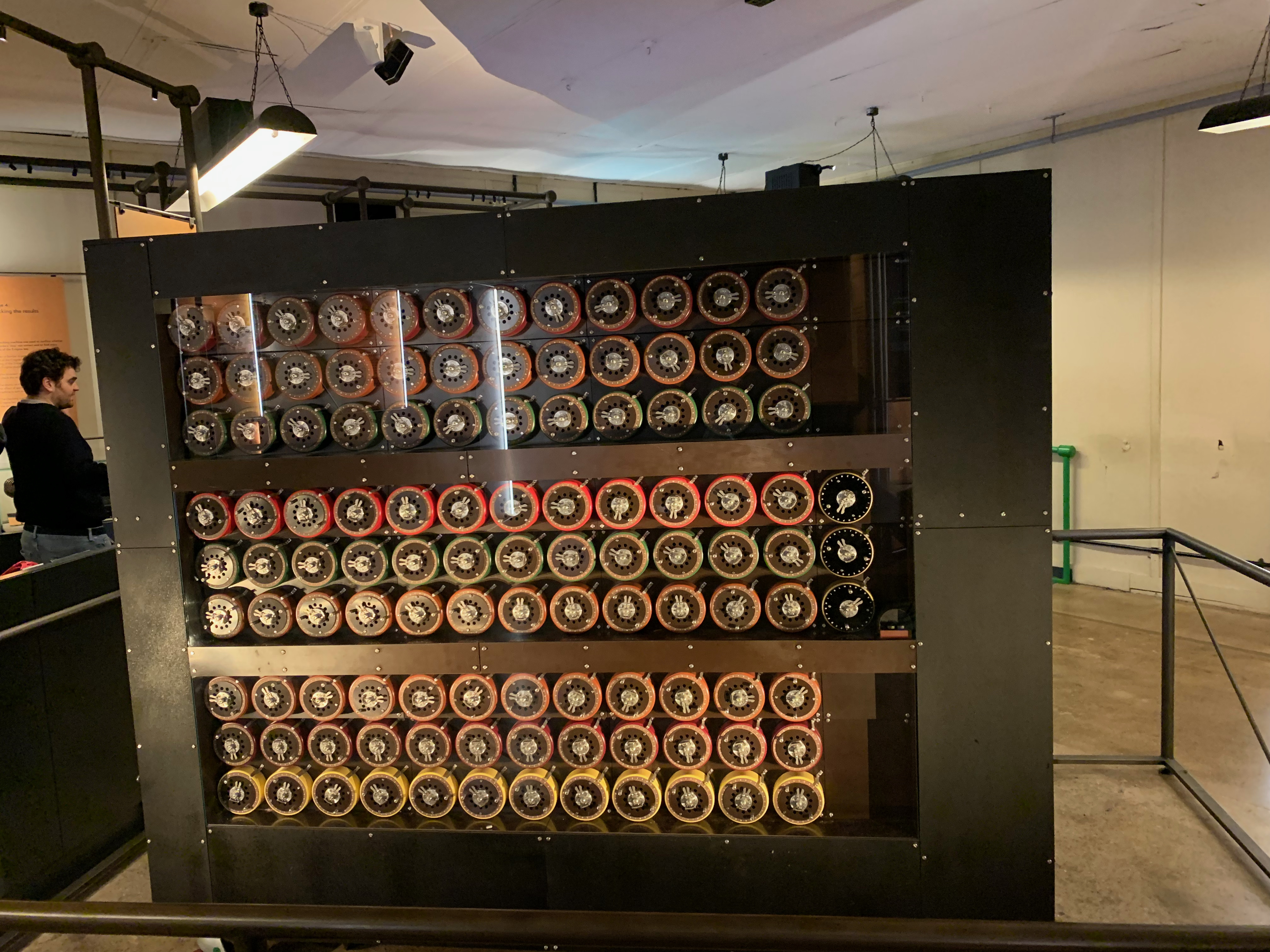
We were shown how the German Enigma machines worked to encode their messages, and how the people at Bletchley went about decoding them. By May 1945, they’d broken 21,971 Enigma messages! That was only possible because Alan Turing and Gordon Welchman designed the Bombe machine to speed things up. It ticks and whirs in Hut 11A. The Colossus, the world’s first large-scale electronic digital computer, was also invented and built at Bletchley.
The Bombe Machine
Tim and I have done our fair share of research into WW2, but our visit to Bletchley brought our reading into reality. It’s hard not to be moved and impressed by the scale and vision of this operation. It is a place filled with personal stories and with triumphs of dedication. People knew that they were saving lives, and they threw themselves into it, working night and day for five long years. It’s a story of human ingenuity that led us to a feeling of awe.
“The work here at Bletchley Park … was utterly fundamental to the survival of Britain. I’m not actually sure that I can think of very many other places where I could say something as unequivocal as that. This is sacred ground.”
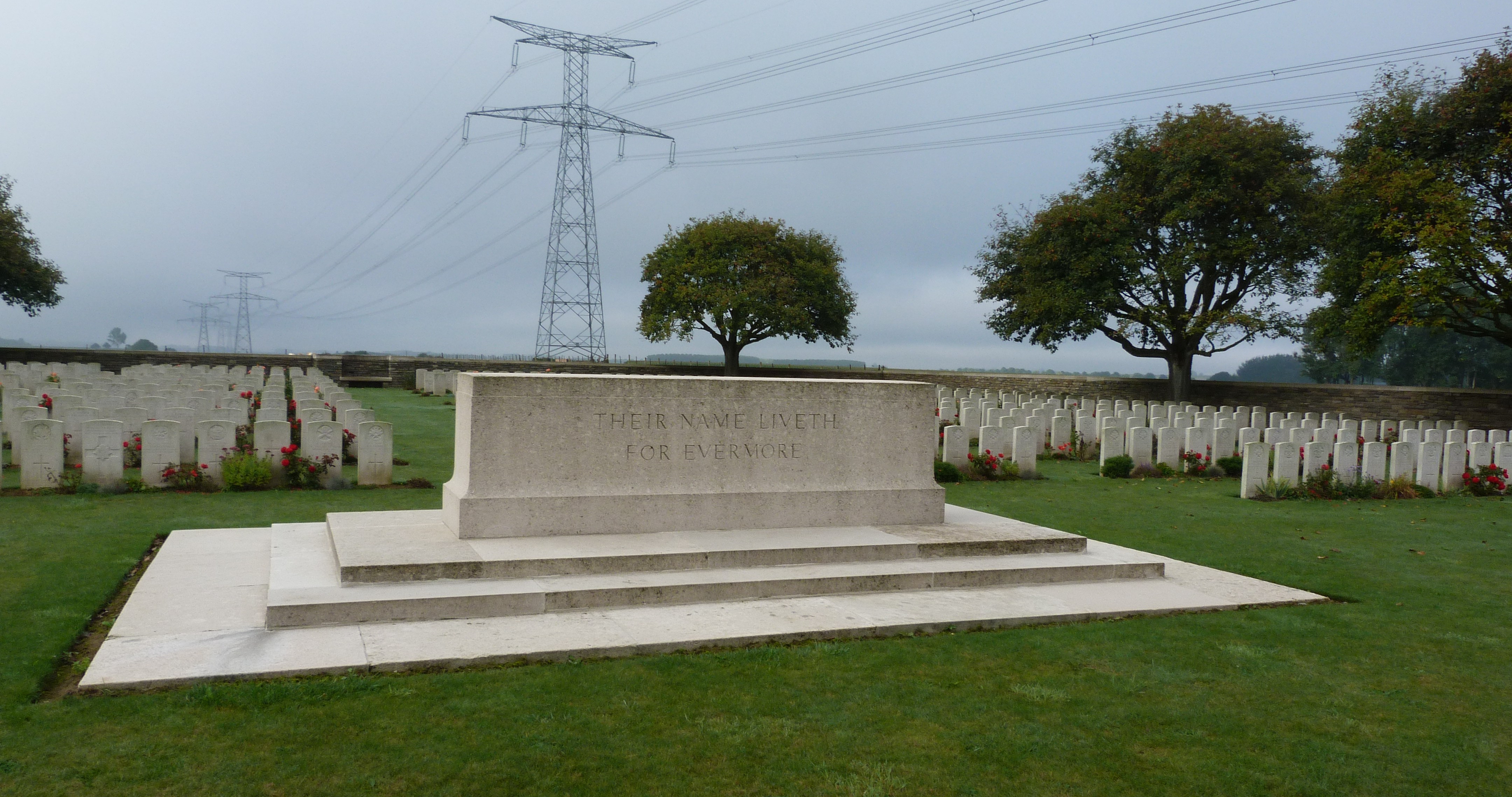
Every cemetery has a stone that states, simply, “Their name liveth for evermore.”
I’ve focused on the Allied side of the Battle of the Somme. The British led the attack, and young men from all parts of the globe were wounded, went missing or died in this pastoral landscape. 44 of the 45 memorials and cemeteries are dedicated to the Allied dead and missing.
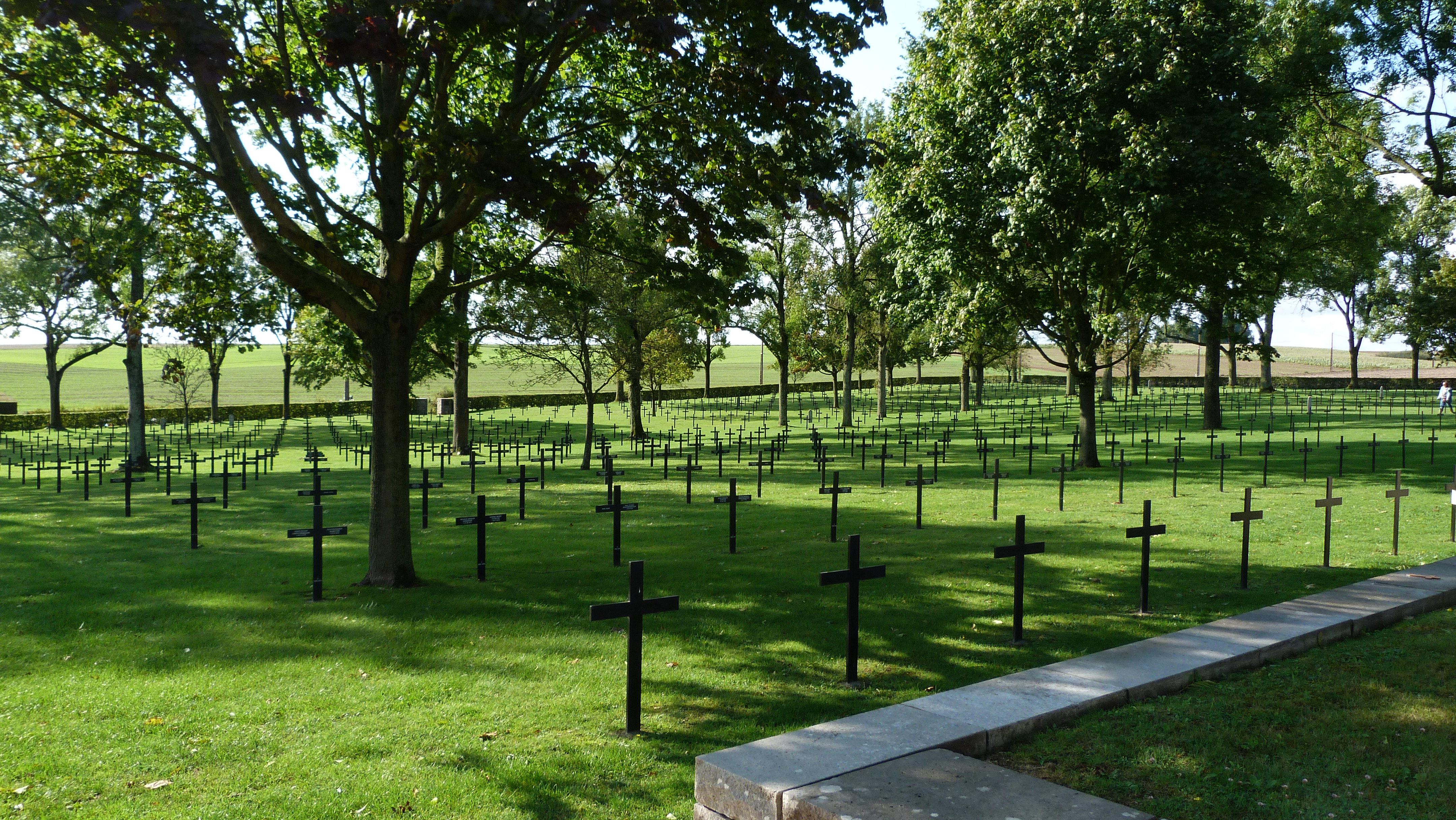
The cemetery at Fricourt is the final resting place for 17, 026 Germans who died in the battle of the Somme. It is quiet and moving, and, I suspect, not often visited by the British or French.
The German cemetery at Fricourt
But these crosses have their own stories to tell, stories of young men doing what they were told, following their leaders into battle just as the British and French men did.
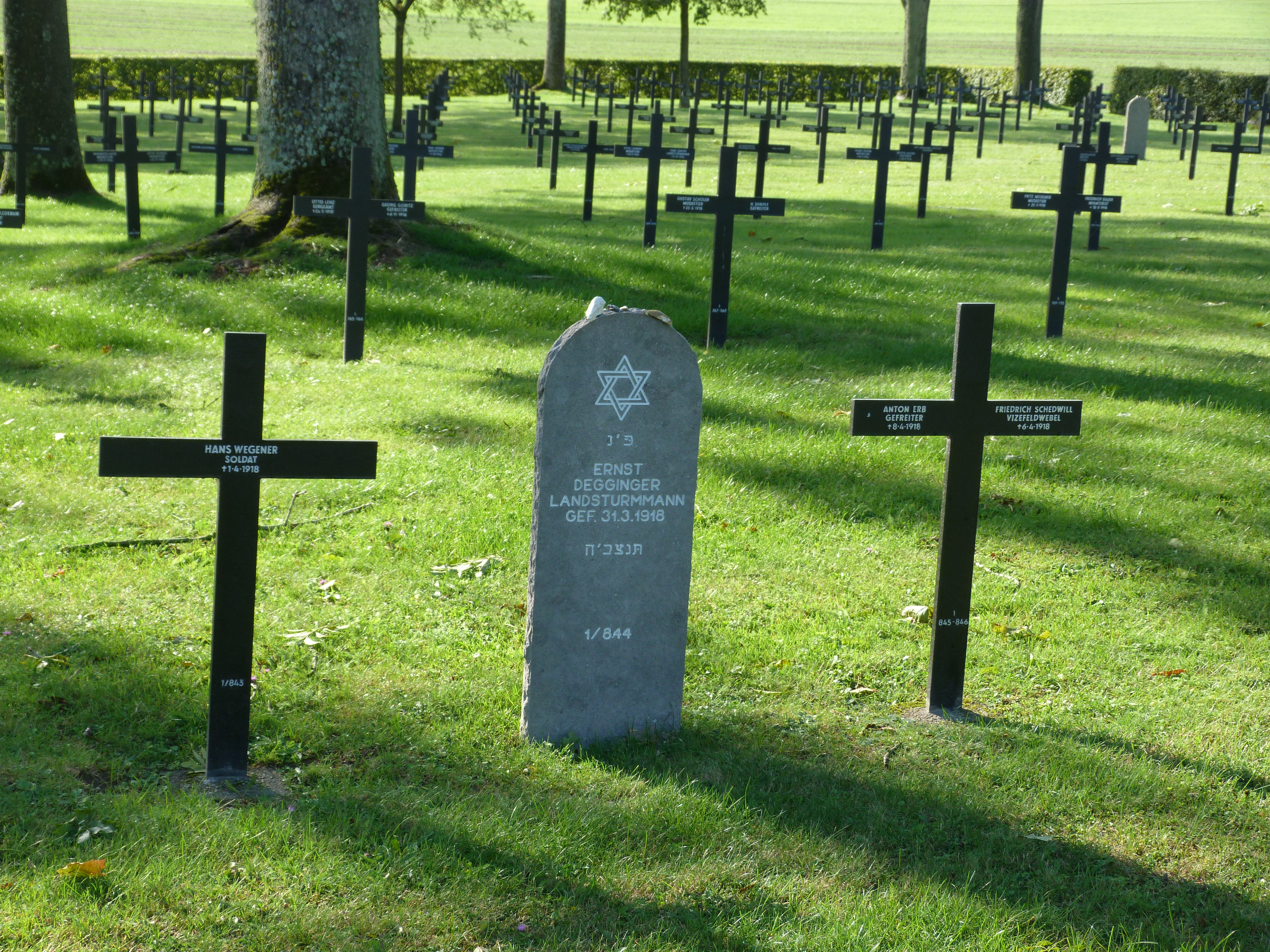
A Jewish headstone in the German cemetery
I was brought up short by the Jewish gravestones in the German cemetery. Pebbles have been placed on many, telling us of someone’s visit. These seemed to me the saddest markers of all. During the Great War, Jewish soldiers were accepted into the ranks without hesitation. They would see a different fate twenty years later.
The only story that Dave can give us here is that the infamous Baron von Richthofen, the Red Baron, used to be buried here until his family came to collect his remains in 1925 to inter them in Germany. Thousands of names, lettered in classic German typography of the early 20th century. Thousands of stories.
Too many to tell. We visit Mamet Wood, Death Valley, Contalmaison, Delville Wood, Caterpillar Cemetery, Poziers. I lose track of specifics and drown in the weight of the numbers and the stories.
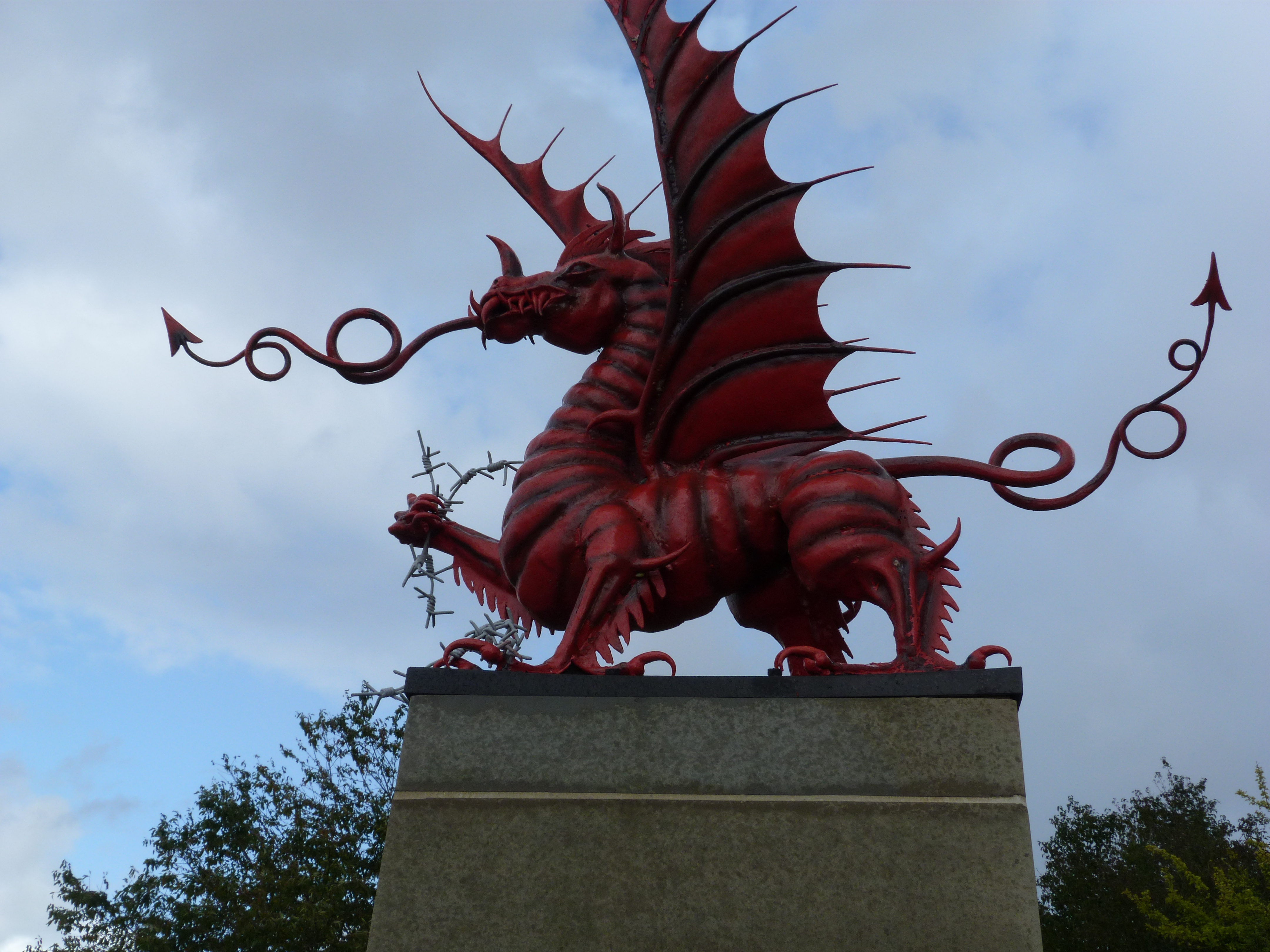
The Welsh memorial at Mametz. 4000 men were killed or wounded.
We move on for one final Canadian story in the Adanac Cemetery (yes, that is Canada spelled backwards. Not sure whose “cute” idea that was). 1075 Canadians are buried in Adanac.
Adanac Cemetary
One more story. An uplifting one. A Canadian story. A story from the fall of 1916, when the battle of Somme was still raging. The battle that was supposed to have ended on one sunny morning in July continued on for five months.
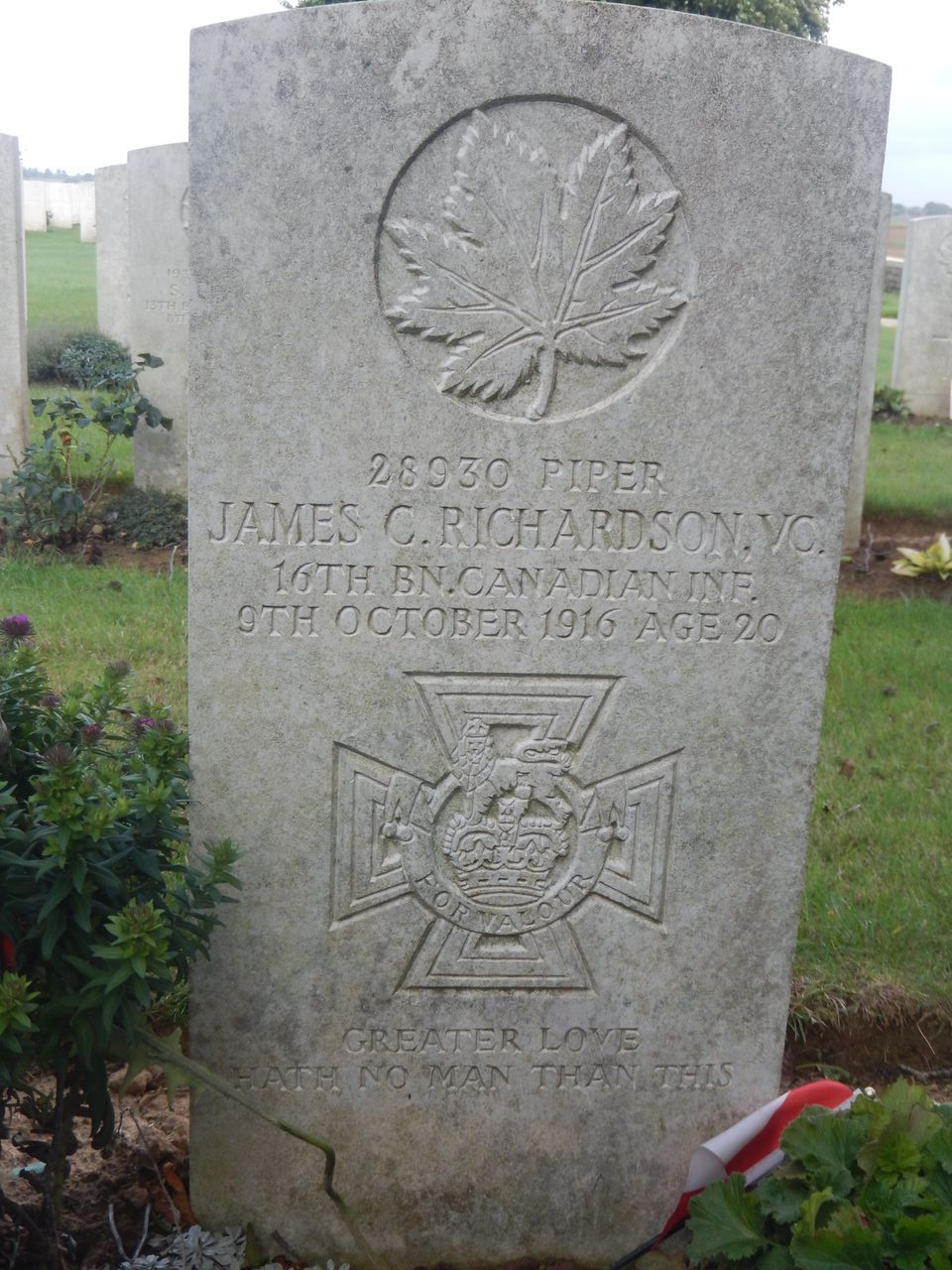
James Richardson was a Scot who emigrated to Canada with his family in 1913. When war broke out, he enlisted with the 16th Canadian Scottish Battalion. James was a Piper, and as such, his job was to inspire the troops. He wasn’t supposed to go into battle. But on the morning of October 8, 1916, he found himself in a company in disarray, with no senior officers, a line of wire that had not been cut, and troops with no direction. So he picked up his pipes and strode up and down playing, inspiring about 100 men to force their way through the wire into the next trench (the Regina Trench), which the company took successfully.
James then turned his attention to escorting German prisoners out of the trench into the rear of the action, until he realized that he’d left his beloved pipes behind on the front line. He went back to get his pipes and never returned. His body was found by a farmer in 1920.
Piper James Richardson
But his story doesn’t end there.
In 2002, a school in Scotland posted information about a set of mud stained bagpipes that they had had on display for 90 years. The pipes had been brought home from the war by a British Army Chaplain who taught at the Ardvreck School in Crieff, Perthshire, Scotland. They had a distinctive Lennox tartan pattern on them, the pattern of the 16th Canadian Scottish Battalion.
Through an investigative search by The Canadian Club and several army sleuths, the pipes were positively identified, in 2007, as James Richardson’s bagpipes. They are now on display in the B.C. Legislature.
The Battle of the Somme represents one small corner of the Great War. Each of these stories and memorials connects us to a single person, to a young man who had the misfortune of living at a time when it was expected that he would go into battle. Over the course of four years, 38.2million men were killed, wounded or went missing in action.
All we can do now is to sit together, and tell their stories. Dave’s done a phenomenal job of bringing some of these young men back to life, and giving us an insight into a moment in time when Western Civilization was irreparably altered. (If you are ever interested in a tour, he said to feel free to contact him. You can leave a comment on my site and I can connect you up.)
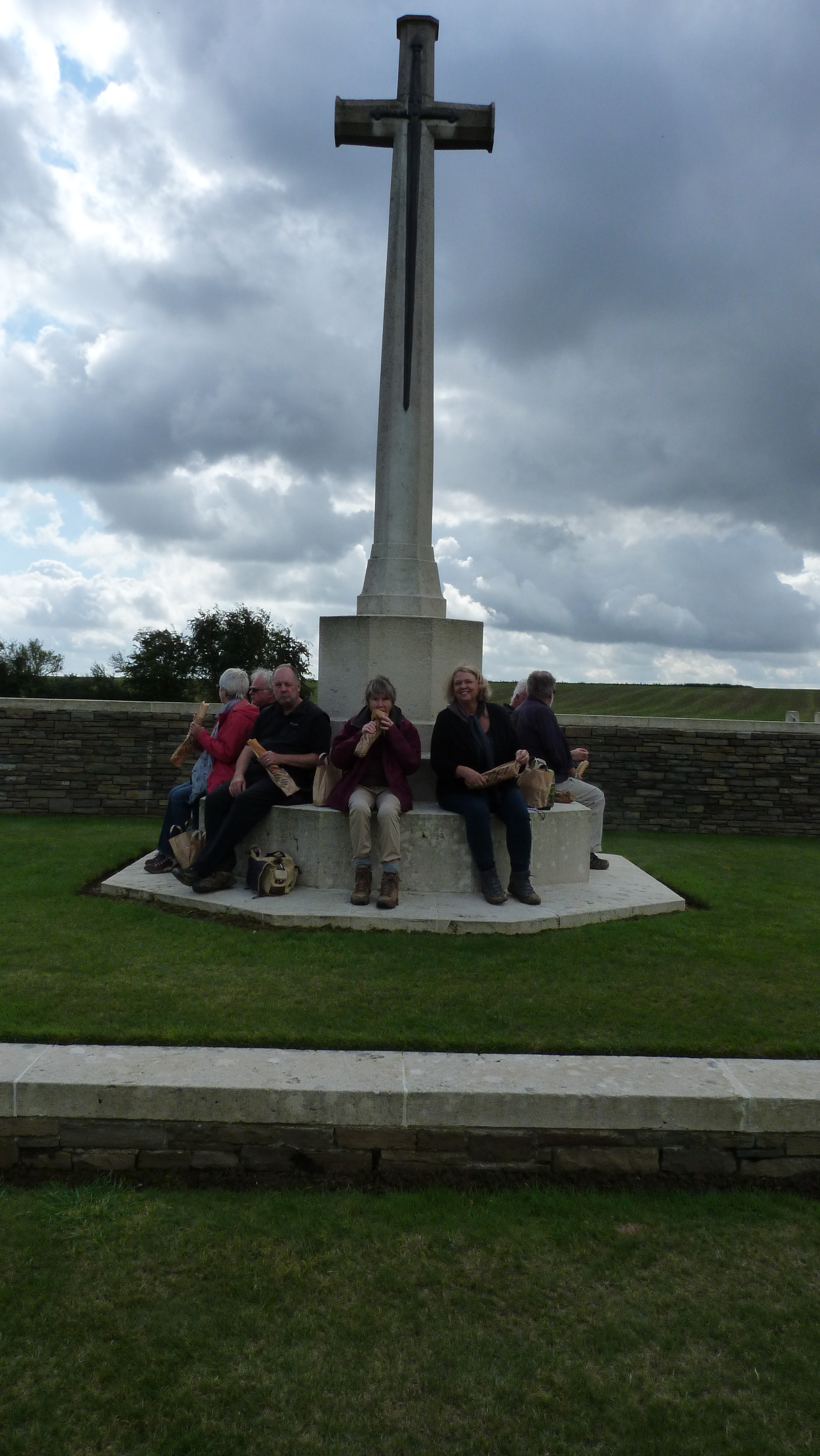
A lunch stop
But I think the last word should go to Private Harry Patch. Harry was born in 1898 and died in 2009, living to be 111 years old. It wasn’t until he was 100 that he started to speak openly about the war. His perspective sums it up.
“It wasn’t worth it. No war is worth it. No war is worth the loss of a couple of lives, let alone thousands. T’isn’t worth it … the First World War, if you boil it down, what was it? Nothing but a family row. That’s what caused it. T’isn’t worth it.”
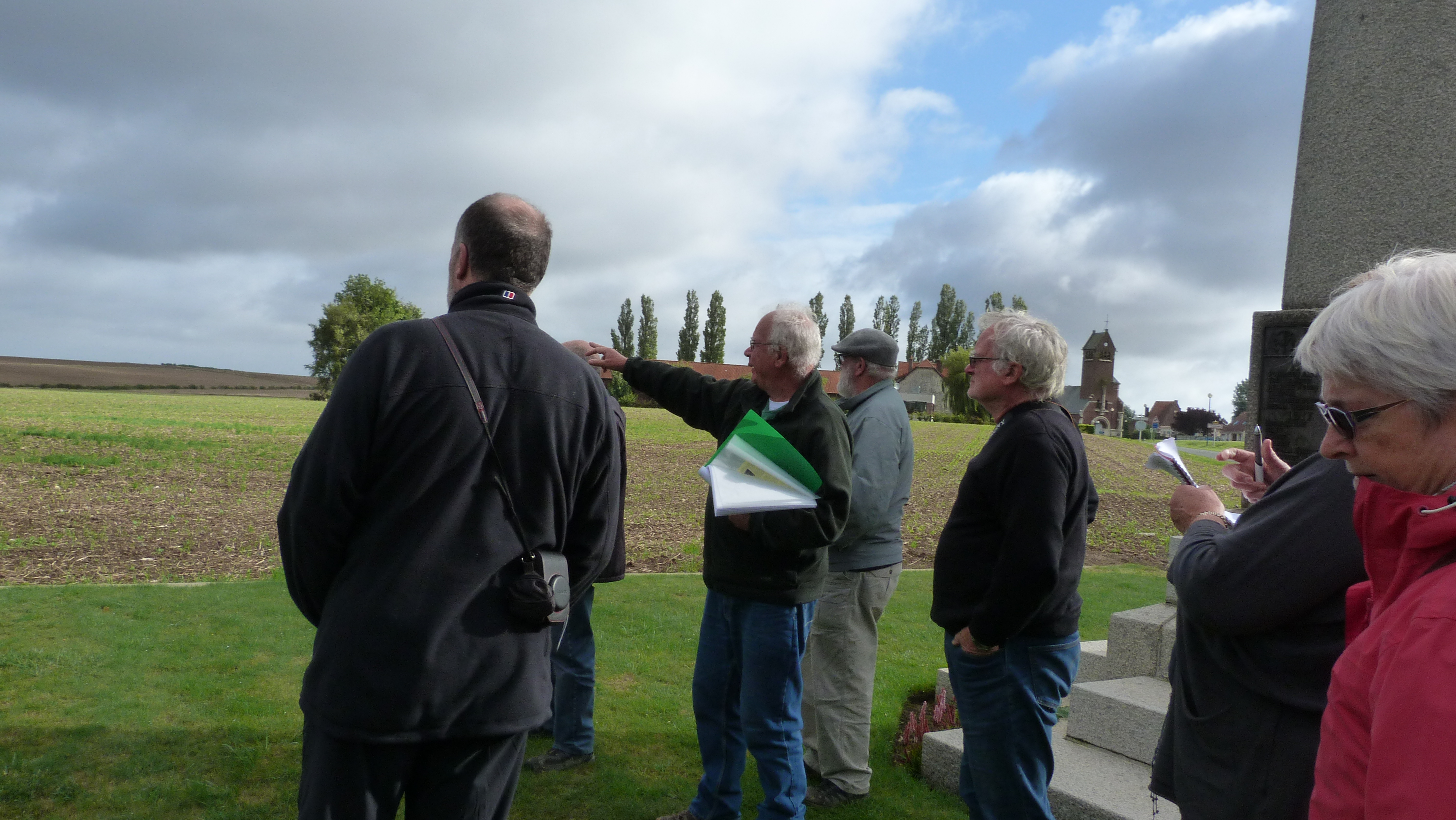
Dave shows us Leipzig Salient and a good view of the middle battleground
On the morning of July 1, 57,470 men on the Allies side were killed, wounded, went missing or were taken prisoner. Figures for the German side are harder to come by, but estimates say that there were between 10,000 – 12,000 German casualties that day.
Until my visit to the Somme, I could look at these as large numbers, but not feel them as individuals. I could grapple with trying to feel the enormity, but I couldn’t relate to these numbers as humans.
But Dave has at least one story from each cemetery. Some stories are of remarkable bravery, like Billy McFadzean from the Ulster Division. Prior to the Ulsterman’s attack on Thiepval Wood, a box of grenades fell on the trench floor, and pins fell out of two of the grenades. They had a 4 second fuse. Billy threw himself onto them to save his comrades. After the war, no one could be sure where the parts of his body ended up so he is named on the huge moment to the missing, the Thiepval Monument.
Theipval Monument.
But each name holds a story. There are over 70,000 names on the Thiepval Monument, all names of British and South African men who died in the Somme between July 1, 1916 and March 20, 1918, men whose remains were never found.
Looking out from Theipval Monument. The names of 70,000 missing men are carved in the white marble surrounding the base,
The monument is an impressive and imposing sight, like a statement that seems to shout on the landscape: Never Again. Construction began in 1928, overtop of a warren of German trenches and tunnels. The monument was unveiled in 1932. In seven years, the world would be at war again.
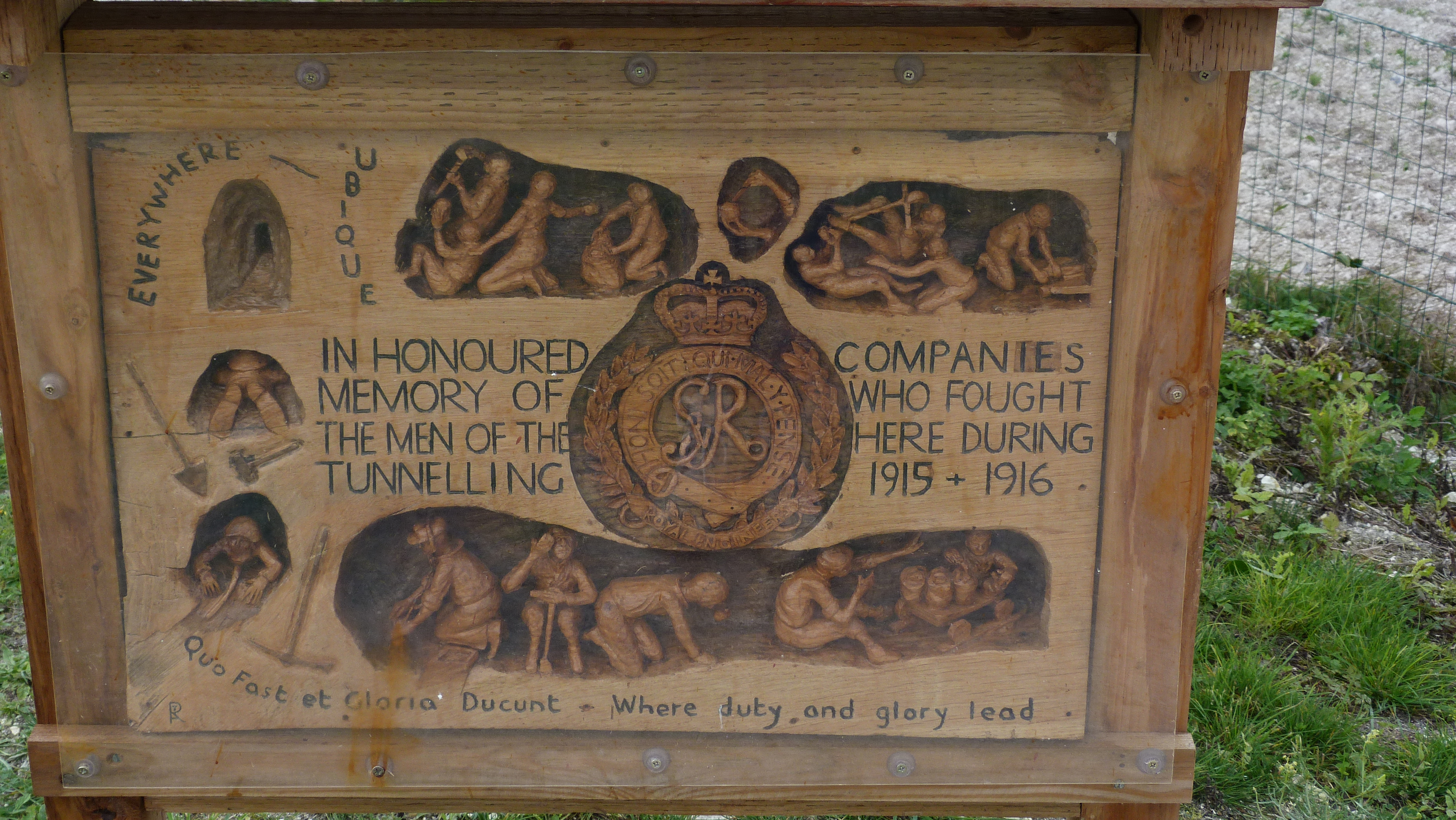
I’m moved by the memorials to the tunnellers.
A memorial to the men who tunnelled. Lochnagor Crater.
Strategic mining was used by both sides, with many kilometers of tunnels ranging in depth from 30 feet (9 meters) to 120 feet (36 meters). At the “Glory Hole,” eight kilometers of German, British and French tunnels skirted each other by mere meters. As they got closer to their objective, the men needed to tunnel slowly, in complete silence. They worked barefoot and fitted handles onto their bayonets, jabbing the point into a crack in the rock and twisting. Another man caught the rock piece before it fell. Backbreaking work, where they feared discovery at any moment.
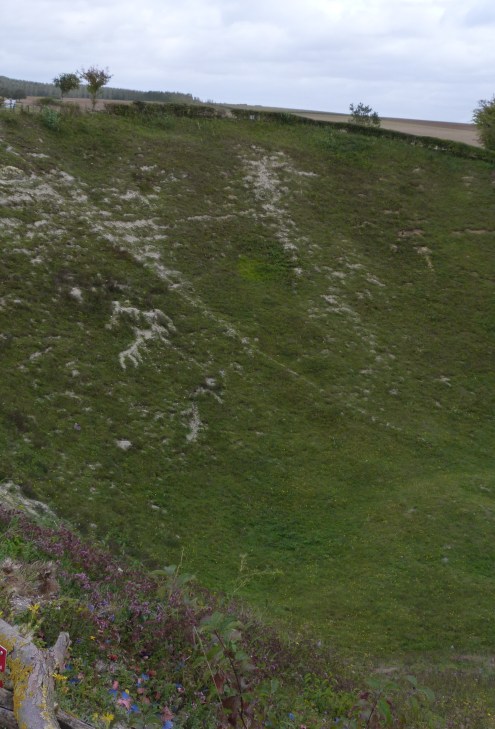
Lochnagor Crater
We visit the Lochnagor Crater, one of the 5 craters left from the mine explosions set underneath the German encampments. As with the blast site at Hawthorn Ridge, photos can’t do the size of this hole justice. But 2nd Lieutenant Cecil Lewis (no relation, but I’d like to adopt him) of the Royal Flying Corps was sent in his plane to observe the blast at Lochnagor as it happened:
“The whole earth heaved and flashed, a tremendous and magnificent column rose up into the air. There was an ear-splitting roar, drowning all the guns, flinging the machine sideways in the repercussing air like a scrap of paper in a gale. The earth column rose higher and higher to almost 4,000 feet. There it hung, or seemed to hang, for a moment in the air, like the silhouette of some great cypress tree, then fell away in a widening cone of dust and debris…” 2nd Lieutenant Cecil Lewis
We finish our day in a museum in the town of Albert. The museum is in a tunnel.
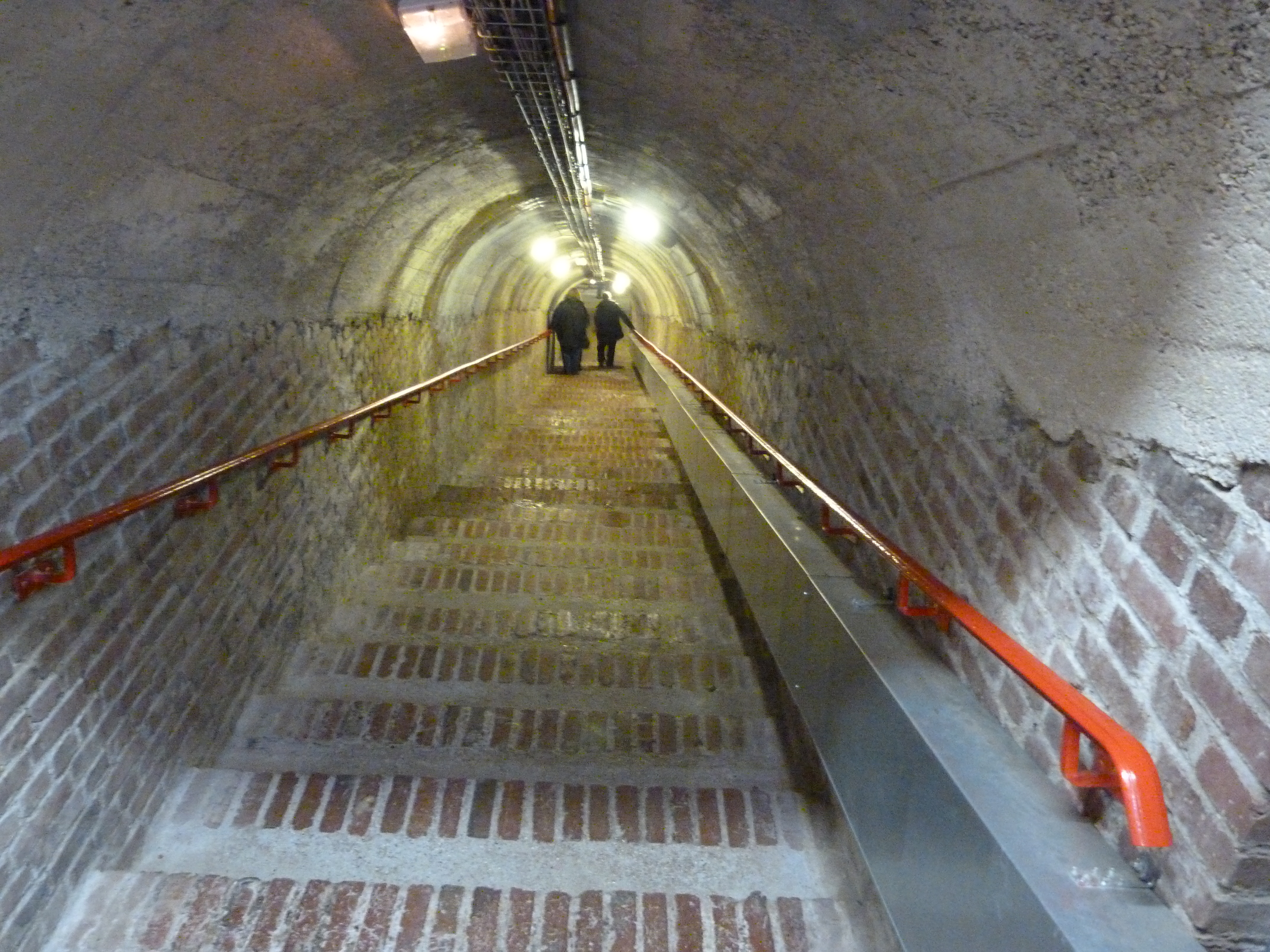
Going down into the Somme museum in Albert
Ten meters underground, 250 meters long, the tunnel was originally built in the 13th century. It was used as an air raid shelter in the Second World War, housing 1500 people. Today, it houses artifacts, dioramas and exhibits.
I’m struck by an exhibit on facial reconstruction. Gueules cassées, or “Broken Faces,” became a term that referred to the more than 15,000 men who returned from the war missing eyes, noses, jaws, cheeks. In trench warfare, the heads of the soldiers are particularly vulnerable. The introduction of metal helmets in 1915 saved many lives, but ironically this meant that many men who would have previously died from head wounds now lived with terrible disfiguration. The new field of plastic surgery helped, but for many the reentry into society was far harder than for those missing limbs.
There are so many ways in which war destroys a life. We return to Chavasse Farm and breathe in the peace.
“…I remember the lads laid in rows, just as if they’d gone to sleep there, and the sun flashing on them bits of tin on their backs all down the lines. The machine guns just laid them out. Some were hanging on the wire, hanging like rags. Machine guns bullets were knocking them round as if it was washing on the line.” Private Frank Lindsay, 16 years old, Pals Battalion, Barnsley
There are some pertinent facts to keep in mind for this cursory view of the first day of The Battle of the Somme. I’m not going to go into the intricacies of the battle. I can only speak from a personal perspective about what I saw, 101 years later, on a landscape that still shows the scars of the war. But a bit of background information might help.
The battle began at 7:30 a.m on July 1, 1916.
13 divisions were deployed under British command. They came from Britain, Ireland, Newfoundland, Bermuda and the colonies of Canada, New Zealand, South Africa, India and Australia. For the most part the men were new recruits, young men who joined up together and took basic training for six months.
The French had asked for British assistance to pull German troops from Verdun. There were 11 divisions under French command, but they, too, operated under British command in the Somme.
There were 6 German divisions, a professional army of young men who had trained for a minimum of two years.
The front was 45 kilometers long
The chain of command was like a game of ‘broken telephone’ going horribly awry. A hierarchical structure of twelve layers of information connected the toffs in the War Command office to the working class Privates in the trenches. Each layer had its own vested interest. The Privates had no choice but to the information they were given.
In 2 hours approximately 72,000 men (from both sides) were killed, wounded or went missing.
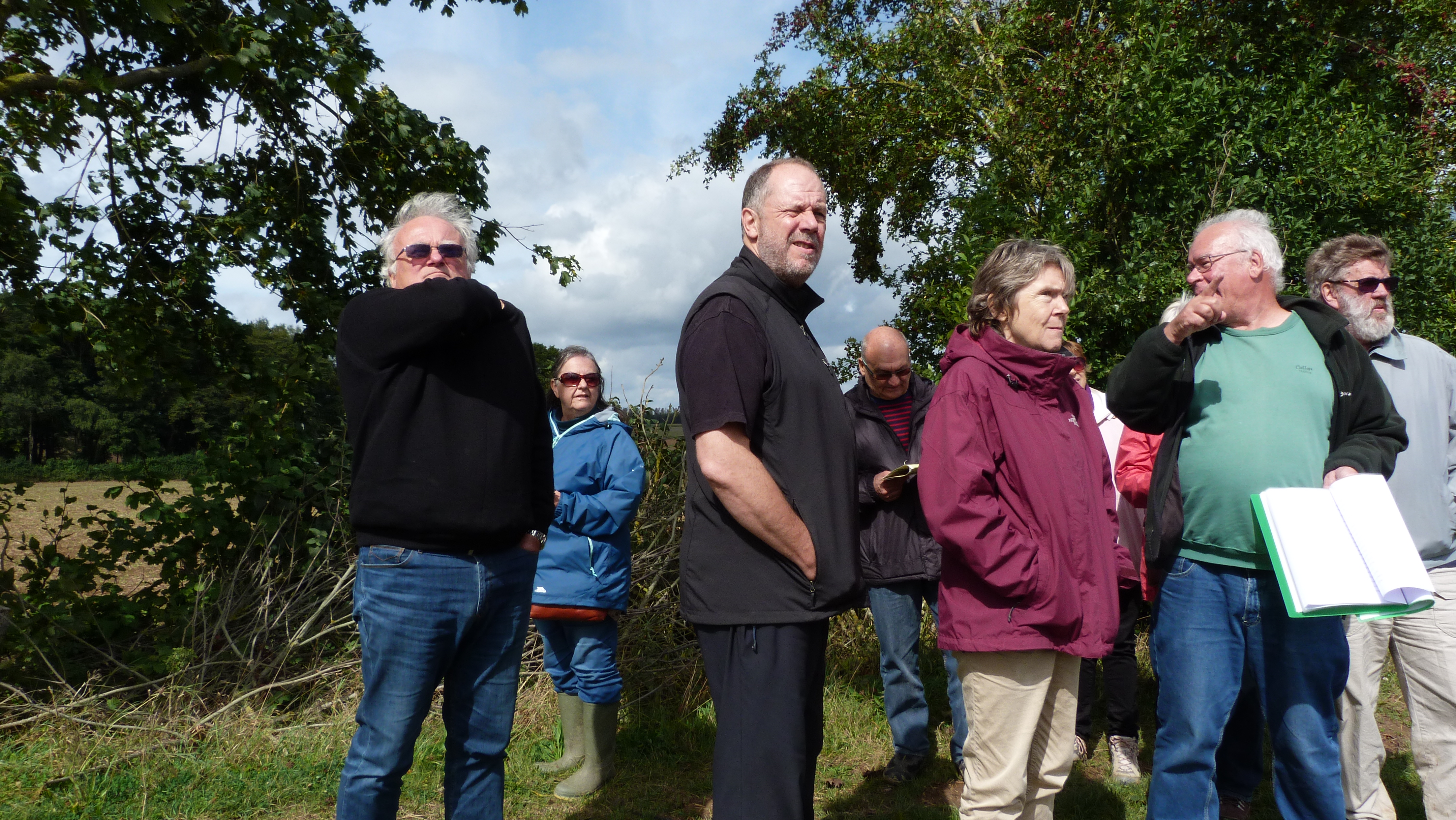
Dave shows us a battlefield near the hamlet of Serre
France is a vast country of rolling farmland. Europe’s garden. It is still farmed by local farmers and families in much the same way it has always been farmed. Cattle graze, tractors harrow, and in the gentle rolls of land it is easy to let the 21st century drift away.
Nowhere is this more true than in the Somme. The area of the Somme is a thriving farming community, but it is also a community that guards the memories of hundreds of thousands of people. The farms are planted around well-tended cemeteries and memorials, sites that are in the middle of the farmed fields.
The cemeteries and memorials are tended by the Commonwealth War Graves Commission, who hire local people to maintain them. There are, every day, hundreds of people who come from all over the world to visit and to find graves of family members who they’ve only heard about in stories.
Up the path, past farms and fields to Luke Copse. Light Railway and Queens Cemeteries,
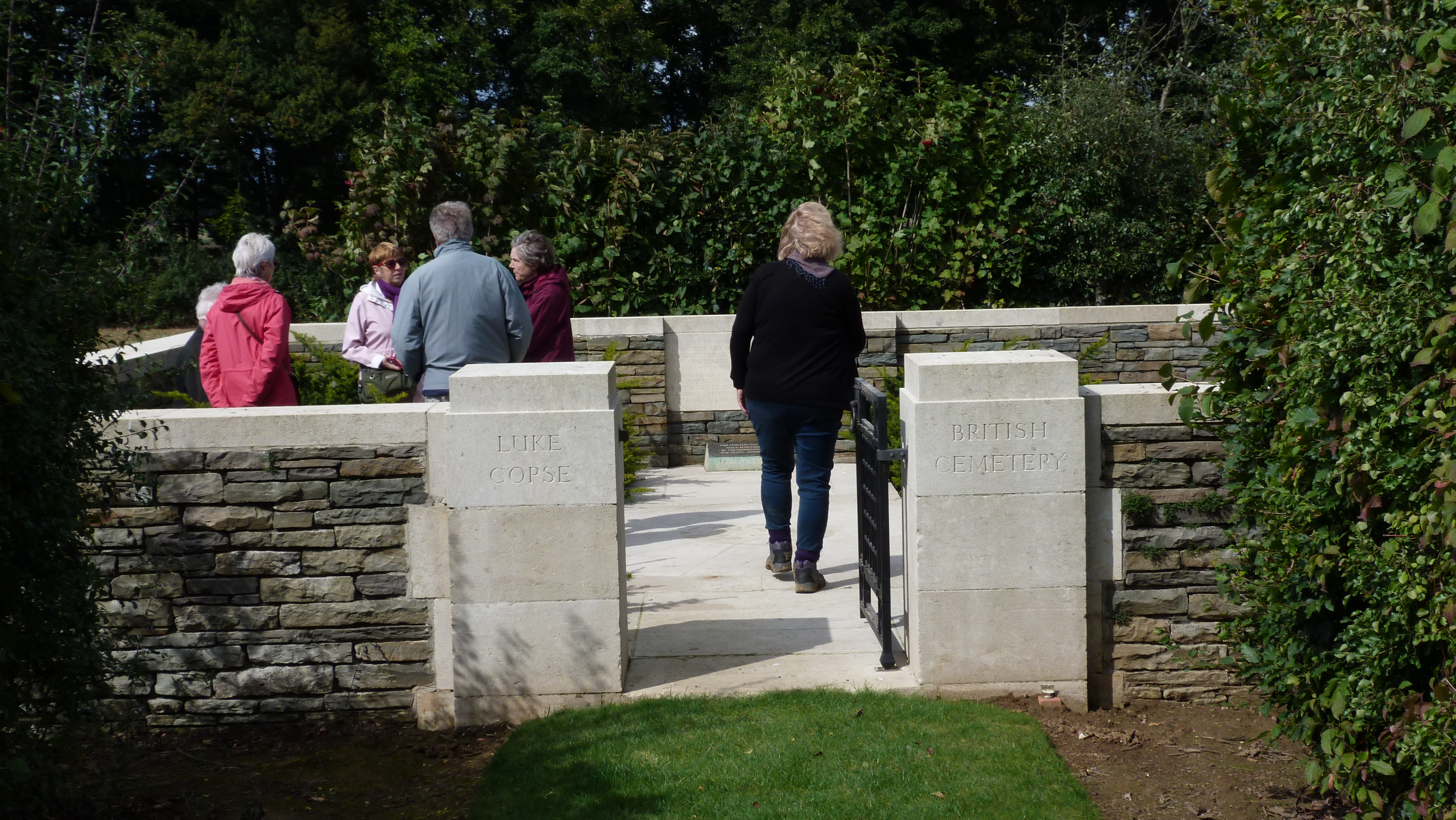
It was in the Luke Copse Cemetery that I began to feel the enormity of our pilgrimage.
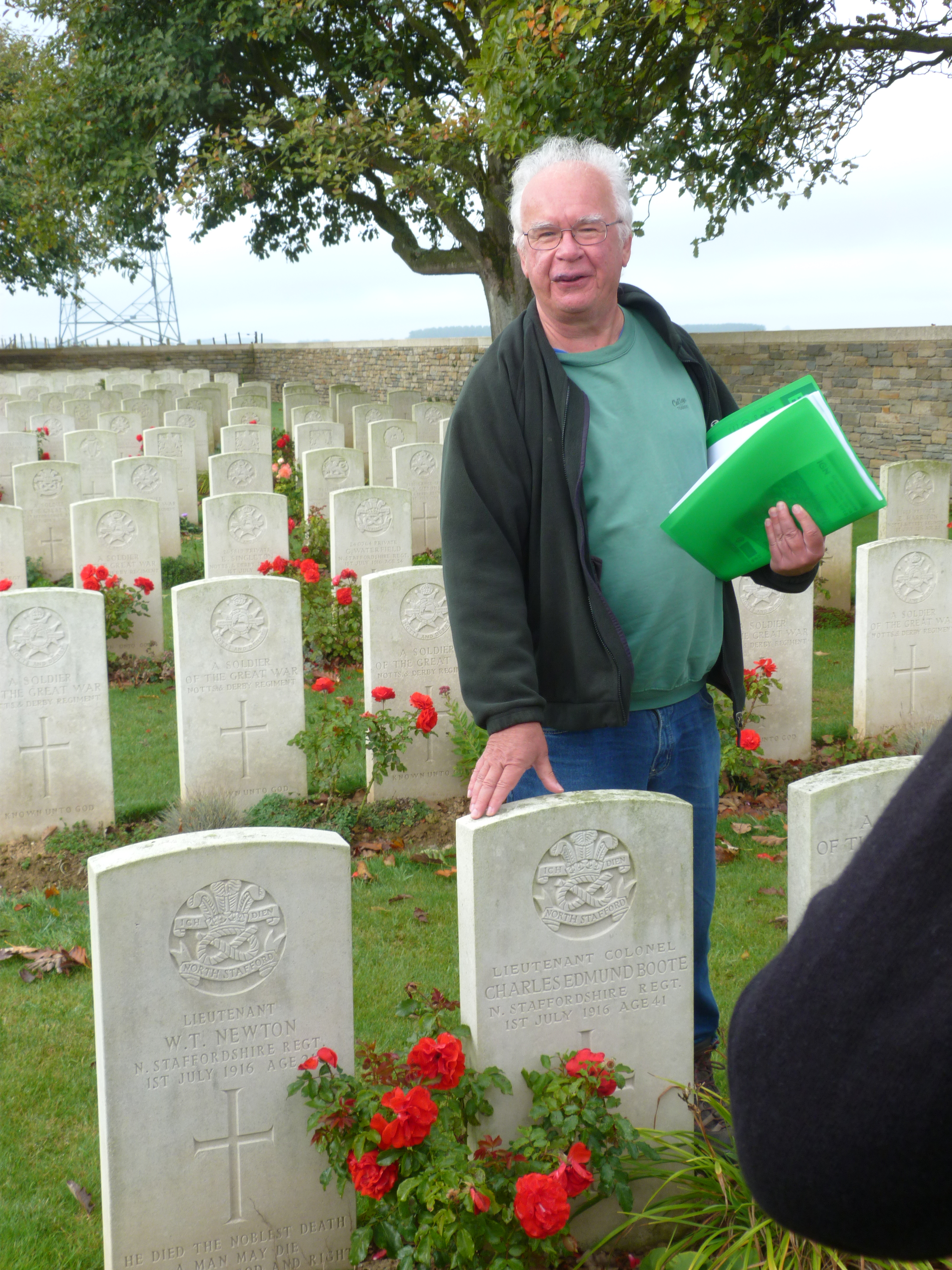
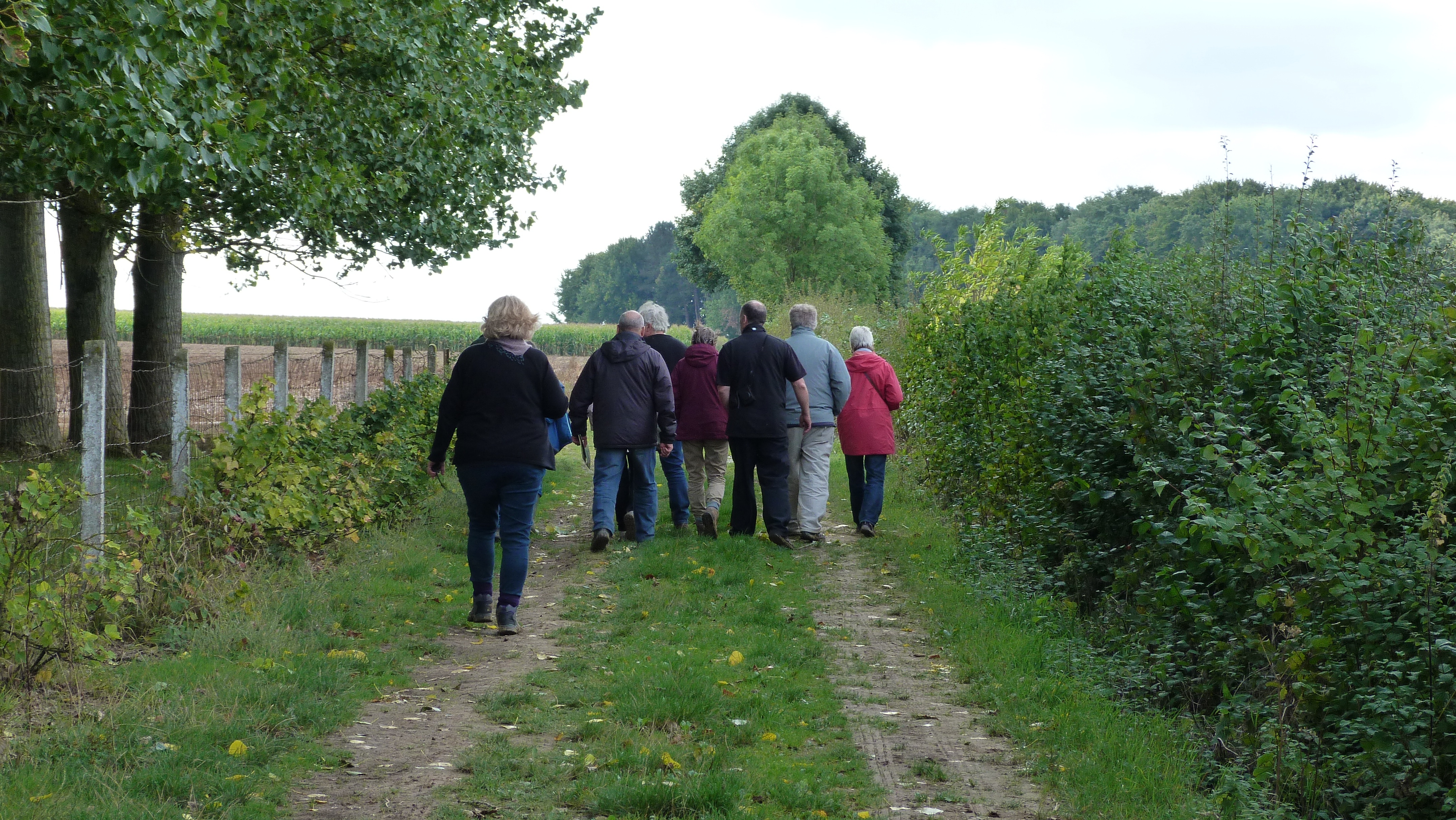
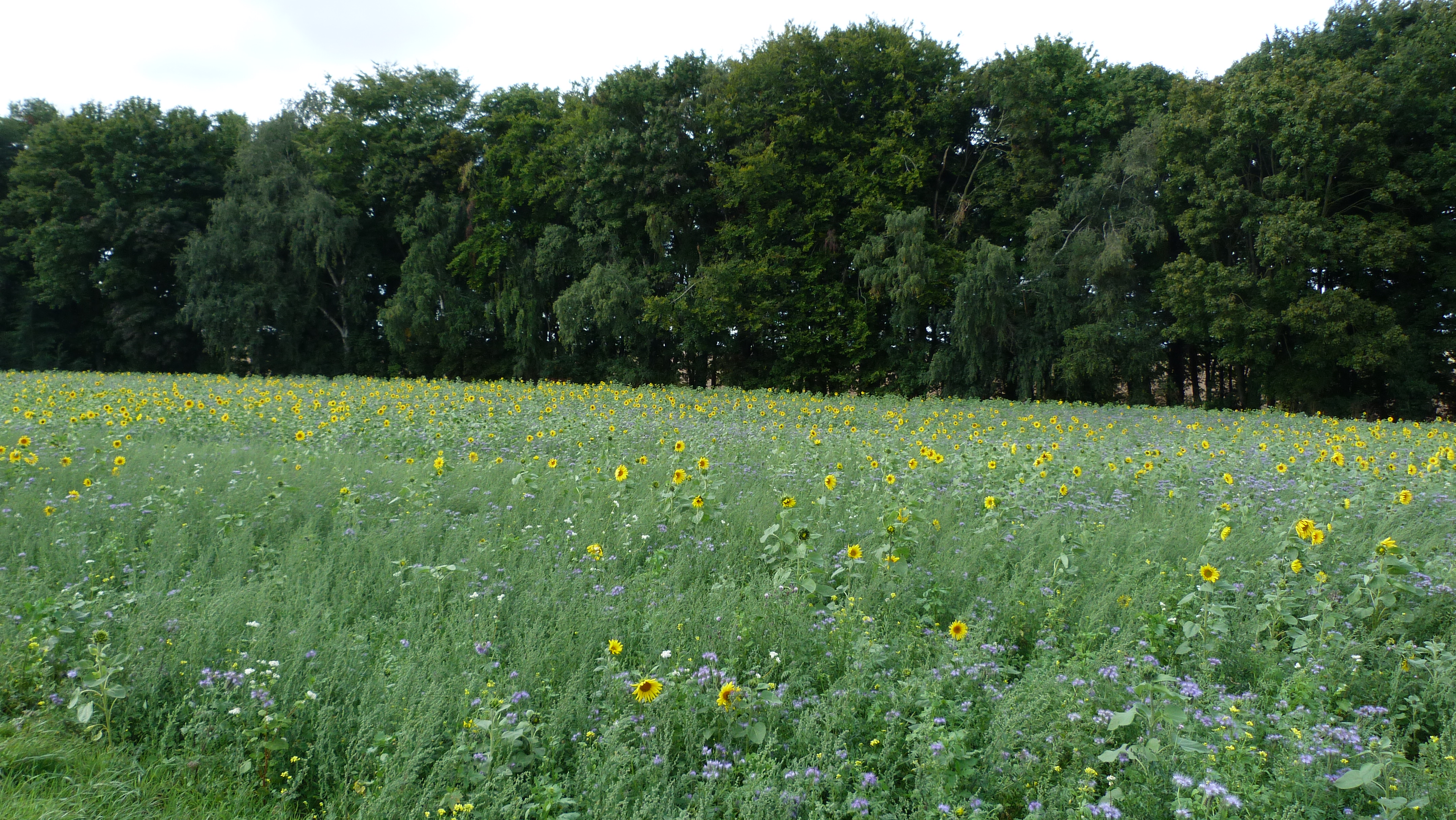
We walked up a tractor path, past fields of sunflowers to a small “battlefield” graveyard, where bodies were placed in pairs a trench, the trench that they had just left minutes before. Dave showed us where two brothers, Lance Corporal Frank Gunstone (25 years old) and Private William Gunstone (24 years old), were buried side by side.
Luke Copse Cemetery
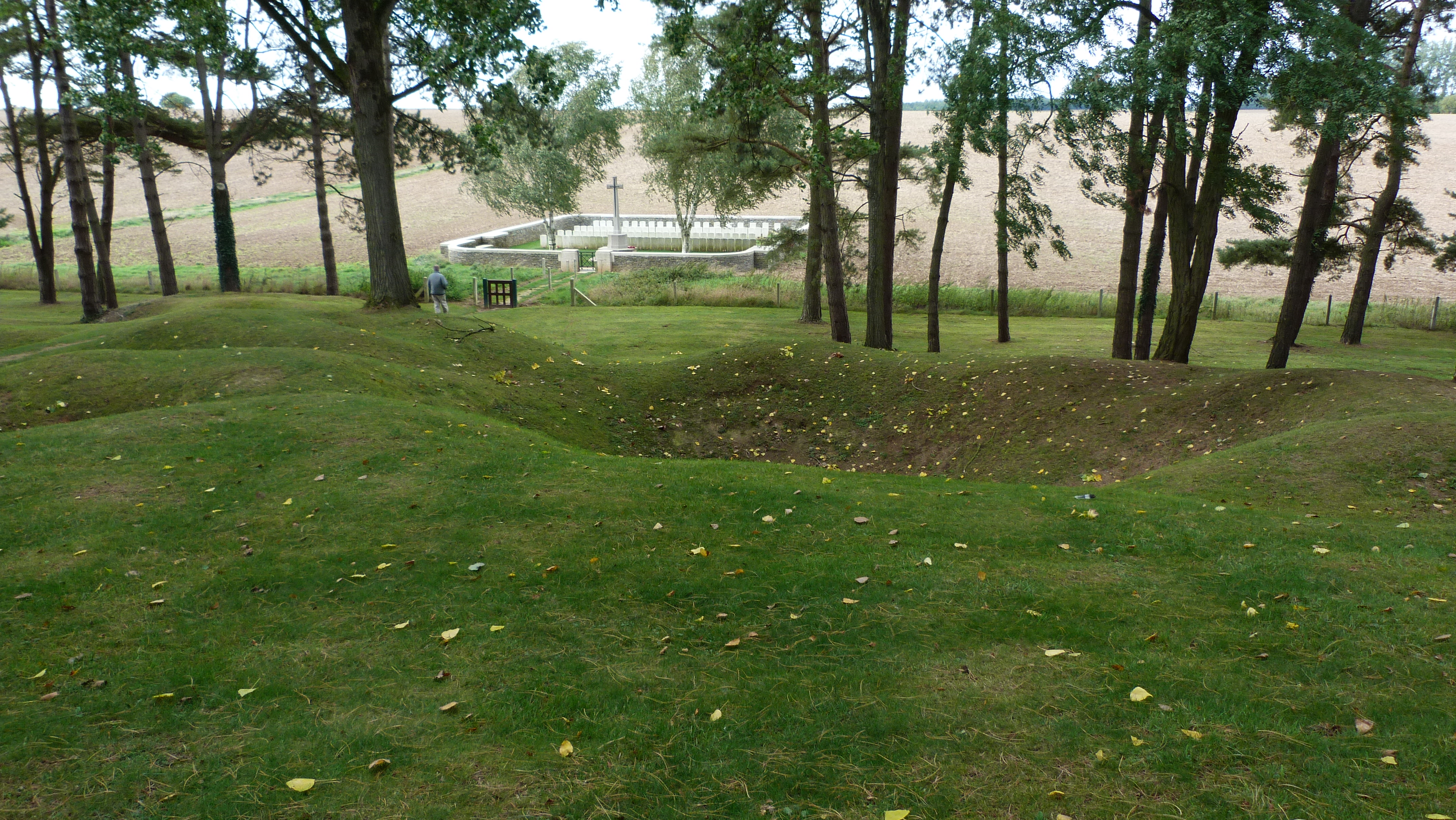
Further along the path we came to the Light Railway Cemetery. Part of battle planning involved building a railway so that wounded men could be carried back to hospitals in Rouen. Trenches and craters from bombardment still mark the site of the battle.
Light Railway Cemetery
We visited the grave of Private Alfred Goodlad who wrote in his last letter home, “The French are a good nation worth fighting for.” I think about today’s troops, dying in foreign countries far from home. I think about the generosity of Private Goodlad’s family, who decided to put this statement on his tombstone.
Across the tractor path, cornfields frame the Queens Cemetery in former no man’s land.
Queens Cemetery
Many of the Accrington Pals are buried here. Pals battalions came from all over Britain, young men who went to school together, or maybe were volunteer firefighters, or on the same football team. Friends who signed up together to fight together, and for the most part, die together. The 700 Accrington Pals were a battalion from the town of Accrington in East Lancashire. They were tasked with taking the town of Serre. Within half an hour, 585 of them were casualties (385 dead, 200 wounded). Serre was left in German hands.
“… it was slaughter. Men fell like ninepins. There was rifle fire, machine-gun fire, it was terrible.” Stanley Brewsher, Accrington Pals
A few kilometers down the road, British sappers had spent months digging carefully under German encampments to lay mines set to explode at the appointed hour and initiate the battle.
Hawthorn Ridge Redoubt
Remarkably, there is footage of the explosion at the Hawthorn Ridge Redoubt, just west of the town of Beaumont-Hamel, the first of five land mines were exploded (https://www.youtube.com/watch?v=g8YfJmwY5Uo) It is remarkable to see the size of the explosion, the earth shooting high into the sky.
There is also footage by the official cinematographer, Geoffrey Malins of the young soldiers of the first battalion of the Lancashire Fusiliers waiting in the “Sunken Lane” (https://www.youtube.com/watch?v=3Sb7urnjEaE) across from the mine site, ready to attack and liberate Beaumont as soon as the mine was exploded.
Sunken Lane, where the 1st Lancashire Fusiliers waited for the explosion at Hawthorn Ridge
For reasons beyond my ability to grasp, let alone explain, the mine at Hawthorn Ridge was exploded 10 minutes early on July, at 7:20 a.m., not at 7:30 as scheduled. The explosion effectively warned the Germans that the attack was about to begin. The German troops moved quickly forward into their trenches before the attack officially started at 7:30. They were therefore very ready when the 1st Lancashire Fusiliers from the Sunken Lane came out into the open. The young men whose faces you see in the film clip were easily picked off.
We walk from the Sunken Lane to the top of the Hawthorn Redoubt to look into the crater left by the mine.
From the bottom of the Hawthorn Ridge crater
Overgrown, it is no more than a hideout for teenagers now. I go down to the bottom and stare up, remembering the young German men who lost their lives suddenly, unexpectedly, as the bomb went off underneath them.
We drive a short distance down the road to Newfoundland Park. Although Newfoundland was not a part of Canada in 1916, it is hard not to feel compassionately patriotic at the sight of a Canadian flag and a huge caribou memorial.
Newfoundland Park
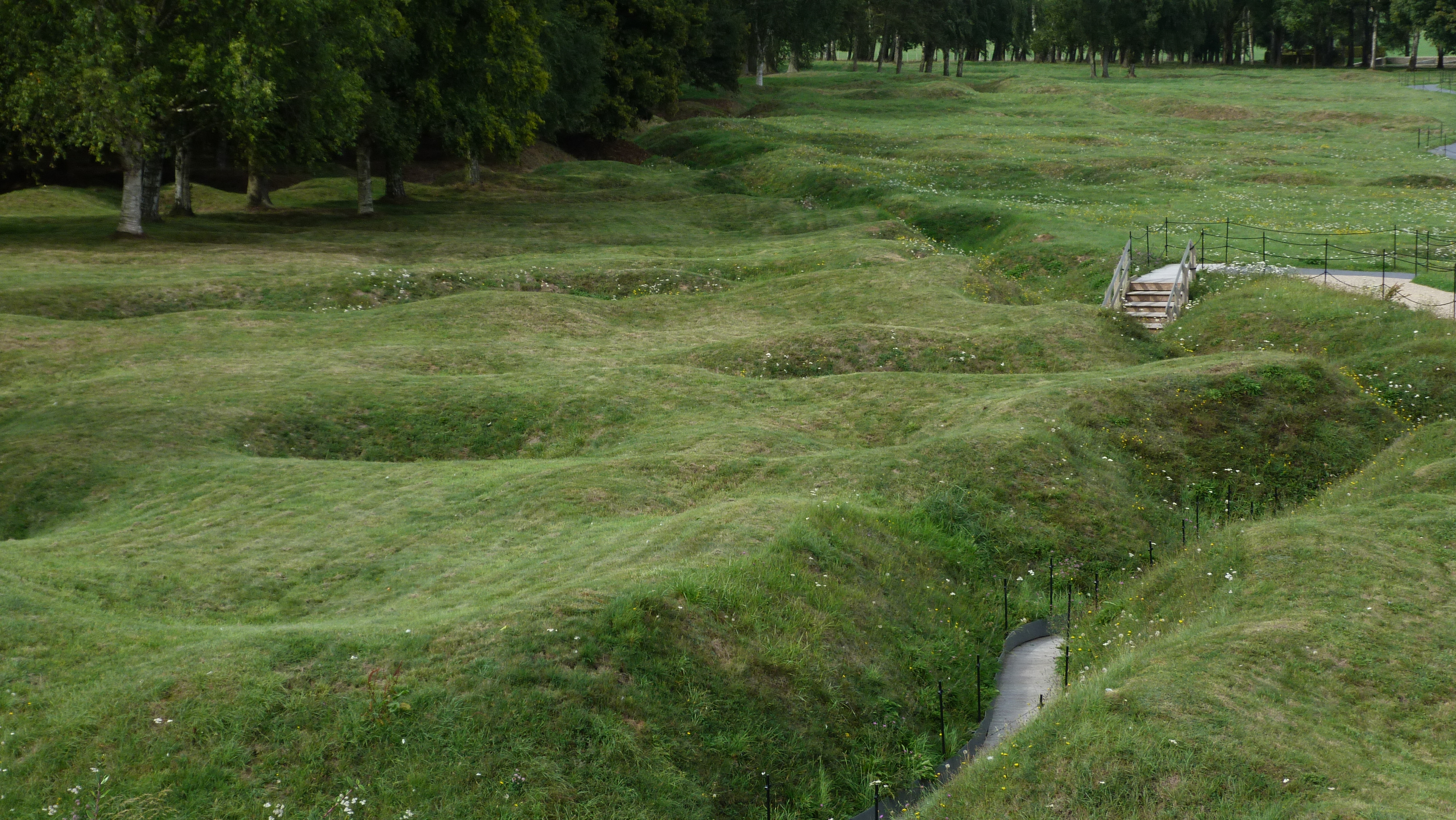
This site has been maintained so that the original trenches are still in evidence, markers to another horror of this war. 801 young men from Newfoundland were pushed forward as part of a second wave of attack after the Hawthorn Ridge explosion. They couldn’t go through the trenches, because they were blocked with the dead and wounded. They had to move across open fields, with little artillery support. They tried to push through the barbed wire of No Man’s Land, wire they had thought destroyed.
Trenches in Newfoundland Park
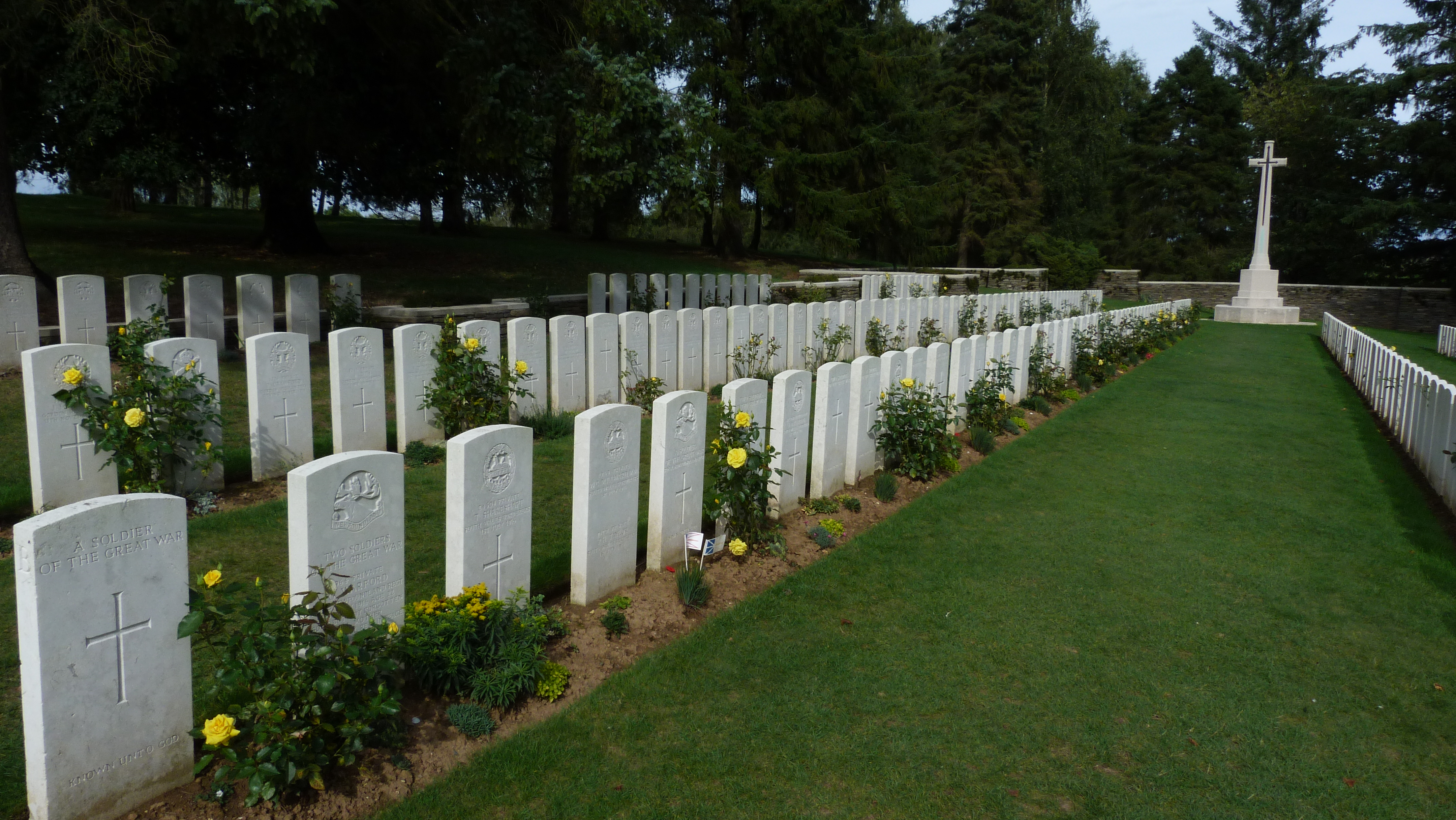
In 30 minutes it was over. Only 68 men of the Newfoundland Regiment survived uninjured. Newfoundland lost a generation of young men. To this day, they are mourned and remembered in Newfoundland on July 1st.
Cemetery for the men of the Newfoundland Regiment
And on and on. Each cemetery tells the story of a regiment, each gravestone tells the story of a man.
Day one of our tour of the Somme is over. We head back to Chavasse Farm and wine that reminds us to enjoy life. Over dinner we sing snatches of songs about peace.





 Stepping off the Treadmill