Last week was the bicentenary of Charles Dickens birth. A big thing around these parts. There have been masses of tributes pouring in from all over the world. There was a birthday party of sorts at Westminster Abbey. Prince Charles laid a wreathe, Ralph Fiennes read from Bleak House, and the largest ever gathering of the Dickens family were in attendance.
I wasn’t invited, but I wanted to pay my respects so I went to the Abbey on my own, on a bleak morning that seemed very much out of a Dickens novel. Big Ben was chiming twelve, and a cold mist had settled on the stones.
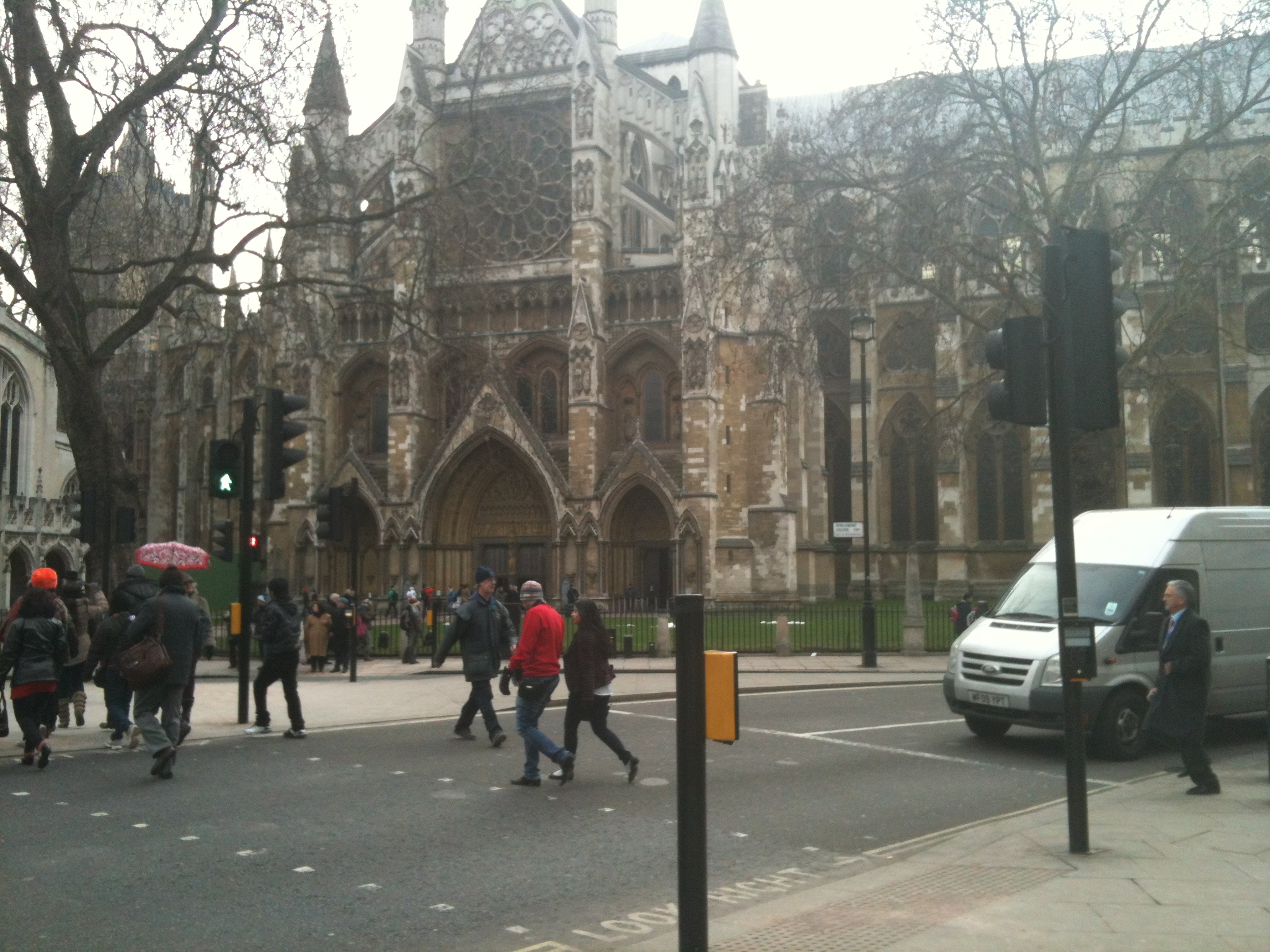
Being in Westminster Abbey is like being in the Who’s Who of English history. Everyone who is anyone is there. My first mission was to go to Poet’s Corner. This part of the abbey is dedicated to remembering important British writers and other artists. Some are buried in the Abbey and some are elsewhere, but remembered here with memorial stones.
Poets’ Corner began with the interment of Geoffrey Chaucer in 1400. Since then, hundreds of worthy British artists have been buried or remembered in the South Transept.
It is here that Dickens is buried, although he wanted to be buried in his home town of Rochester. When he died there was a huge public demand for him to be in London, and so he was buried in Westminster against his wishes. The price of fame.
Dickens has a prominent, but simple stone on the floor. I had arrived two days after his birthday, and the wreathes from the celebration were still there. Just close to Dickens is Handel, his carved figure clutching a piece of music, music that had its premiere performance in Westminster Abbey. Across from Handel is a statue of Shakespeare. Shakespeare is buried in Stratford-upon-Avon, and although there was talk of moving him to Westminster, he seems well settled in his home town. His memorial in Westminster is suitably impressive, however, and he holds a carved manuscript page from “The Tempest”:
The cloud-capp’d towers, the gorgeous palaces,
The solemn temples, the great globe itself,
Ye all which it inherit, shall dissolve
And, like this insubstantial pageant faded,
Leave not a rack behind.
The Tempest, Act 4, Scene 1
Shakespeare’s marble eyes gaze down to the floor to look upon a stone for Lawrence Olivier, whose ashes are buried beneath. The beauty of this moved me to tears.
Beside Shakespeare there is a huge tomb for Oliver Goldsmith, out of proportion for our day and age, but suitable for his worth in the 16th century. Rudyard Kipling, Charles Dodgson (aka Lewis Carroll), Dylan Thomas, Ted Hughes, William Blake, Jane Austen – they are all here. There is a beautiful new carving for the founders of the Royal Ballet, Fredrick Ashton, Margo Fonteyne, Constant Lamburt and Ninette de Valois. In keeping with their profession, the letters are swooped and graceful, full of movement.
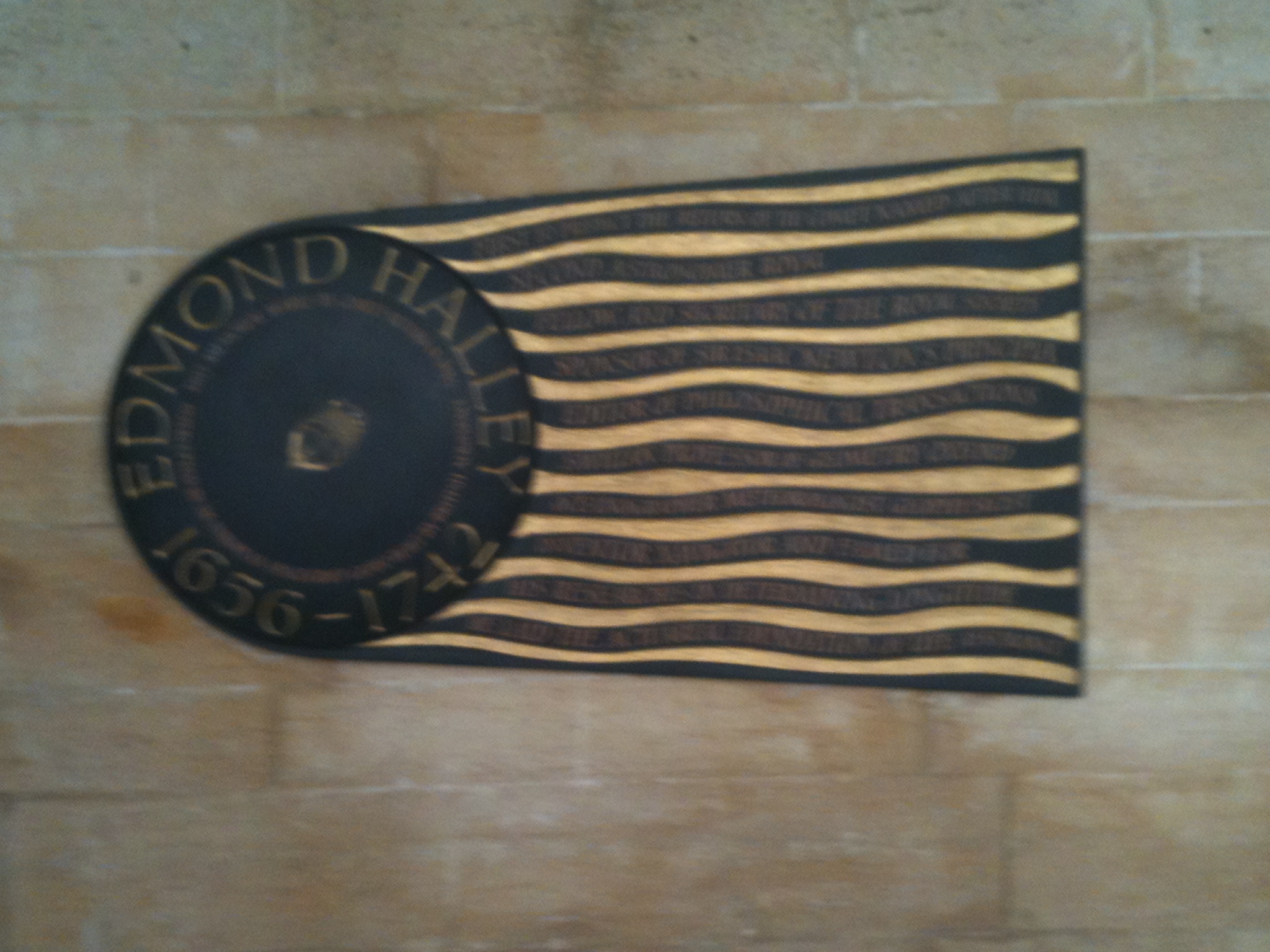
As a calligrapher and letter carver, I was thrilled to see some of these newer carvings. You can’t take photos in the Abbey, but I was able to take a few out in the Cloisters. I particularly liked one in slate dedicated to Edmond Halley, of the comet fame, with gorgeous gold leaf trails. A bit blurry, unfortunately. It was very cold in the Cloisters.
But these monuments and memorials are all recent history for the Abbey. Westminster Abbey was begun in the 11th century by Edward the Confessor. The first coronation was held there in 1066 for William the Conqueror. All coronations of English kings have taken place there ever since. Coronations, and of course, subsequent burials. There are tombs for various Edwards, Richards and Henrys. Elizabeth 1 is there, her half-sister Mary Tudor buried beneath her. I have just been reading Wolf Hall by Hilary Mantel and getting a glimpse into the terrible relationship between these two daughters of Henry VIII. In life, they could not have been more divided. In death they are buried one on top of the other, with the inscription: “Partners in throne and grave, here we sleep, Elizabeth and Mary, sisters, in hope of the Resurrection”. The other Mary, Mary Queen of Scots is just across the hall.
It seems as though the whole history of Great Britain is contained here. And I realized that up until that moment, all of these Royal figures had been a fiction in my mind. I knew that they existed from reading about them. But, to quote Lewis Carroll, “They may write such things in a book“. Seeing their tombs, their likenesses carved from their death masks, gave them substance and a reality they hadn’t had for me before. Walking amongst these tombs gave life to history.
As I started to leave the Abbey, past the commemorative, side by side sculptures of Isaac Newton and Charles Darwin, I came upon a small door covered in locks and chains. This is an Amnesty memorial remembering jailed dissidents the world over. This week we were urged to remember Liu Xiaobo, Chinese writer and human rights activist jailed in 2009 as a political prisoner.
Tellingly, across from the Amnesty memorial is the “Tomb of the Unknown Soldier”, a simple black marble slab, marked with a border of poppies. An unidentified soldier who died in France in the First World War, “For God, for King and Country, For loved ones home and empire, For the sacred cause of justice and freedom of the world. They buried him here among the Kings because he had done good toward God and his house”.
I left the Abbey feeling very alive and thankful. I may not have gotten a loot bag at the birthday party, but I was leaving with riches galore. Happy Birthday Mr. Dickens.
“Dickens’s humanity and compassion made an extraordinary impact on Victorian England through his writings …This bicentenary should help renew our commitment to improving the lot of the disadvantaged of our own day.” Dean of Westminster, the Very Reverend Dr. John Hall

 Stepping off the Treadmill
It’s hard to find educated people about this topic, however, you
sound like you know what you’re talking about!
Thanks