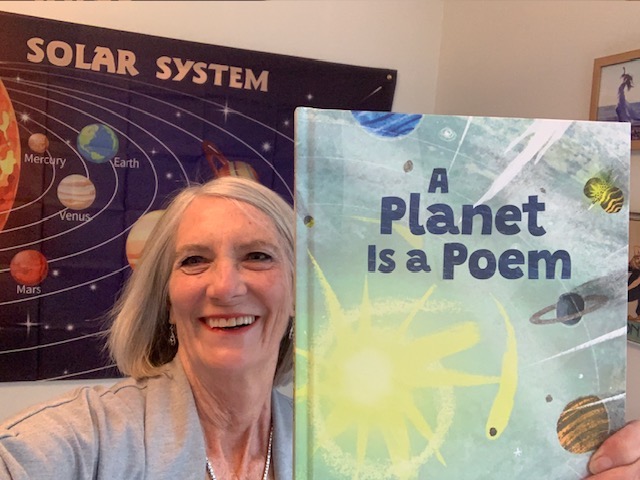
I didn’t set out to become a poet.
In fact, I actively avoided writing poetry. There are SO MANY bad poems in the world. And I had to say, so many people who write bad poetry. And yet, even after writing a novel in verse and a book of poetry about the planets, I would be very hesitant to call myself a poet.
But poetry has always been a huge part of my life. I studied calligraphy when I was young, eventually becoming a full-time calligraphic artist. I spent countless hours lettering beautiful poems. As an actor, my voice training included work with vibrant poems of all genres, spoken, memorized and incorporated into performances.
But compose a poem? Never.
When I did my first residency for my MFA in writing for children and youth (VCFA), we were assigned Steven Fry’s book The Ode Less Travelled. This deliciously funny, wicked, irreverent book on writing and reading poetry forced me to realize that my years of reading, lettering and speaking poetry had left a mark. Words were deep in my cells –– the look of them, the sound of them, the rhythm, skip and beath of them, the feel of them in my mouth, lips and chest.
Words are the building blocks for any writer. But as a writer for young people, I needed to embrace my role as a writer who constructed meaning from little bits of sound. Children learn language through playing with words, and I needed to rediscover a sense of play. I needed to get over myself.
Still, I am more comfortable with boundaries. I need discipline around the edges, not a free for all wallowing in self-centred bliss. As I read more picture books, I discovered the American poet Joyce Sidman. Sidman writes nature books, combining information with the language of poetry. Her book Caldicott winning book Dark Emperor and other Poems of the Night is a masterful combination of sound that explores the world of night creatures. This is fabulous, I thought. I can do that!
I’m a regular listener to the CBC show Quirks and Quarks. Every week, there is something new –– some beetle, some volcano, some newly discovered moon of Jupiter, some surprising discovery that connects us to the universe around us. I began trolling through Quirks and Quarks for interesting subjects, doing further research. I wrote poems about the Wandering Glider, lowly Mites, and the newly discovered Dracoraptor and Therapoda dinosaurs. But it was when I discovered new findings from Pluto that I went crazy.
Poor little Pluto, bouncing between classifications as a Planet and a Dwarf Planet, little Pluto has a red, heart-shaped plateau on it that ebbs and flows as though it was a beating heart! It has skies that are bright blue! Who couldn’t fall in love with that?
But how to actually structure a poem? At that point, I was studying different poetry forms and had just discovered the Pantoum and voila! Alliteration! A Pantoum for Pluto! It was a marriage made in poetry heaven.
But one poem does not a collection make. And one poem does not make a poet.
I started discussing the idea of a book of poems about new discoveries in our solar system with Katie Scott at Kids Can Press. Because of my background in poetry, we came up with the idea of choosing a different poetic form for each planet. The characteristics of each planet would influence the choice of poetic form. Young people would learn about the planets AND learn about poetry. Brilliant, I thought. I get to learn more about poetry while I am learning about the planets! Bring it on!
Had I had ANY idea of how hard this was, I would have run away screaming. I am not a scientist nor am I a poet. What on earth was I thinking?
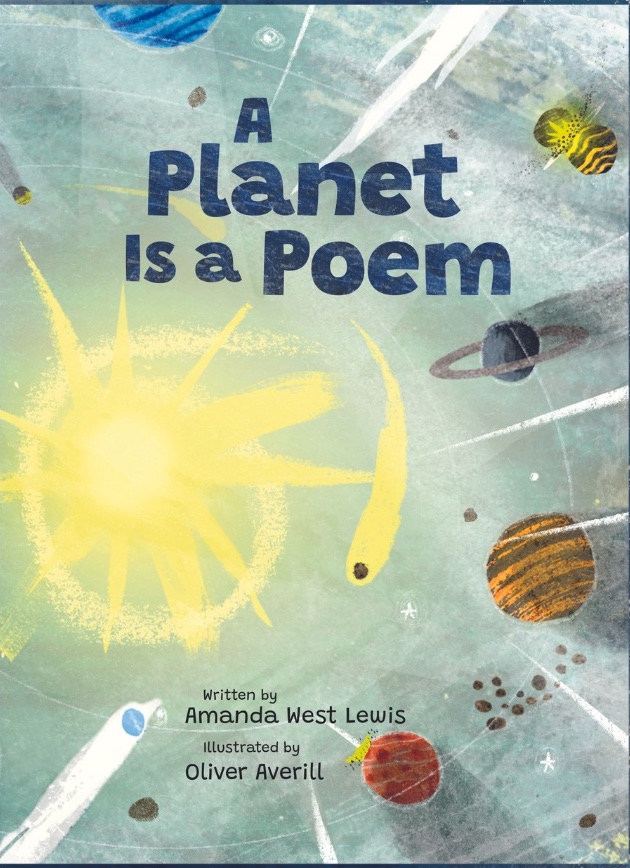
Eight years later, A Planet is a Poem is coming out from Kids Can Press. I am thrilled, and of course terrified. I’m confident in my facts (if you can’t trust NASA, who can you trust?), but aware that to aspire to good poetry is to aspire to divinity. You can see it, you can love it, but you can never achieve it. Still, it is a book I am proud of because if combines the logic of poetic forms with the wonders of the solar system. The discipline of art is married to the mystery of science.
I would still be hesitant to call myself a poet. I love the process, the puzzle, and the agony of working with words. But poetry is sacred. It is the purest form in which we can convey ideas, and I haven’t yet achieved that effervescence, that translucence that I aspire to. But I am no longer afraid to try. Because I will always love the bounce, thrum, wobble, and slither of language. It’s what we have that connects us to our world.

 Stepping off the Treadmill