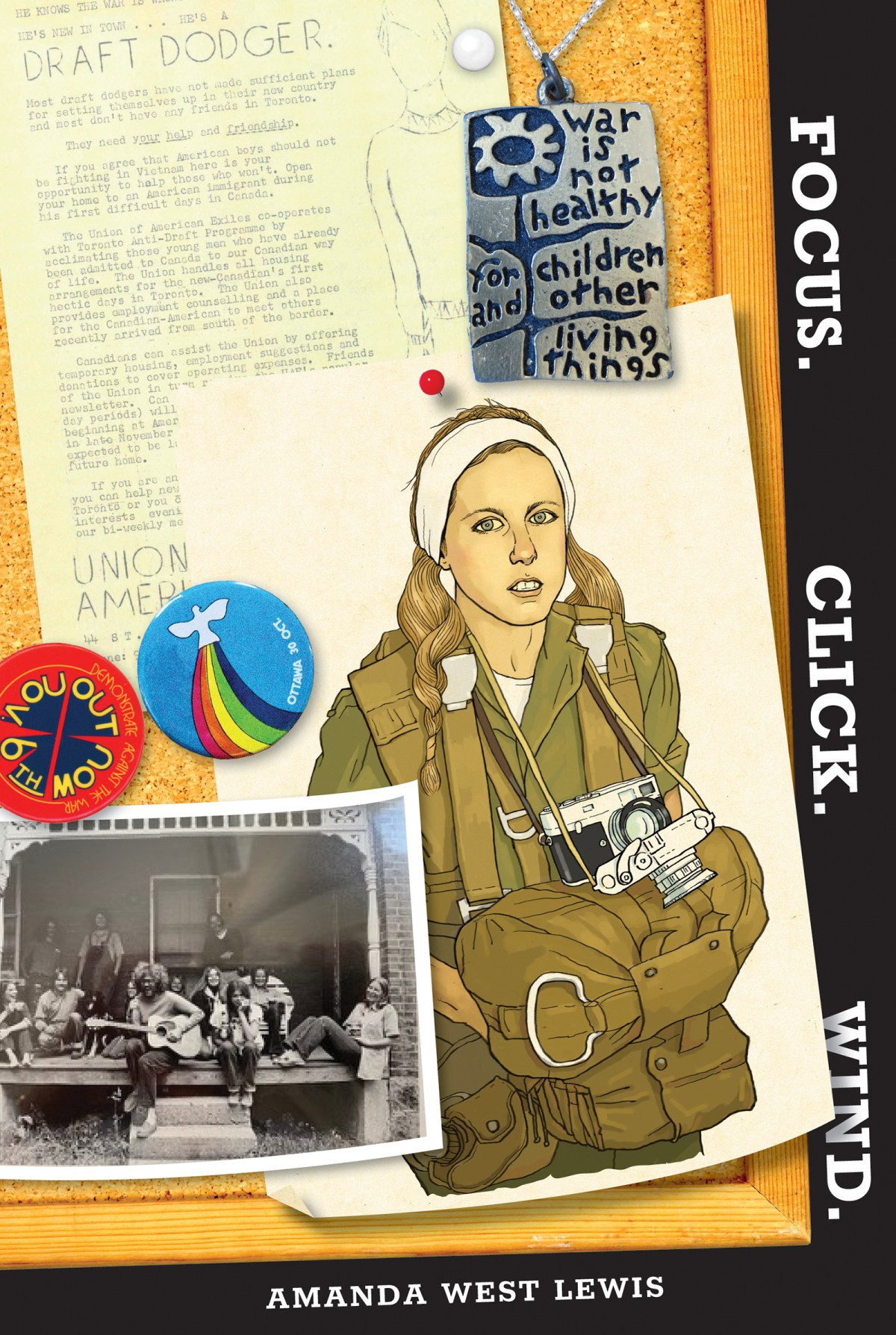

Today is the official launch of Focus. Click. Wind ! As I mark the occasion, I’ve been thinking a lot about the book’s genesis. In some ways, this book has been in the making for fifty years. But practically speaking, there are some seeds of the book that started about fifteen years ago.
At that time, I had a job in a city that required me to live away from home for most of the week. I loved the job, but my husband Tim and I missed each other. I’m not sure how the idea of writing letters came about –– not writing letters to each other, but writing “in role” as characters. At the time, we were both interested in exploring issues to do with the immigration of American draft dodgers to Canada during the war in Vietnam. My mother had been very active in the “Underground Railroad” in Toronto, and our house was a haven for drafters and people in need. I think Tim has always been fascinated with this aspect of my life. We decided that his character, Paul, would be living at my mother’s house, having fled to Canada from the States while my character, Jill, was left behind. I’d spent a fair amount of time in California when I was a teenager and had cousins who were ready to flee to our house in Toronto if they were drafted. So, I decided that I wanted to give Jill California as a home base.
All through that winter, Tim wrote to me as Paul, in Toronto, and I responded as Jill in Santa Cruz. We didn’t pre-plan anything. It was a writing exercise. We were playing to see where it would lead us.
Which was basically nowhere. The letter writing fizzled out.
Ten years and several books later, I was preparing to go to a writing workshop. I had just finished a full draft of a semi-autobiographical middle grade, a book that became my novel These Are Not the Words. I had no idea what I would work on next. All I needed for the workshop was two scenes, but the days were getting closer and I had nothing. I was close to panic when suddenly, unbidden, Paul and Jill burbled up into my consciousness. It was time to bring them together.
I figured since I was bringing these two characters together for the first time in their fictional lives, the first scene should be a sex scene. Then, since their relationship was built on the war, the second scene would be at a protest. The protests at Columbia University in 1968 were considered the epicenter of the movement that year. Two scenes, two rough characters. In bed. At a protest. In New York. Phew! I could head to the workshop.
But These Are Not the Words was still in my head. In that book, the central character, Miranda Billie Taylor, aka Missy, lives in New York City. She is steeped in art and trails her father to jazz clubs and bars. It is set in 1963 and she is twelve years old. Missy had some rather difficult things to deal with and it was a relief to be in a workshop playing with Jill in 1968. After all, she, too, was in New York and surrounded by music, although this time it was rock and roll. I knew that she’d be about seventeen years old in 1968. I suspected I might take her to Toronto at some point. Jill became more and more real to me as the workshop progressed, and I began to seriously think about her role in a new book.
When was it that I did the math? Certainly, it was long after I’d left the workshop. Missy was twelve in 1963. Jill was seventeen in 1968. Both were in New York. Both were struggling with their relationships to men (father/boyfriend). Both were a product of their time (jazz vs rock and roll, Mad Men vs hippies.) How long did it take me to realize that Jill was Missy? Or rather, she was Miranda Billie Taylor, now known as Billie.
These Are Not the Words became, essentially, a hugely detailed backstory. A prequel. This realization was a gift to me as a writer. Focus. Click. Wind rose out of the earlier book like an unsuspecting phoenix and Miranda Billie Taylor became as real to me as the memories of my own life.
People ask me if I’ll write another book with her as the protagonist. I find it hard to imagine. She’s been through so much and worked hard to come out the other side. I don’t want to make life hard for her again. But there’s a lot of living that still happens after you turn eighteen. It’s never clear sailing, and although Billie knows where she is now, she might still have some adventures ahead.
Her future is excitingly murky.


